 reckoner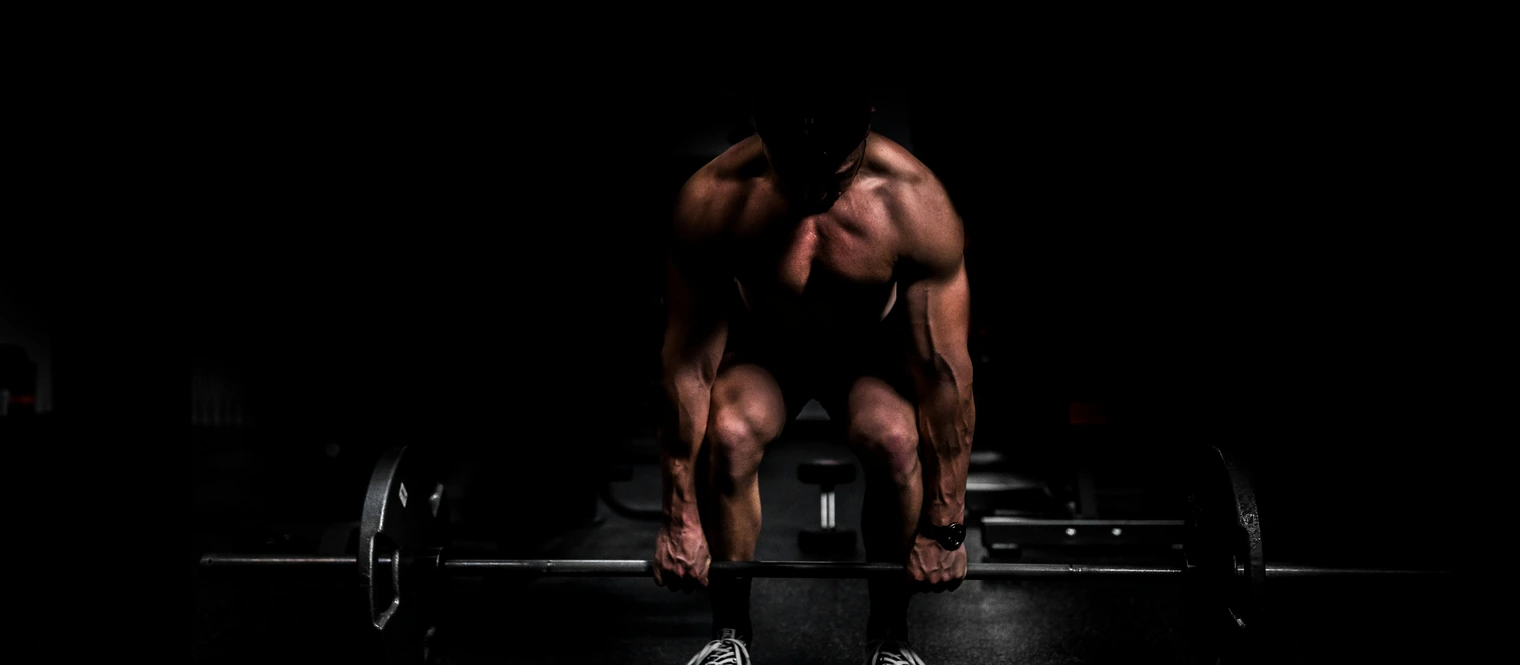
Conventional deadlift
The heaviest thing most people will ever pick up in a gym, and the lift that asks most of everything down the back of you. It moves more weight than anything else in the library and it costs the most to recover from, so what you do before the bar leaves the floor matters more here than anywhere else.
Flat back, take the slack out first.
- Pattern
- Hinge
- Trains
- Glutes, hamstrings, spinal erectors, upper back
- Kit
- Barbell
- Loading
- A weight you choose
- Reckoner prescribes
- 4 sets of 5 to 8 reps at RPE 8
- Progression step
- 5 kg once the top of the range is clean
- Bar
- 20 kg
- Skill
- Technical, worth coaching
- Recovery cost
- Very high
- Not prescribed if you have declared
- Lower back, hip, knee, neck
Muscles worked
How to do it
Set your feet under the bar
Bar over the middle of your foot, close enough that it brushes your shins when you stand up straight. Feet about hip width, toes forward or turned out a few degrees. A bar sitting out in front of your shins makes the lift heavier before you have touched it.
Reach down and drop the hips to the bar
Push the hips back and reach down. Grip just outside your shins. Then drop the hips only until your shins meet the bar. This is not a squat, and the hips start higher than most people expect them to.
Take the slack out
Pull up against the bar until you feel the plates settle against the collars, chest up and back flat. That is the cue Reckoner puts on your wrist and it is most of the lift. A bar that jumps off the floor is a bar you started pulling before you were braced.
Push the floor away
Drive through the whole foot and stand. The bar stays against your legs the whole way up. Hips and shoulders rise together: if the hips shoot up first, the bar is heavier than the position you took.
Stand tall, then put it down
Lock out by standing up. No leaning back, no shrugging at the top. Then push the hips back and lower the bar down your legs. Every rep starts from the floor again.
What goes wrong
Letting the back change shape as the bar gets heavier
Hold the same back position every week, and hold it because a lift that changes shape as it gets heavier has no record behind it. Hold it for that rather than out of fear. A review of eleven studies went looking for a link between lumbar flexion while lifting and low back pain, did not find one, and rated its own evidence low quality1. A round rep is information about the load, not proof of an injury.
Yanking the bar off the floor
There is slack in the bar and slack in your arms, and ripping at a loaded bar takes both up at once while your back is still soft. Pull up until everything is tight, then pull. It is the difference between a lift you started and a lift that started without you.
Bouncing the reps
Every rep starts from a dead stop. A bounced rep borrows the floor and the plates to do part of the work, which makes each one easier than the last in a way that never appears in what you logged. Next week is built out of that log.
How Reckoner progresses this lift
Six weeks of this lift, from 100 kg, run through the real engine. Nothing below was typed in: the prescription, the decision and the sentence beside it all come from the same code that writes your week.
| Week | Prescribed | What it did |
|---|---|---|
| 1 | 4 x 5 at 100 kg | More reps 5 → 6 repsYou finished every set with three reps left in the tank (RPE 7) and room left in the range, so the reps climb before the load does. |
| 2 | 4 x 6 at 100 kg | More reps 6 → 7 repsYou finished every set with three reps left in the tank (RPE 7) and room left in the range, so the reps climb before the load does. |
| 3 | 4 x 7 at 100 kg | More reps 7 → 8 repsYou finished every set with three reps left in the tank (RPE 7) and room left in the range, so the reps climb before the load does. |
| 4 | 4 x 8 at 100 kg | Load up 100 kg → 105 kgYou hit the top of the range with three reps left in the tank (RPE 7), so the bar goes up 5 kg to 105 kg. The weight went up, so the reps come down to six. You are now working 5 to 8. |
| 5 | 4 x 6 at 105 kg | Deload 40% of sets offFive weeks of building, then one week lighter. About 40% of the sets come off. The load holds and your reps stay where you earned them, so you keep the strength and lose the fatigue. |
| 6 | 2 x 6 at 105 kg | More reps 6 → 7 repsYou finished every set with three reps left in the tank (RPE 7) and room left in the range, so the reps climb before the load does. The lighter week is over, so this is back to four sets. |
Real engine output, not an illustration. Every row was produced by running the engine itself when this page was generated.
The full rule, and why the reps move before the load does, is in how Reckoner decides to add weight.
Questions people ask
Conventional or sumo?
Whichever one you can hold a position under, and then stay with it. Thirty experienced lifters were measured through both at 85 per cent of their best single. The conventional pull produced higher hip extension moments and more activity in the hamstring and the upper back, while the sumo pull put more demand on the knee and on holding the hip steady across the body2. Neither is the cheat version. Reckoner treats them as separate movements, so a switch mid block is logged as a different lift: it is never read as a stall, and it does not move the other lift's numbers, but neither record learns much that week. Pick one and stay with it.
My lower back is the problem. Will Reckoner still give me this?
No. Declare a lower back restriction in setup and this movement comes out of your plan entirely. It is also held back by a hip, a knee or a neck restriction, which are the other three the library records against it.
Can a block be built around this lift?
Yes. It is one of the movements Reckoner will anchor a block on rather than hang off the end of one, which is the whole reason its recovery cost is worth paying.
Similar movements
Reckoner eases the load first when this lift stalls, and offers one of these only if it stalls again after that. A lift already as light as your kit goes has no load left to ease, so the offer comes straight away. Each of them has a page.
Sources
- Saraceni and colleagues, Journal of Orthopaedic and Sports Physical Therapy, 2020. To Flex or Not to Flex? Is There a Relationship Between Lumbar Spine Flexion During Lifting and Low Back Pain? A Systematic Review With Meta-analysis eleven studies reviewed, finding low-quality evidence that greater lumbar spine flexion during lifting was not a risk factor for low back pain onset or persistence
- Hanen and colleagues, Frontiers in Bioengineering and Biotechnology, 2025. Biomechanical analysis of conventional and sumo deadlift thirty experienced male lifters pulling both styles at 85 per cent of one repetition maximum, the conventional pull producing higher hip extension moments and greater biceps femoris and thoracic erector spinae activity, the sumo pull greater knee extension and knee abduction moments and more vastus lateralis activity