Never wonder what to lift next.
You walk in, open Reckoner, and today is already written: the lifts, the weight on the bar, the sets and the reps. Next week changes because of what you did this week.
You train. It reckons the rest.
Seven questions, under two minutes, and nothing you answer is locked in. Your first session corrects whatever the questions got wrong.
Free while we build it, no card and nothing to cancel. It runs in your browser, so you do not need a Garmin, or a watch of any kind.
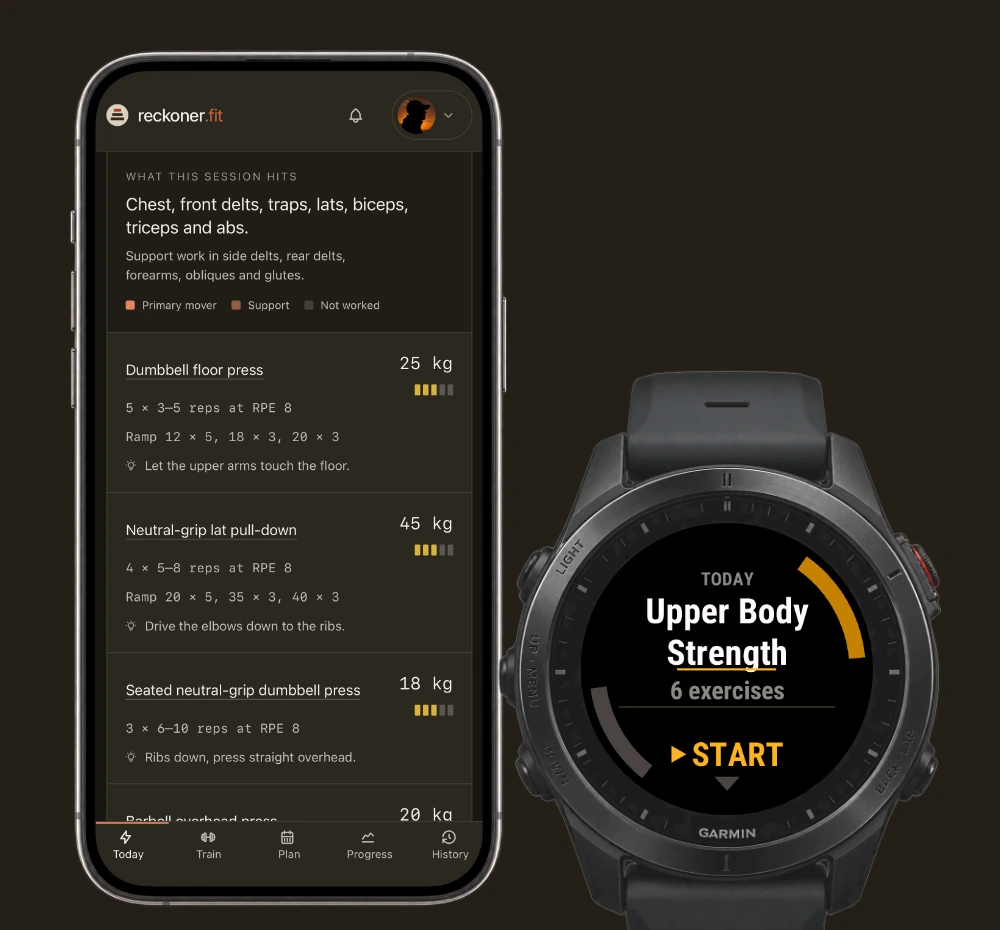
Recording the set is the easy half.
Keeping a log is a solved problem. Deciding what the log means, on a Thursday, when you slept badly and the last set was harder than it should have been, is the part still left to you.
A history is not a plan
You can scroll back eight weeks and still not know what to put on the bar. Numbers you have already lifted do not tell you the next one.
Written before it met you
Week four was set months ago by somebody who never saw your week three. It cannot know you came in flat, so the adjusting falls back on you.
So Reckoner does the deciding
It reads what you actually lifted and writes next week from it. You keep the final say at the rack.
It decides what you lift next, and tells you why.
Any app can store what you did. The question nobody answers is what to do on Thursday. Reckoner answers it, lift by lift.
If it adds a plate, it says what you did to earn it.
Six weeks of it, rule by ruleThursday, upper body strength
 You hit the top of the range with two reps left in the tank (RPE 8), so the bar goes up 2.5 kg to 82.5 kg. The weight went up, so the reps come down to nine. You are now working 6 to 10.
One week the engine wrote in full, reasoning and all. Run it on your own numbers and it shows the same working.
What it actually looks like
You are never guessing the weight
Answer seven questions and every lift opens with a proposed weight, deliberately on the light side. Take it as written, or change it at the rack. An override is data, not a mistake, and the next session is built from what you actually lifted.
Seven questions, then it writes the week.
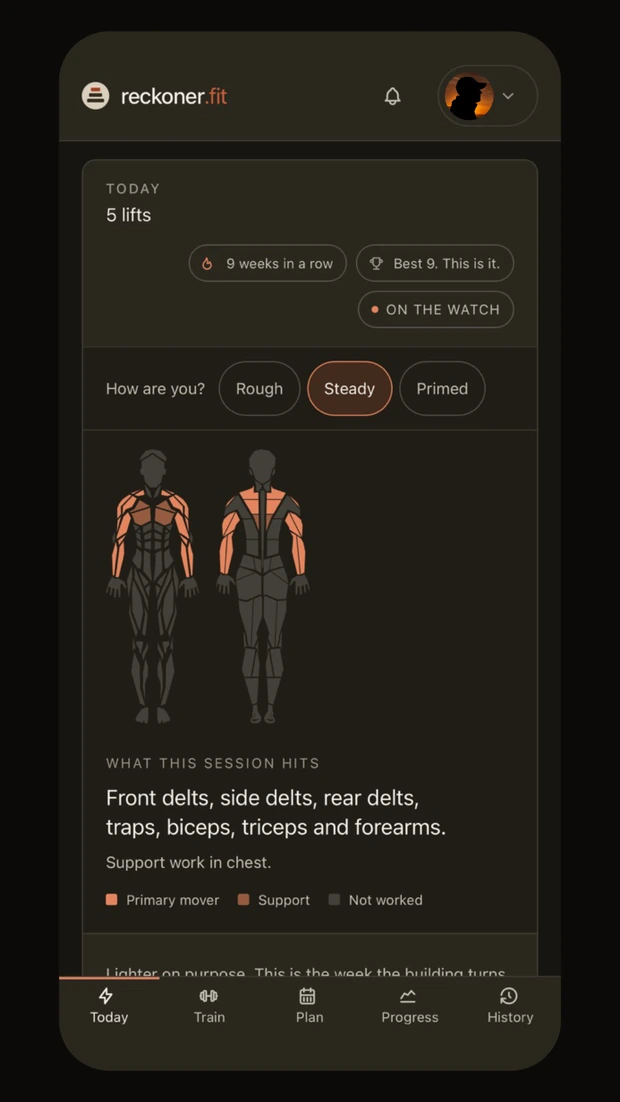
Open it and today is written
The lifts, in order, and a map of what the session actually works. It asks how you are before it asks anything else, and a rough day changes the numbers.
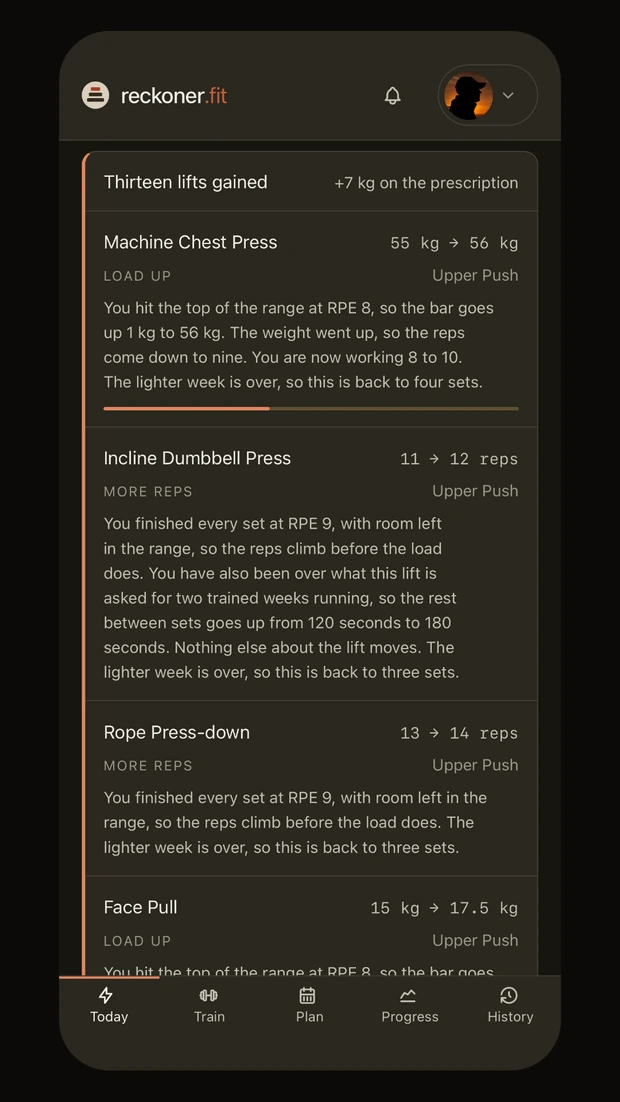
Next week, with the reason
What you logged, what moved, and what happens to the reps and the sets because of it.
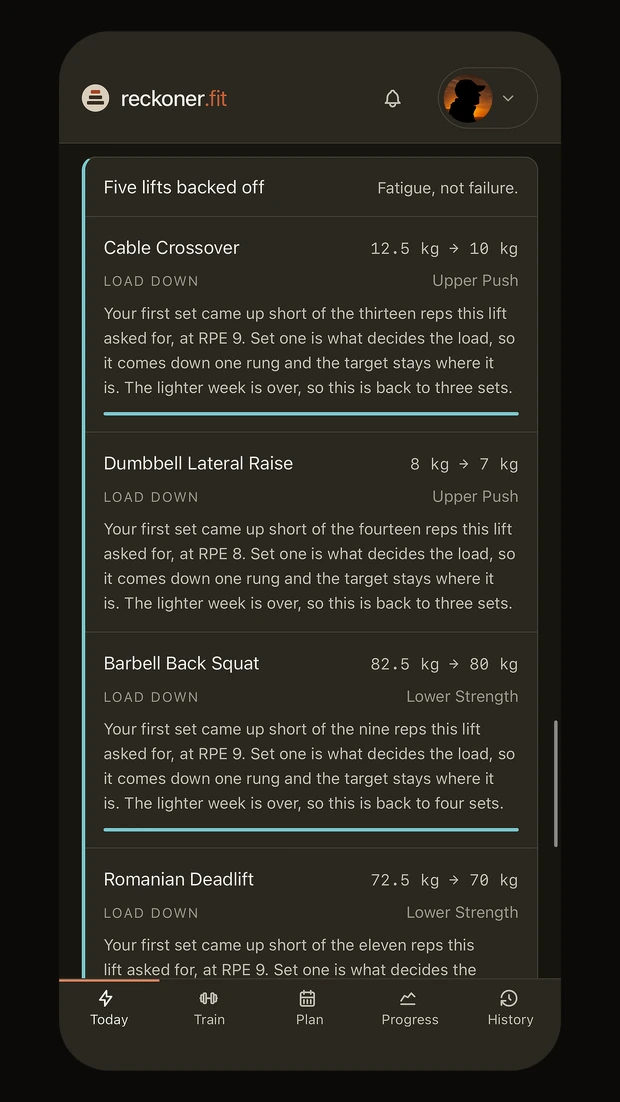
It backs off before you dig a hole
Come in short on the first set and the load comes down a rung on purpose. Fatigue, not failure, and it says so in those words.
Same engine. It just meets you further along.
Not knowing is the normal starting condition.
It is not a gap you have to close before you are allowed in. Here is the whole of your first five minutes, so nothing is a surprise.
Nothing you answer is permanent, and nothing assumes you have lifted before.
How many days you can train, and how long you have
Then what you are after, anything you cannot do, and whether you are in kilos or pounds. No numbers you are expected to know already.
Your lifts and your opening weights, on the light side
Chosen to be finishable rather than impressive. The first session is what calibrates them, so starting light costs you nothing.
Today is at the top, in the order you do it
Lifts, weight, sets and reps, and a map of what the session works. Nothing left to decide once you are standing there.
Lift what it says, then say roughly how the last set felt
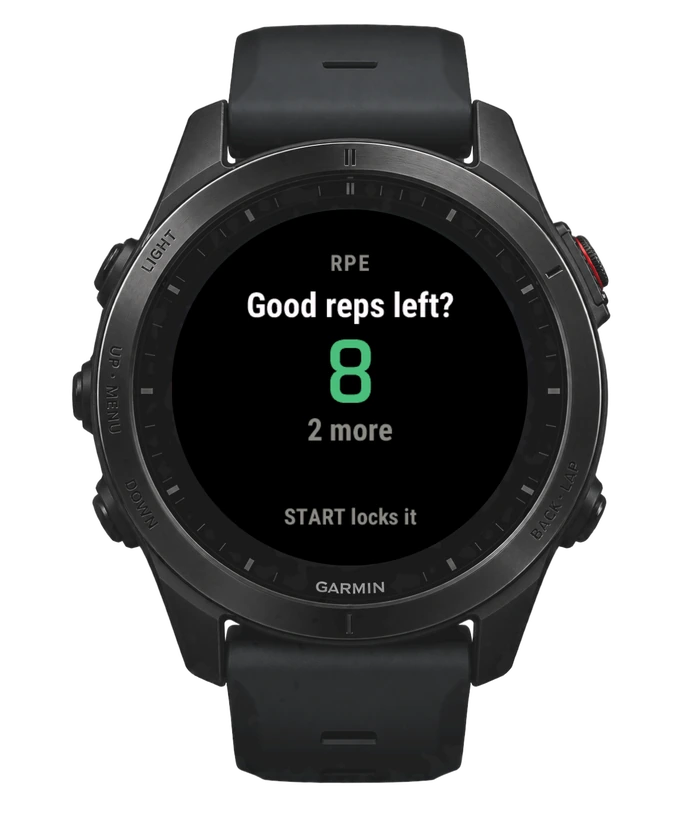
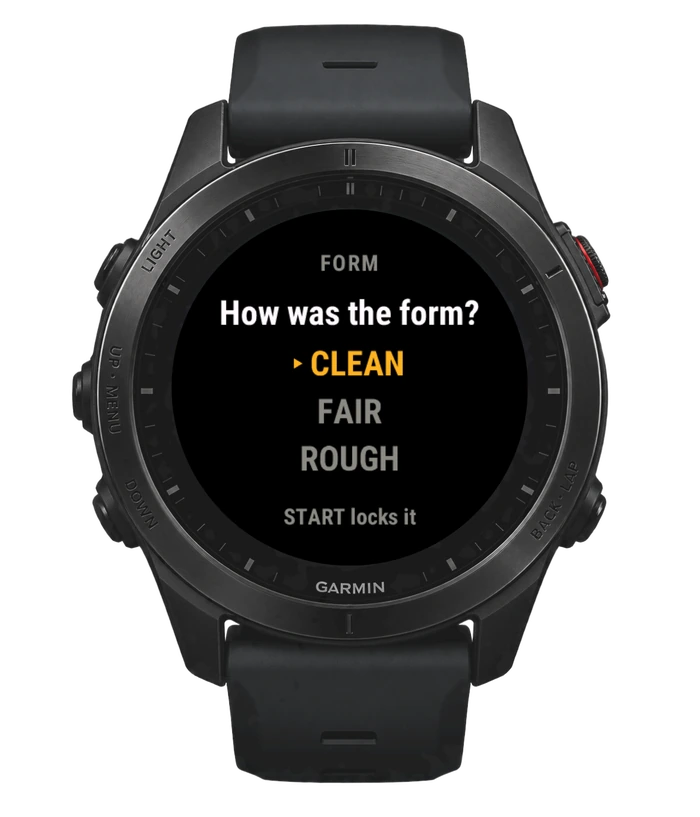
In plain words, not a scale you have to study: roughly how many good reps you had left, and how the form looked. Those two answers and the reps you logged are what the next week is built from.
The weeks you would rather skip are the ones it handles.
Most people do not stall because they are lazy. They stall because a bad fortnight has no plan attached to it, and coming back means guessing where you left off. Reckoner keeps that arithmetic and hands you a week you can finish.
Build the range before the load.
It walks the load back, not you
Nothing you logged is lost. Your first week back comes in about 10% lighter and rebuilds from there, so it is one you can actually finish.
It resets the bar before you grind
Three weeks short of the target and it takes the weight off on its own, in its own words: reset to 52.5 kg, build back through it.
Bring it. Logging is free for good
Write your split, your lifts, as many as you like. Hand the planning over whenever you get tired of doing it.
Swap the lift, keep the target
Every lift carries a swap list. Pick the substitute, it is logged as one, and next week is written knowing that is what you did.
Stop being your own programmer.
Reckoner does the arithmetic you were doing by hand on a Sunday evening, and argues with you when the log says you are wrong. A second opinion on your own program, with the reasoning shown rather than asserted.
It is not smarter than you. It is more diligent than you.
Its own rule for every movement
Your bench and your squat are not forced to progress at the same pace, and neither is tied to a block someone else wrote.
An override is data, not a mistake
Change the load, drop the set, move the day. A pattern of edits changes the next block rather than being quietly reverted.
An estimated 1RM that updates every session
Whole history per lift and fatigue over time. You never have to test a single to see it move.
Export everything, whenever
It is yours. Take the history and go, with our blessing, and the free logging half stays free for good.
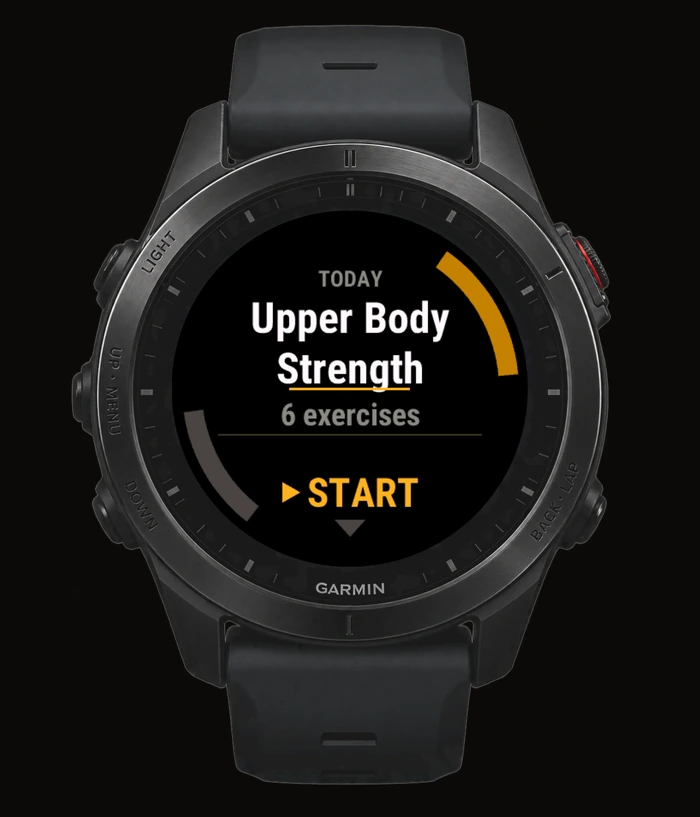
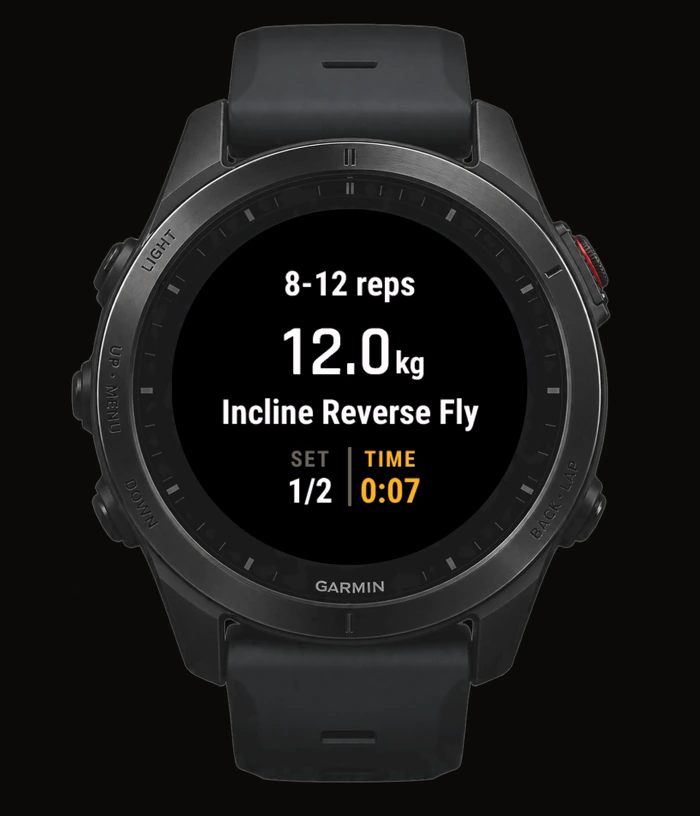
Optional: put the week on your wrist
Everything works in the browser without a watch. If you own a Garmin, install the app, sign in once with a 6-digit code, and each reckoned week lands on the watch by itself. It runs offline in a basement gym, on 90+ models including ones Garmin stopped selling years ago.
What lifters say
Reckoner is the only strength tracking app I’ve actually stuck with. Everything about it just clicked way better than other apps I’ve tried. Logging workouts is easy and seeing my progress week to week keeps me motivated and actually accountable. What really makes it stand out is the dev. Super responsive, always fixing bugs and rolling out new features and exercises based on what people actually ask for. I suggested being able to set different equipment for different workout days since I train upper body at home and everything else at a commercial gym, and the dev made it happen so quickly it was unbelievable. With the Garmin strength tracking being so lacking, Reckoner definitely filled that gap for me.
Great app, nice feedback. Seems like perfect app to achieve the goals I need.
The creator has been on top of things and suggestions! With enough data and help, I believe this app will help me achieve what I’ve been missing on my lifts and progress!
The founding hundred is closed.
All hundred places went, and nobody can be added to them now, which was the whole idea. Their names are on the board along with everything they asked us to build. Nothing is behind a wall for the rest of us: logging stays free for good, and the library and the tools need no account.
The three people ask first
Do I need a Garmin watch?
No. Everything works in a browser on your phone, and plenty of people never pair anything. A Garmin only means you can leave the phone in your bag.
Is it a workout tracker or a workout planner?
A planner first. It writes the session before you get there, then you log against what it wrote. If you only ever want the tracker half, that half is free for good.
Do I need to know what RPE or RIR means?
No. After a lift it asks two things in plain words: roughly how many good reps you had left, and how the form looked. With the reps you logged, that is all the engine needs, and the words are written out in the guides if you want them.
Come and lift with us.
Seven questions, under two minutes, and Thursday is written. If it turns out not to be for you, take your history and go, with our blessing.
No card, nothing to cancel. The library and the calculators need no account at all, so you can borrow those and never sign up.
What we have been writing
 22 October
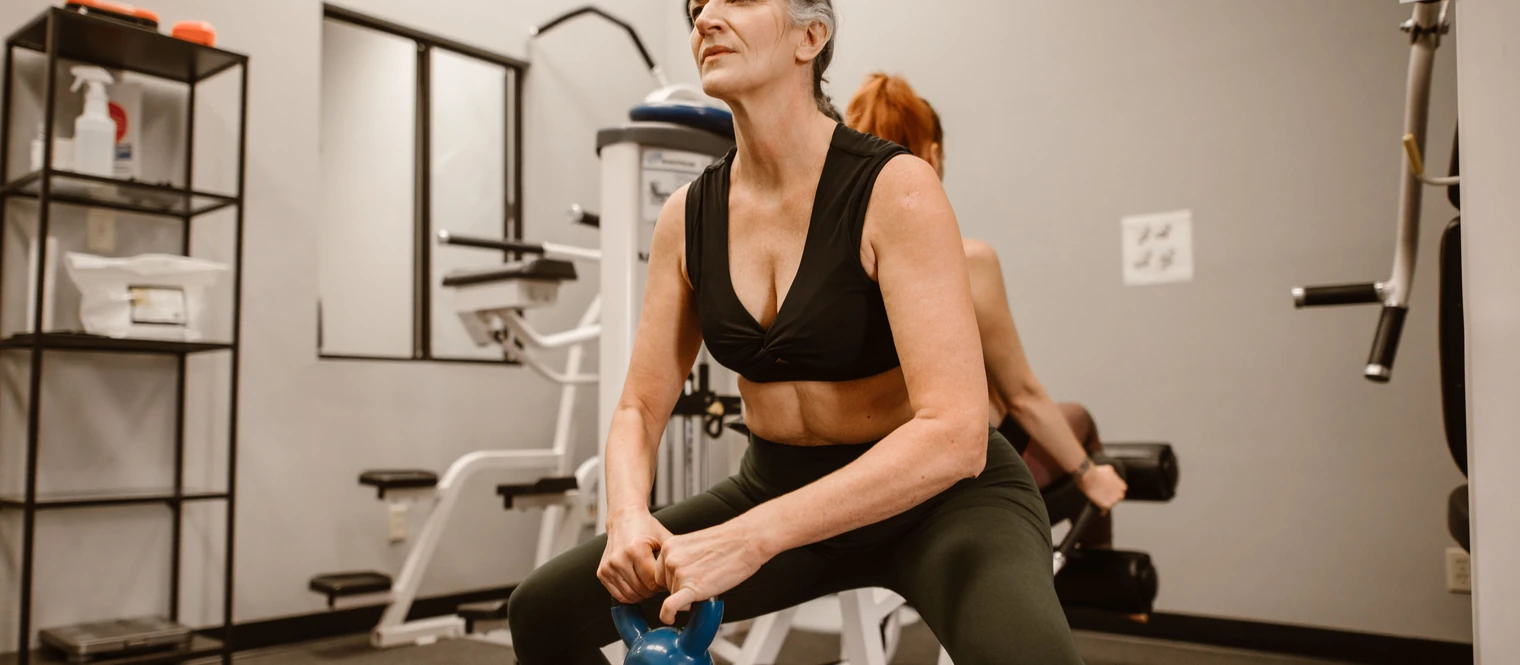
Strength training through menopause
Menopause changes your hormones, your sleep and your bones. It does not change the fact that you can get stronger, and lifting is one of…
 22 October
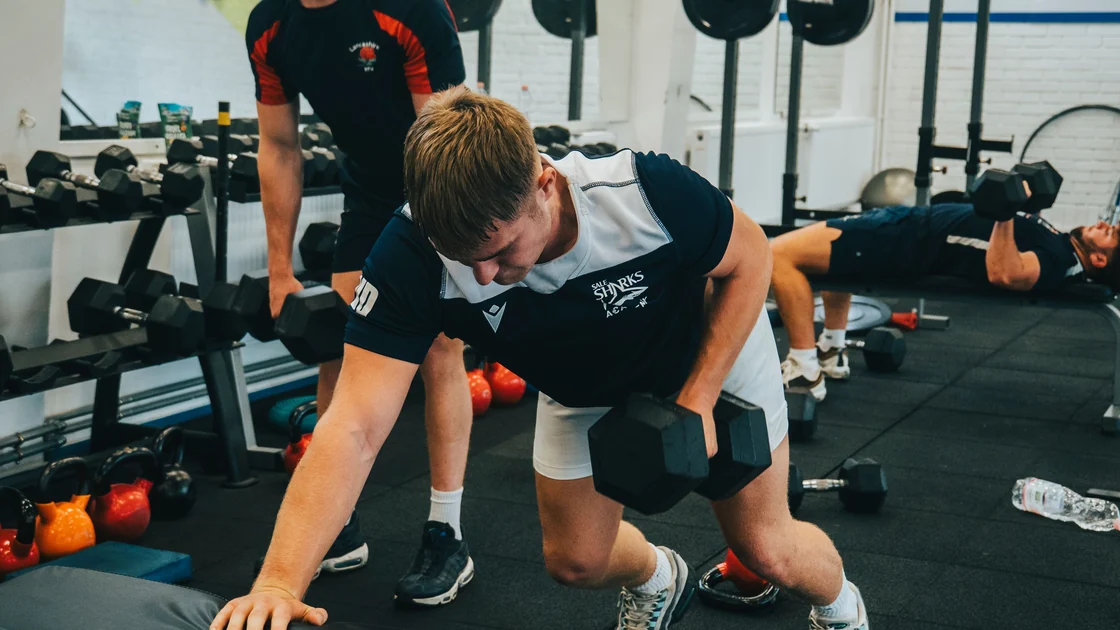
A push pull legs plan for beginners
Three sessions: push, pull and legs, four or five lifts each, every set stopped with two or three good reps left. Run it once a week to…
 21 October
Lifting and bone health: why it matters for women
Bone is living tissue, and it responds to load much like muscle does. Women build less of it and lose it faster around menopause, which…