 reckoner
Single-leg glute bridge
The glute bridge on one leg, which roughly doubles what the working side has to lift and adds a job that was not there before: keeping your hips level while it does. It needs a floor, and it is where most people find out one side has been carrying the other.
Hips level, drive through the heel.
- Pattern
- Hip isolation
- Trains
- Glutes
- Kit
- Bodyweight, floor
- Loading
- Your own bodyweight
- Reckoner prescribes
- 3 sets of 10 to 15 reps at RPE 8
- Progression step
- Nothing to add, so the sets climb instead
- Skill
- Some technique
- Recovery cost
- Low
Muscles worked
How to do it
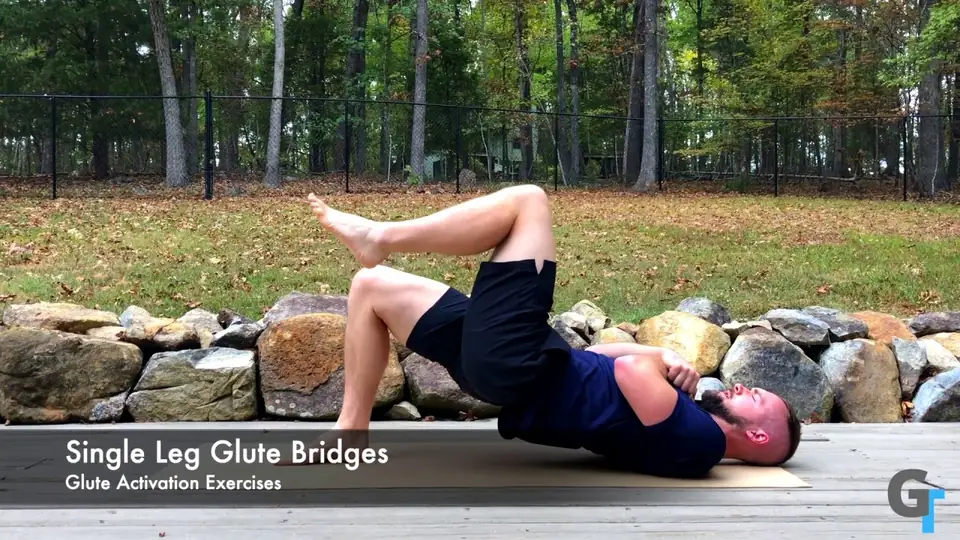
Lie down and set one foot
On your back, one knee bent with the foot flat, the other leg off the floor. Hold the free leg wherever you can keep it still without gripping: knee tucked or leg straight both work.
Level the hips before you move
Both hip bones the same height off the floor at the start. If one is already lower, the rep will start crooked and finish more so.
Drive through the working heel
Push the hips up until your body is a straight line from the working knee to your shoulder, with the hips still level. Drive through the heel, which is the cue on your wrist.
Lower without letting the free hip drop
Come down slowly and keep both hips at the same height the whole way. The rep ends when your hips reach the floor, not when you run out of control.
What goes wrong
Letting the free hip sag on the way down
This is the fault the exercise exists to expose, so it is worth watching for rather than working around. If the free side drops as you lower, stop the set. The reps after that are training something you did not choose.
Keeping the working heel tucked in close
Twenty-eight people were measured through single-leg bridges at two knee angles. With the knee bent to about 90 degrees the hamstring sat at 75 per cent of its maximum voluntary contraction. With the foot further away and the knee at about 135 degrees that fell to 23 per cent, while gluteus maximus and gluteus medius activity held roughly where they were1. If your hamstring cramps on this, move the foot away from you.
Doing the strong side first and then matching it
Whichever side goes first sets the number, and if that is the strong one the weak side finishes a set it could not have started. Start on the side you trust least and let it decide.
How Reckoner progresses this lift
Six weeks of this lift, run through the real engine. Nothing below was typed in: the prescription, the decision and the sentence beside it all come from the same code that writes your week.
| Week | Prescribed | What it did |
|---|---|---|
| 1 | 3 x 10 | More reps 10 → 11 repsYou finished every set with three reps left in the tank (RPE 7) and room left in the range, so the reps climb before the load does. |
| 2 | 3 x 11 | More reps 11 → 12 repsYou finished every set with three reps left in the tank (RPE 7) and room left in the range, so the reps climb before the load does. |
| 3 | 3 x 12 | More reps 12 → 13 repsYou finished every set with three reps left in the tank (RPE 7) and room left in the range, so the reps climb before the load does. |
| 4 | 3 x 13 | More reps 13 → 14 repsYou finished every set with three reps left in the tank (RPE 7) and room left in the range, so the reps climb before the load does. |
| 5 | 3 x 14 | Deload 40% of sets offFive weeks of building, then one week lighter. About 40% of the sets come off. The load holds and your reps stay where you earned them, so you keep the strength and lose the fatigue. |
| 6 | 2 x 14 | More reps 14 → 15 repsYou finished every set with three reps left in the tank (RPE 7) and room left in the range, so the reps climb before the load does. The lighter week is over, so this is back to three sets. |
Real engine output, not an illustration. Every row was produced by running the engine itself when this page was generated.
The full rule, and why the reps move before the load does, is in how Reckoner decides to add weight.
Questions people ask
Where exactly should the working foot go?
Further out than feels natural. At roughly 135 degrees of knee bend the hamstring contributed about a third of what it did at 90 degrees, and the glutes did not drop off with it1. Start where your hamstring stays quiet and adjust from there.
One side is much weaker than the other. What do I do?
Train both, start with the weaker one, and stop the stronger side where the weaker one stopped. What not to do is add reps on the strong side so the set feels finished. The difference is the information.
Can a block be built around this lift?
Yes, unlike the two-legged bridge. It is one of the movements Reckoner will anchor a block on, and it carries no restrictions at all in the library.
Similar movements
There is no load to ease on this lift, so Reckoner offers one of these the first time it stalls. Each of them has a page.
Sources
- Lehecka and colleagues, International Journal of Sports Physical Therapy, 2017. Building a Better Gluteal Bridge: Electromyographic Analysis of Hip Muscle Activity During Modified Single-Leg Bridges twenty-eight healthy adults, hamstring activity falling from 75.34 to 23.49 per cent of maximum voluntary contraction when the knee went from about 90 to about 135 degrees of flexion while gluteus maximus and gluteus medius activity held roughly steady. Flagged as older than five years and kept because no later work replaces it