 reckoner
Wall tibialis raise
Lean your back against a wall, walk your heels out a step, and lift your toes off the floor. The muscle you are training runs down the front of your shin and it is the one that lifts your foot when you walk. Almost nobody trains it on purpose, which is most of the reason it is here: an athlete asked for it.
Lean back on the wall, pull your toes up.
- Pattern
- Dorsiflexion
- Trains
- Tibialis anterior
- Kit
- Bodyweight, wall
- Loading
- Your own bodyweight
- Reckoner prescribes
- Nothing yet. Reckoner only prescribes what the science backs, and for the shin the science is not there yet. It is in the library so you can read it and train it on your own terms.
- Skill
- Simple to learn
- Recovery cost
- Very low
- Not prescribed if you have declared
- Ankle
Muscles worked
How to do it
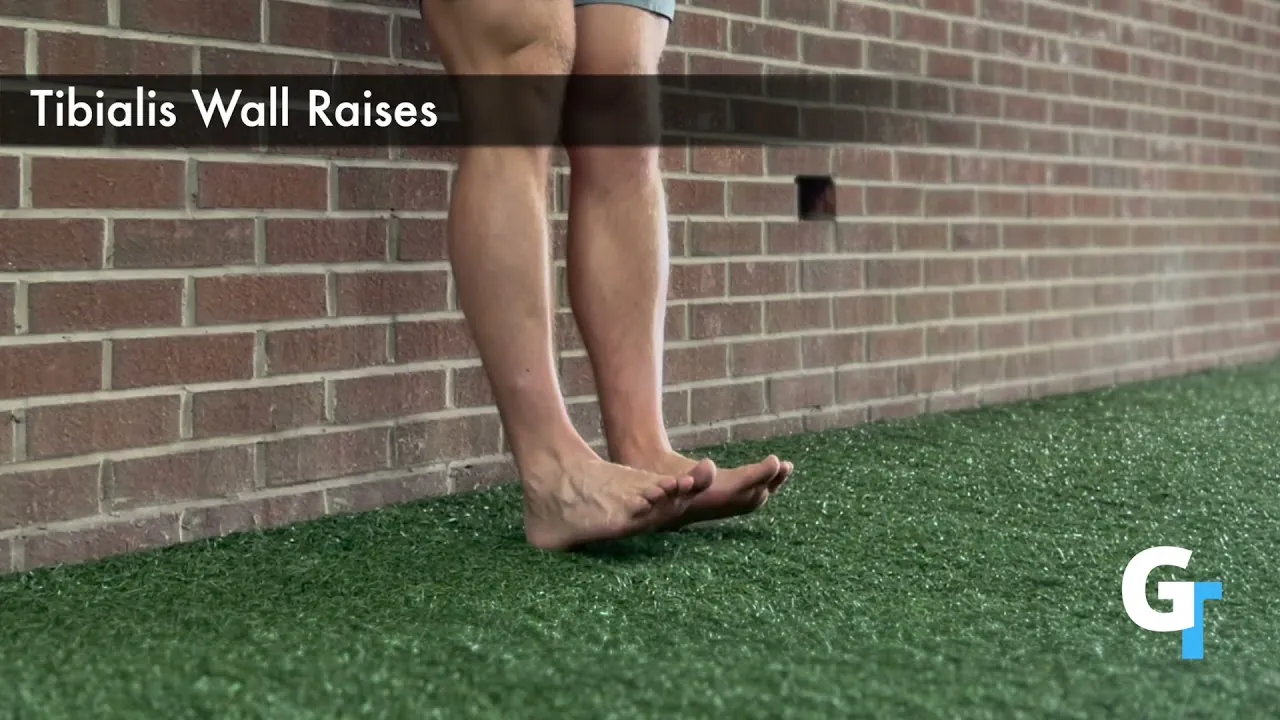
Back flat on a wall, heels a step out
Stand with your back and your backside against the wall, then walk your feet forward until your heels are roughly a boot length away. Further out is harder. Keep your legs straight and your weight on your heels.
Lean back on the wall, pull your toes up
That is the cue on your wrist. Let the wall hold you, then drag the toes and the front of both feet up toward your shins as far as they will travel. Keep the heels planted.
Go to the top and hold for a beat
Most of the work happens in the last inch, and most people stop short of it. A pause at the top is how you find out whether you got there.
Lower slowly, and do not let the feet drop
There is no weight to add here, so tempo and range are the dials you have. Take longer coming down than going up, and stop the feet before they slap the floor.
Make it harder by moving your feet, not by adding reps
Walk the heels further from the wall and the same set gets harder. That is the progression the movement has, and it costs nothing.
What goes wrong
Standing too close to the wall
With your heels underneath you there is barely any lean, so there is barely any resistance and the set feels easy for the wrong reason. It reads as being good at the exercise. Walk the feet out until the last few reps are genuinely hard.
Bending the knees to get more range
Once the knees soften the hips take over and the shins stop working, which is why the rep suddenly feels easier near the top. Straight legs, all the way through.
Training through new shin pain
Soreness in the front of the shin a day after unaccustomed work is ordinary and will settle. Pain that builds while you are moving and eases when you stop is a different thing, and it is not something to add sets to. The muscles on the front of your shin sit in a compartment that cannot expand, so stop the movement and get it looked at rather than progressing through it5.
Questions people ask
What does the tibialis anterior actually do?
It lifts the front of your foot. In walking it is the muscle that clears your toes off the ground as your leg swings through, and one study of the swing phase found it more active than any other muscle at that moment1. That is the claim the anatomy supports, and it is a narrower claim than the ones usually made for this exercise.
Will this stop shin splints or stop me falling?
There is no good evidence for either, and this page would rather say so. Reviews of what actually puts runners at risk of medial tibial stress syndrome do not list dorsiflexion strength among the risk factors3, and the review that looked directly at leg muscle strength found no difference between people with the condition and people without it2. On falls, a 2025 meta-analysis of ankle and foot exercise in older people could not show an improvement in dorsiflexion strength at all, and found no effect on falls4. Train it because you want to train it, not for those.
How many sets of this should I be doing a week?
Nobody knows, and Reckoner will not invent a number. Every weekly set target this app uses comes from published research, and no dose response study has ever measured this muscle. It is the only muscle in the library with no volume target of its own, deliberately, and Reckoner would rather leave that gap visible than fill it with a figure somebody made up.
Similar movements
Reckoner does not program this one, and it is the only shin movement in the library, so there is nothing to swap it for yet. You can still add it to your own plan.
Sources
- Perera, Gopalai, Ahmad and Gouwanda, Frontiers in Public Health, 2021. Muscles Affecting Minimum Toe Clearance the tibialis anterior carried the highest activation of any muscle in the swing phase of gait, making it the primary muscle governing minimum toe clearance
- Mattock, Steele and Mickle, Sports Medicine Open, 2021. Are Leg Muscle, Tendon and Functional Characteristics Associated with Medial Tibial Stress Syndrome? A Systematic Review no statistically significant difference in maximal voluntary isometric contraction strength between people with medial tibial stress syndrome and controls
- Menéndez, Batalla, Prieto, Rodríguez, Crespo and Olmedillas, International Journal of Environmental Research and Public Health, 2020. Medial Tibial Stress Syndrome in Novice and Recreational Runners: A Systematic Review the risk factors it reports for novice and recreational runners, which are mainly hip and foot alignment and movement ones such as pelvic tilt, hip rotation, navicular drop and foot pronation, and which do not include ankle dorsiflexion strength
- Liang, Chow, Leung, Mo, Ng, Woo and Lam, Physical Therapy, 2025. The Effects of Ankle and Foot Exercises on Ankle Strength, Balance, and Falls in Older People: A Systematic Review and Meta-Analysis no significant improvement in dorsiflexion strength, and no significant effect on fear of falling, risk of falls or fall incidence
- Raza, Mabrouk and Kaiser, StatPearls, 2025. Tibial Anterior Compartment Syndrome the anterior compartment is non expansile, and exercise related shin pain that builds during activity and settles with rest is not a thing to train through