 reckoner
Incline dumbbell press
The incline press for a gym with no free incline rack, which is most gyms at six in the evening. Two bells let you set the angle you actually want rather than the angle the rack pins allow, and the hardest part of the set happens before the first rep.
Lower the bells to the upper chest.
- Pattern
- Horizontal push
- Trains
- Chest, front delts, triceps
- Kit
- Dumbbell, incline bench
- Loading
- A weight you choose
- Reckoner prescribes
- 4 sets of 6 to 10 reps at RPE 8
- Progression step
- 2 kg once the top of the range is clean
- Skill
- Some technique
- Recovery cost
- Moderate
- Not prescribed if you have declared
- Shoulder
Muscles worked
How to do it
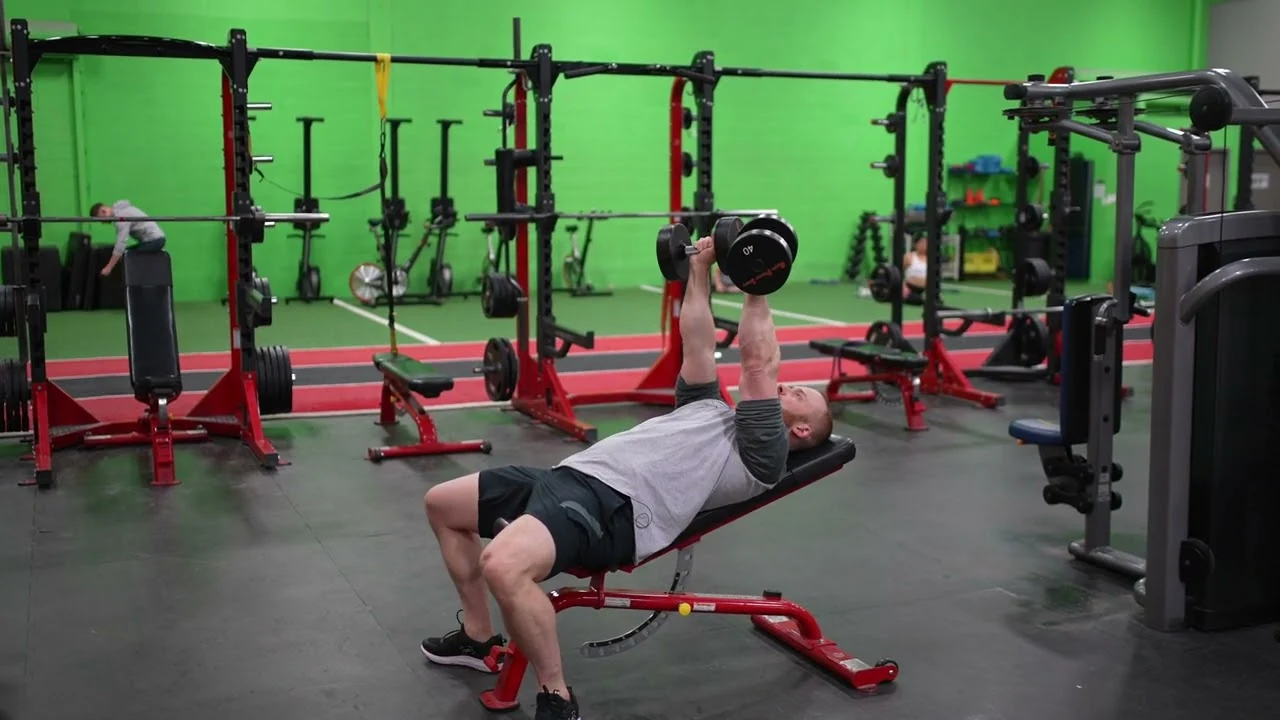
Set the bench near thirty degrees
That is where the upper chest works hardest, and past forty five degrees the front of the shoulder takes over and the chest does less1. With dumbbells you are not tied to whatever angle a rack's uprights allow, so use the freedom.
Get the bells up on your thighs first
Sit tall with a bell resting on each thigh, close to your hips. This is the position you kick from, and starting with the bells anywhere else is how the first rep becomes a shoulder problem.
Kick and lie back together
Drive one knee up to punch a bell toward your shoulder, then the other, and let your back settle onto the pad as they arrive. On an incline the bells have further to travel than on a flat bench, so the kick matters more here.
Press from the upper chest, slightly in
Lower until your upper arms are roughly level with your torso, elbows at about sixty degrees. Press up and slightly together so the bells finish over your shoulders. They should never touch at the top.
What goes wrong
Hauling the bells up with the shoulders
Reaching down for them from a reclined position loads the front of the shoulder at the end of its range with a weight you have not started pressing yet. Sit up, park them on your thighs, kick them into place.
Letting the bells drift back over your face
On an incline the natural drift is toward your head, and the further back they go the more the front of the shoulder holds. Keep them stacked over the joint pressing them.
Running an angle you never chose
A bench left where the last person had it is a training variable set by a stranger. The angle is the whole reason this movement is on the page: check it before the first set, every time.
How Reckoner progresses this lift
Six weeks of this lift, from 18 kg, run through the real engine. Nothing below was typed in: the prescription, the decision and the sentence beside it all come from the same code that writes your week.
| Week | Prescribed | What it did |
|---|---|---|
| 1 | 4 x 6 at 18 kg | More reps 6 → 7 repsYou finished every set with three reps left in the tank (RPE 7) and room left in the range, so the reps climb before the load does. |
| 2 | 4 x 7 at 18 kg | More reps 7 → 8 repsYou finished every set with three reps left in the tank (RPE 7) and room left in the range, so the reps climb before the load does. |
| 3 | 4 x 8 at 18 kg | More reps 8 → 9 repsYou finished every set with three reps left in the tank (RPE 7) and room left in the range, so the reps climb before the load does. |
| 4 | 4 x 9 at 18 kg | More reps 9 → 10 repsYou finished every set with three reps left in the tank (RPE 7) and room left in the range, so the reps climb before the load does. |
| 5 | 4 x 10 at 18 kg | Deload 40% of sets offFive weeks of building, then one week lighter. About 40% of the sets come off. The load holds and your reps stay where you earned them, so you keep the strength and lose the fatigue. |
| 6 | 2 x 10 at 18 kg | Load up 18 kg → 20 kgYou hit the top of the range with three reps left in the tank (RPE 7), so the dumbbell weight goes up 2 kg to 20 kg. The weight went up, so the reps come down to six. You are now working 6 to 10. The lighter week is over, so this is back to four sets. |
Real engine output, not an illustration. Every row was produced by running the engine itself when this page was generated.
The full rule, and why the reps move before the load does, is in how Reckoner decides to add weight.
Questions people ask
Is this better than the incline barbell press?
Neither is better. This one lets each arm find its own path and lets you set the angle exactly, and the barbell version carries more weight. Reckoner puts them in one swap group, so it will offer this when the barbell version has nowhere to go.
How do I get out from under them at the end?
Bring your knees up, let the bells come down onto your thighs, and sit forward with them. Do not lower them out to the sides to set them down: that is a fly at the end of a hard set of presses, with tired arms.
Is the weight the pair or one bell?
One bell, which is the number written on the thing you pick up. Reckoner prescribes and records it that way, and the step it climbs in is the dumbbell rack's own step rather than a percentage.
Similar movements
Reckoner eases the load first when this lift stalls, and offers one of these only if it stalls again after that. A lift already as light as your kit goes has no load left to ease, so the offer comes straight away. Each of them has a page.
Sources
- Rodríguez-Ridao and colleagues, International Journal of Environmental Research and Public Health, 2020. Effect of Five Bench Inclinations on the Electromyographic Activity of the Pectoralis Major, Anterior Deltoid, and Triceps Brachii during the Bench Press Exercise peak activation of the upper pectoralis major at a thirty degree bench inclination, and inclinations above forty five degrees producing significantly higher anterior deltoid activation while reducing pectoralis major performance