 reckoner
Inverted row
Lie under a bar, hold a plank, and pull your chest up to it. When three rows were measured together it was the inverted row that produced the highest latissimus dorsi and upper back activation of the three, at the lowest load on the lower back1.
Body straight, chest to the bar.
- Pattern
- Horizontal pull
- Trains
- Upper back, lats
- Kit
- Bodyweight, sturdy surface
- Loading
- Your own bodyweight
- Reckoner prescribes
- 4 sets of 6 to 10 reps at RPE 8
- Progression step
- Nothing to add, so the sets climb instead
- Skill
- Some technique
- Recovery cost
- Moderate
Muscles worked
How to do it
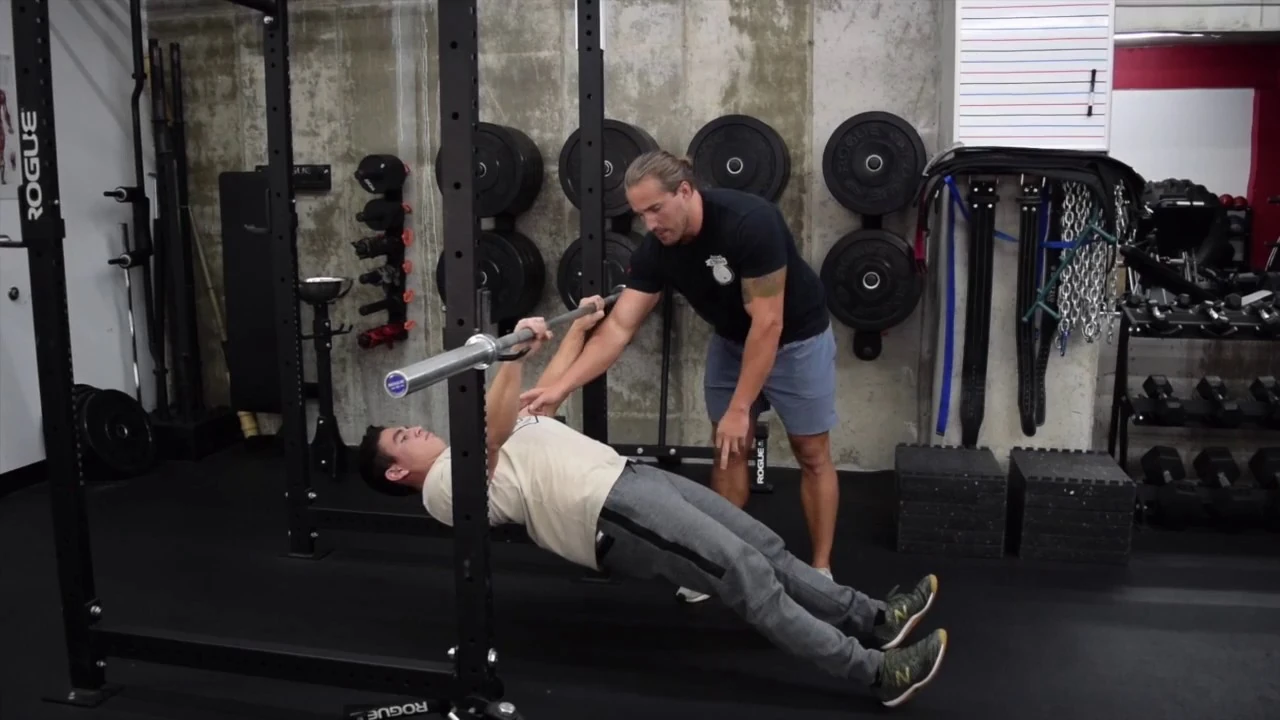
Set the bar and pick your angle
A Smith machine bar, a squat rack pin or a set of rings, roughly hip to chest height. The higher the bar, the easier the row. Set it so your last rep is hard and your first rep is not a fight.
Get under it and build the plank
Hands a little wider than your shoulders, heels on the floor, squeeze the glutes and brace the belly until you are one straight line from ankle to ear. Body straight, which is the cue on your wrist.
Pull your chest to the bar
Drive the elbows down and back, keep them close to your sides, and touch your chest to the bar or bring your hands to your ribs on rings. Hips stay level with your shoulders the whole way.
Lower until the arms are straight
Come down slowly until your elbows are straight and your shoulder blades have opened, without letting the hips drop first. Full range beats a shortened one across every pooled outcome2.
What goes wrong
Letting the hips sag first
The chest reaches the bar because the middle of you dropped rather than because your arms pulled. Look down at your own hip line between reps. If it broke, the set is finished.
Making it easier by lifting your chin
Craning the head up gets the face near the bar with the chest still low. The chest is the part that has to arrive, and the neck stays in line with the spine while it does.
Never changing the difficulty
The bar height is the entire load setting on this movement, and once a height gets easy the reps stop meaning much. Lower the bar or elevate your feet rather than adding another ten reps.
How Reckoner progresses this lift
Six weeks of this lift, run through the real engine. Nothing below was typed in: the prescription, the decision and the sentence beside it all come from the same code that writes your week.
| Week | Prescribed | What it did |
|---|---|---|
| 1 | 4 x 6 | More reps 6 → 7 repsYou finished every set with three reps left in the tank (RPE 7) and room left in the range, so the reps climb before the load does. |
| 2 | 4 x 7 | More reps 7 → 8 repsYou finished every set with three reps left in the tank (RPE 7) and room left in the range, so the reps climb before the load does. |
| 3 | 4 x 8 | More reps 8 → 9 repsYou finished every set with three reps left in the tank (RPE 7) and room left in the range, so the reps climb before the load does. |
| 4 | 4 x 9 | More reps 9 → 10 repsYou finished every set with three reps left in the tank (RPE 7) and room left in the range, so the reps climb before the load does. |
| 5 | 4 x 10 | Deload 40% of sets offFive weeks of building, then one week lighter. About 40% of the sets come off. The load holds and your reps stay where you earned them, so you keep the strength and lose the fatigue. |
| 6 | 2 x 10 | One more set 2 → 5 setsYou hit the top of the range with three reps left in the tank (RPE 7) and there is no weight left to add. When a lift runs out of load, the set is the increment, so it does five sets next week. |
Real engine output, not an illustration. Every row was produced by running the engine itself when this page was generated.
The full rule, and why the reps move before the load does, is in how Reckoner decides to add weight.
Questions people ask
Is this a real exercise or a beginner's pull-up?
It is a real row, and by measurement a good one: it produced higher latissimus dorsi and upper back activation than a standing bent-over row or a one-armed cable row, and the lowest spine load of the three1.
How do I make it harder without weights?
Lower the bar so your body is closer to horizontal, then put your feet up on a bench. Both change the leverage rather than the movement, and the elevated-feet version is in the library as its own entry.
What does Reckoner do with this when I get strong at it?
It climbs the rep range first, then adds a set, because there is nothing to load on a bodyweight movement. The elevated-feet version is in the same swap group. Each lift keeps its own record in Reckoner. Swapping between them loses neither record and merges neither, and the lift you swap to opens at its own weight if you have trained it before.
Similar movements
There is no load to ease on this lift, so Reckoner offers one of these the first time it stalls. Each of them has a page.
Sources
- Fenwick, Brown and McGill, Journal of Strength and Conditioning Research, 2009. Comparison of different rowing exercises: trunk muscle activation and lumbar spine motion, load, and stiffness seven men instrumented through three rows, with the inverted row producing the highest latissimus dorsi, upper back and hip extensor activation of the three and the lowest measured compression at the fourth and fifth lumbar joint at 2339 newtons, against 2457 for a standing one-armed cable row and 3576 for a standing bent-over row
- Wolf and colleagues, International Journal of Strength and Conditioning, 2023. Partial vs full range of motion resistance training: a systematic review and meta-analysis a meta-analysis reporting a trivial standardized mean difference of 0.12 in favor of full range training, with every outcome favoring full range but all effects between trivial and small, and a subgroup suggesting partials held at long muscle lengths may match or beat full range for size