 reckoner
Neutral-grip lat pull-down
Same machine, same overhead pull, palms facing each other on a V handle or a parallel bar. The grip is worth having for the shoulders and elbows it suits, rather than for anything it adds to the lats.
Drive the elbows down to the ribs.
- Pattern
- Vertical pull
- Trains
- Lats, upper back, biceps
- Kit
- Machine lat pulldown
- Loading
- A weight you choose
- Reckoner prescribes
- 4 sets of 6 to 10 reps at RPE 8
- Progression step
- 5 kg once the top of the range is clean
- Skill
- Simple to learn
- Recovery cost
- Low
Muscles worked
How to do it
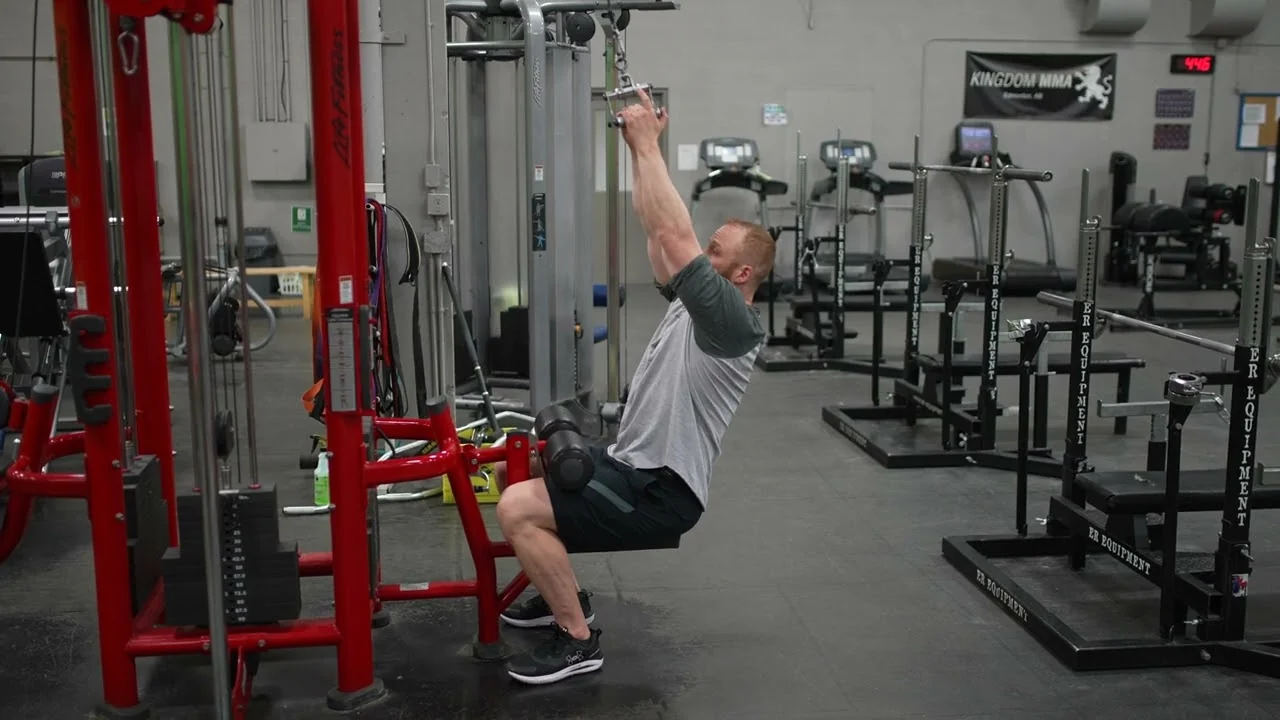
Pin the thighs and pick the handle
Bring the pad down until you cannot lift off the seat. A close V handle and a wide parallel bar both count as neutral, so take whichever one your gym has and stay with it between sessions.
Sit tall and take the hang
Reach up, let the shoulders rise, then sit up straight and lean back only a few degrees. Set that torso angle before the first rep and hold it for the whole set.
Pull the elbows down to your ribs
Think about the elbows and the back does the work. Think about the hands and the arms take it. Bring the handle to your upper chest and pause there for a beat.
Let it rise until the arms are straight
Reverse it slowly, all the way, until you feel the shoulder blades lift again. That stretch at the top is most of the reason the pull-down is worth doing at all.
What goes wrong
Expecting the grip to change which muscle grows
It does not. Across seven pull-down variants differing in grip type, width and trunk angle, latissimus dorsi activation came out the same1. Choose it because it feels better, not because it targets something.
Leaning back to finish the rep
Once the torso is swinging it is a row with an awkward angle and the load has stopped being the load. If you need the lean, take the pin up one.
Stopping short at the top
Holding the handle a few inches down keeps constant tension on the arms and takes the stretch away from the lats. Pooled evidence favors the full range over a shortened one on every outcome measured2.
How Reckoner progresses this lift
Six weeks of this lift, from 45 kg, run through the real engine. Nothing below was typed in: the prescription, the decision and the sentence beside it all come from the same code that writes your week.
| Week | Prescribed | What it did |
|---|---|---|
| 1 | 4 x 6 at 45 kg | More reps 6 → 7 repsYou finished every set with three reps left in the tank (RPE 7) and room left in the range, so the reps climb before the load does. |
| 2 | 4 x 7 at 45 kg | More reps 7 → 8 repsYou finished every set with three reps left in the tank (RPE 7) and room left in the range, so the reps climb before the load does. |
| 3 | 4 x 8 at 45 kg | More reps 8 → 9 repsYou finished every set with three reps left in the tank (RPE 7) and room left in the range, so the reps climb before the load does. |
| 4 | 4 x 9 at 45 kg | More reps 9 → 10 repsYou finished every set with three reps left in the tank (RPE 7) and room left in the range, so the reps climb before the load does. |
| 5 | 4 x 10 at 45 kg | Deload 40% of sets offFive weeks of building, then one week lighter. About 40% of the sets come off. The load holds and your reps stay where you earned them, so you keep the strength and lose the fatigue. |
| 6 | 2 x 10 at 45 kg | Load up 45 kg → 50 kgYou hit the top of the range with three reps left in the tank (RPE 7), so the weight on the machine goes up 5 kg to 50 kg. The weight went up, so the reps come down to six. You are now working 6 to 10. The lighter week is over, so this is back to four sets. |
Real engine output, not an illustration. Every row was produced by running the engine itself when this page was generated.
The full rule, and why the reps move before the load does, is in how Reckoner decides to add weight.
Questions people ask
Is a neutral grip better for the lats than an overhand one?
No. Grip and forearm orientation did not significantly change latissimus dorsi activation in a study of forty trained men across seven pull-down variants1, and a separate comparison of three pronated widths found the same3. The grip is a comfort decision.
Is it safer for my shoulder?
Nobody can tell you that, because no trial has compared injury rates between grips. What is known is that the lats work the same either way1, so choosing the grip that does not aggravate your shoulder costs you nothing measurable.
Should I use this or the standard pull-down?
Whichever one you can do the most honest reps with. They share the pull-down group. Each lift keeps its own record in Reckoner. Swapping between them loses neither record and merges neither, and the lift you swap to opens at its own weight if you have trained it before. The library records no restriction against this one.
Similar movements
Reckoner eases the load first when this lift stalls, and offers one of these only if it stalls again after that. A lift already as light as your kit goes has no load left to ease, so the offer comes straight away. Each of them has a page.
Sources
- Buonsenso and colleagues, Journal of Functional Morphology and Kinesiology, 2025. Electromyographic analysis of back muscle activation during lat pulldown exercise: effects of grip variations and forearm orientation forty men with at least five years of training pulling seven pull-down variants at seventy per cent of their repetition maximum, with no significant difference in latissimus dorsi activation across any of them, and the only significant finding a rise in posterior deltoid activity with a wide pronated grip and a thirty degree trunk lean
- Wolf and colleagues, International Journal of Strength and Conditioning, 2023. Partial vs full range of motion resistance training: a systematic review and meta-analysis a meta-analysis reporting a trivial standardized mean difference of 0.12 in favor of full range training, with every outcome favoring full range but all effects between trivial and small, and a subgroup suggesting partials held at long muscle lengths may match or beat full range for size
- Andersen and colleagues, Journal of Strength and Conditioning Research, 2014. Effects of grip width on muscle strength and activation in the lat pull-down fifteen men pulling a six repetition maximum at narrow, medium and wide pronated grips, one, one and a half and twice the distance across the shoulders, with similar latissimus, trapezius and infraspinatus activation at every width and the wide grip the one they were measurably weakest at