 reckoner
One-arm dumbbell row
One hand and one knee on a bench, the other hand rowing a dumbbell to your hip. Bracing on the bench takes most of the hinge out, so you can row something heavy without your lower back being the first thing to run out.
Flat back, drive the elbow to the hip.
- Pattern
- Horizontal pull
- Trains
- Lats, upper back
- Kit
- Dumbbell, bench
- Loading
- A weight you choose
- Reckoner prescribes
- 4 sets of 6 to 10 reps at RPE 8
- Progression step
- 2 kg once the top of the range is clean
- Skill
- Some technique
- Recovery cost
- Moderate
Muscles worked
How to do it
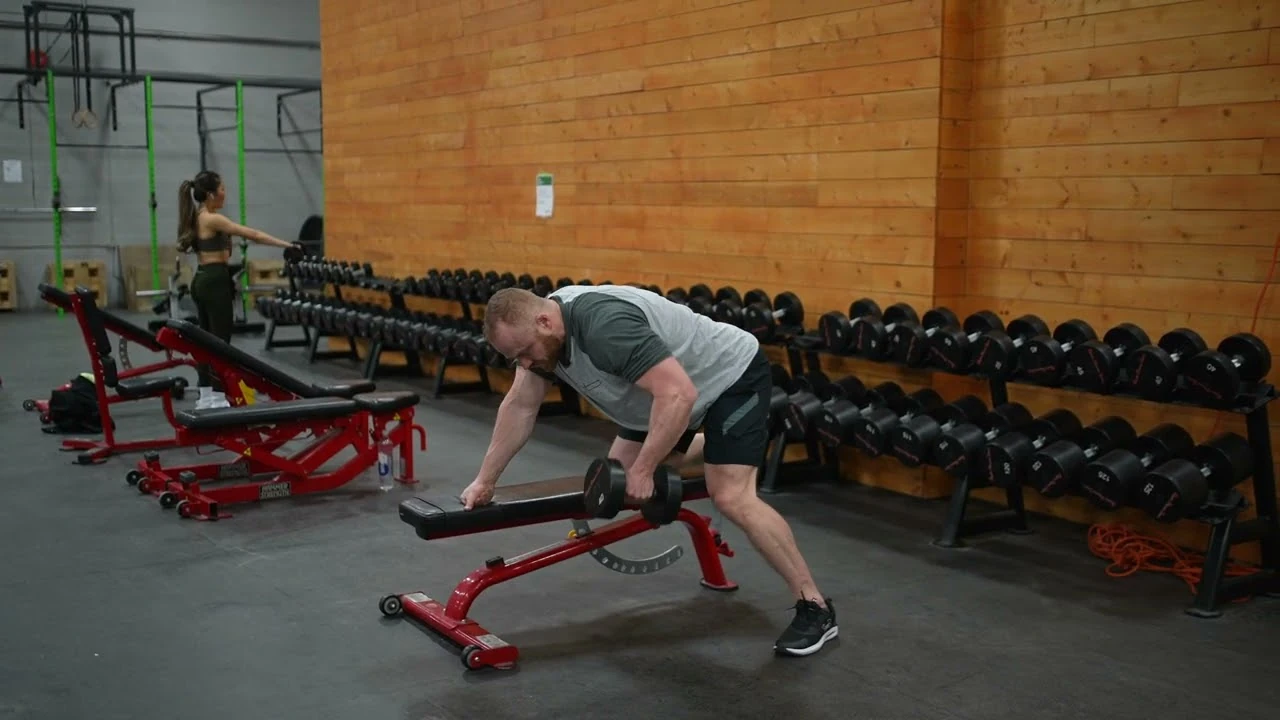
Build a flat platform
Left hand and left knee on the bench, right foot on the floor and a little back, torso roughly parallel to the ground. Flat back, which is the cue on your wrist. Your shoulders should be level with each other before you pick anything up.
Pick the bell up from a dead stop
Reach down with a straight arm and let the shoulder blade travel forward. That reach at the bottom is part of the rep, not a preamble to it.
Drive the elbow to the hip
Pull the elbow back and slightly in, so the dumbbell finishes near your waist rather than your armpit. The lats extend the shoulder, so a path toward the hip is the one that suits them2.
Lower all the way and let the blade open
Control it back to a straight arm and allow the shoulder to travel forward again before the next rep. Pooled evidence favors the full range on every outcome measured3.
What goes wrong
Turning the torso to finish the rep
The shoulder on the working side climbs, the ribcage twists open, and the last third of the pull came from rotation rather than the back. Keep both shoulders level and stop the set when they stop being level.
Rowing to the armpit
Flaring the elbow wide and pulling high shifts the work up into the rear shoulder and out of the lats. Elbow tight, dumbbell to the hip.
Loading the strong side and matching it on the weak one
Run both arms at what the weaker one can do honestly, and let it catch up. Strength gains follow the way you train, and training one arm at a time is a good way to close a side-to-side gap and an easy way to widen one1.
How Reckoner progresses this lift
Six weeks of this lift, from 24 kg, run through the real engine. Nothing below was typed in: the prescription, the decision and the sentence beside it all come from the same code that writes your week.
| Week | Prescribed | What it did |
|---|---|---|
| 1 | 4 x 6 at 24 kg | More reps 6 → 7 repsYou finished every set with three reps left in the tank (RPE 7) and room left in the range, so the reps climb before the load does. |
| 2 | 4 x 7 at 24 kg | More reps 7 → 8 repsYou finished every set with three reps left in the tank (RPE 7) and room left in the range, so the reps climb before the load does. |
| 3 | 4 x 8 at 24 kg | More reps 8 → 9 repsYou finished every set with three reps left in the tank (RPE 7) and room left in the range, so the reps climb before the load does. |
| 4 | 4 x 9 at 24 kg | More reps 9 → 10 repsYou finished every set with three reps left in the tank (RPE 7) and room left in the range, so the reps climb before the load does. |
| 5 | 4 x 10 at 24 kg | Deload 40% of sets offFive weeks of building, then one week lighter. About 40% of the sets come off. The load holds and your reps stay where you earned them, so you keep the strength and lose the fatigue. |
| 6 | 2 x 10 at 24 kg | Load up 24 kg → 26 kgYou hit the top of the range with three reps left in the tank (RPE 7), so the dumbbell weight goes up 2 kg to 26 kg. The weight went up, so the reps come down to seven. You are now working 6 to 10. The lighter week is over, so this is back to four sets. |
Real engine output, not an illustration. Every row was produced by running the engine itself when this page was generated.
The full rule, and why the reps move before the load does, is in how Reckoner decides to add weight.
Questions people ask
Is one arm at a time better than a barbell row?
Not for size. Pooling nine studies, unilateral and bilateral training produced no significant difference in muscle growth1. What it is better at is sparing your lower back, because the bench carries the torso that a bent-over row makes you hold up.
Knee on the bench or foot on the floor?
Either. A knee on the bench is more stable and lets you go heavier. Standing with a hand on the bench keeps more of your hips and midsection working. Pick one and keep it, so the numbers you log mean the same thing week to week.
How far should the dumbbell travel?
From a fully straight arm with the shoulder blade reaching forward, to your hip with the blade pulled back. If the range is shrinking as the set goes on, that is the set ending rather than the reps continuing.
Similar movements
Reckoner eases the load first when this lift stalls, and offers one of these only if it stalls again after that. A lift already as light as your kit goes has no load left to ease, so the offer comes straight away. Each of them has a page.
Sources
- Kassiano and colleagues, Sports Medicine, 2025. Comparison of muscle growth and dynamic strength adaptations induced by unilateral and bilateral resistance training: a systematic review and meta-analysis nine studies pooled, finding no significant difference in muscle growth between training one limb at a time and training both, and strength gains that follow specificity, bilateral training favoring bilateral tests and unilateral training favoring unilateral ones
- Wu and Bordoni, StatPearls, National Library of Medicine, 2023. Anatomy, shoulder and upper limb, scapulohumeral muscles the latissimus dorsi running from the lower thoracic and lumbar spine, the bottom of the ribcage and the rim of the pelvis to the front of the upper arm bone, and being the shoulder's most important adductor, extensor and internal rotator
- Wolf and colleagues, International Journal of Strength and Conditioning, 2023. Partial vs full range of motion resistance training: a systematic review and meta-analysis a meta-analysis reporting a trivial standardized mean difference of 0.12 in favor of full range training, with every outcome favoring full range but all effects between trivial and small, and a subgroup suggesting partials held at long muscle lengths may match or beat full range for size