 reckoner
Pike push-up
A push-up folded in half at the hips so you press mostly upward instead of mostly forward. Get the hips high enough and the shoulders are underneath the load rather than in front of it, which is the difference between training your chest and training your shoulders with the same two hands on the same floor.
Crown to the floor, hips stacked high.
- Pattern
- Vertical push
- Trains
- Front delts, triceps
- Kit
- Bodyweight, floor
- Loading
- Your own bodyweight
- Reckoner prescribes
- 4 sets of 6 to 10 reps at RPE 8
- Progression step
- Nothing to add, so the sets climb instead
- Skill
- Some technique
- Recovery cost
- Moderate
- Not prescribed if you have declared
- Shoulder, wrist
Muscles worked
How to do it
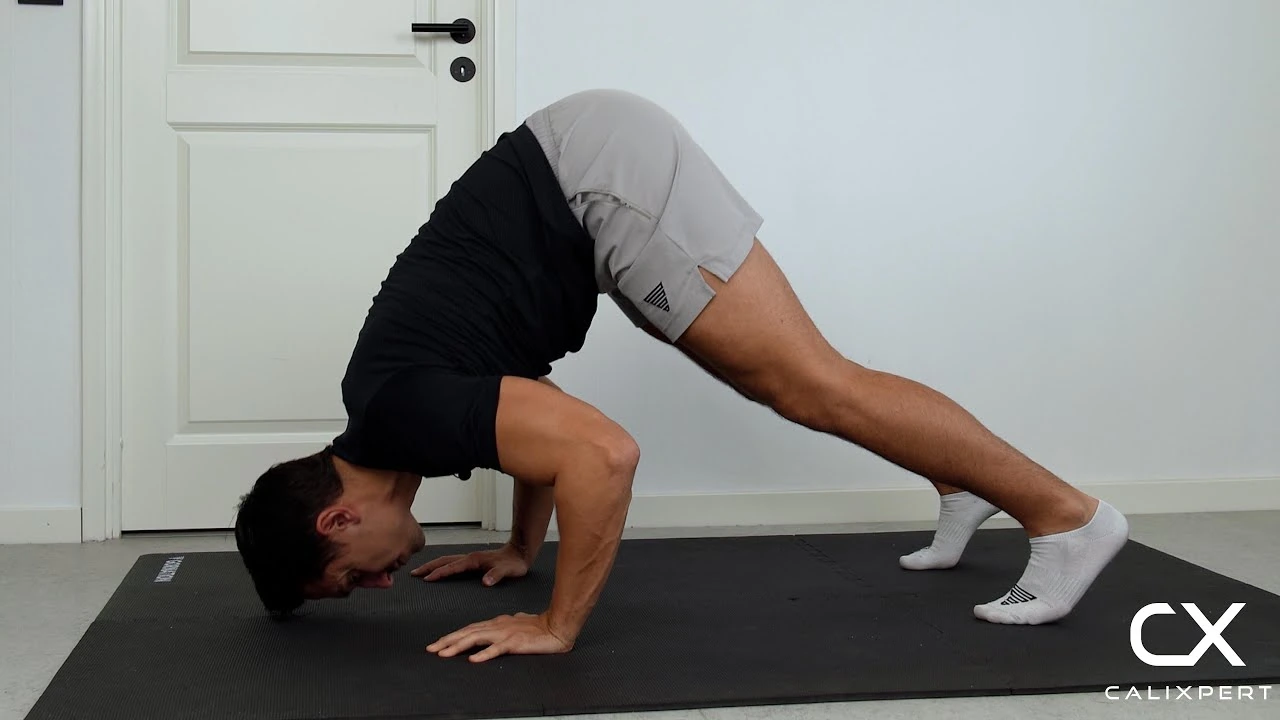
Start in a push-up and walk your feet in
Hands under the shoulders, then step the feet toward your hands and let the hips rise. You are aiming for an upside down V with straight legs and a straight back, heels down or as close to down as your hamstrings allow.
Get the hips over the shoulders
This is the whole movement. If the hips are behind the shoulders you are doing a steep push-up. Stacked, and your arms are pressing something that is genuinely above them. Look back between your feet rather than forward at the floor and the spine will follow.
Lower the crown of your head toward the floor
Between your hands, not in front of them, elbows traveling back and slightly out. Touch lightly or come close, then hold the position rather than resting on your head. That is the cue Reckoner puts on your wrist: crown to the floor, hips stacked high.
Press back up with the hips where they were
Straighten the arms and finish with the shoulders pushed away from the ears. The hips dropping on the way up is the commonest way this turns back into a push-up halfway through a set.
What goes wrong
Hips too low
It looks like a pike and presses like a decline push-up, and the load goes back to the chest. If it is burning across the chest rather than the front of the shoulders, walk the feet in further before you do anything else.
Head landing in front of the hands
Everything tips forward, the shoulders come out over the wrists and the vertical line you set up for is gone. Down between the hands, every rep.
Walking the feet back through the set
The hardest position drifts into an easier one over eight reps and the last few are a different exercise. Mark where your toes start if you have to. A set that got easier is a set that told you nothing.
How Reckoner progresses this lift
Six weeks of this lift, run through the real engine. Nothing below was typed in: the prescription, the decision and the sentence beside it all come from the same code that writes your week.
| Week | Prescribed | What it did |
|---|---|---|
| 1 | 4 x 6 | More reps 6 → 7 repsYou finished every set with three reps left in the tank (RPE 7) and room left in the range, so the reps climb before the load does. |
| 2 | 4 x 7 | More reps 7 → 8 repsYou finished every set with three reps left in the tank (RPE 7) and room left in the range, so the reps climb before the load does. |
| 3 | 4 x 8 | More reps 8 → 9 repsYou finished every set with three reps left in the tank (RPE 7) and room left in the range, so the reps climb before the load does. |
| 4 | 4 x 9 | More reps 9 → 10 repsYou finished every set with three reps left in the tank (RPE 7) and room left in the range, so the reps climb before the load does. |
| 5 | 4 x 10 | Deload 40% of sets offFive weeks of building, then one week lighter. About 40% of the sets come off. The load holds and your reps stay where you earned them, so you keep the strength and lose the fatigue. |
| 6 | 2 x 10 | One more set 2 → 5 setsYou hit the top of the range with three reps left in the tank (RPE 7) and there is no weight left to add. When a lift runs out of load, the set is the increment, so it does five sets next week. |
Real engine output, not an illustration. Every row was produced by running the engine itself when this page was generated.
The full rule, and why the reps move before the load does, is in how Reckoner decides to add weight.
Questions people ask
How does it compare with a loaded overhead press?
Nobody has published a comparison, and that is worth saying plainly rather than filling with a guess. There is no measurement of the pike push-up against a barbell or dumbbell press for muscle activity, strength or size. The closest measured thing is the push-up family itself, where raising the feet puts more force through the hands than any other variation tested1, which is the ladder this movement sits on.
Can something with no weight on it actually build anything?
Yes, within limits, and the limits are the interesting part. Across twenty one trials where every set was taken to failure, light loads and heavy loads produced similar muscle growth, while heavy loads produced clearly more one repetition maximum strength2. So a bodyweight press can build size on the same terms as a loaded one. If what you want is a bigger press, you will need something to press.
What does Reckoner do when there is nothing to add?
It climbs the rep range and then adds a set, because volume is the only lever a bodyweight movement has. And when it stalls there is no load to take back, so unlike a loaded lift there is no reset to try first: it goes straight to offering you the other movement in this group, which is the elevated version. Raising your feet is yours to do.
Similar movements
There is no load to ease on this lift, so Reckoner offers one of these the first time it stalls. Each of them has a page.
Sources
- Ebben and colleagues, Journal of Strength and Conditioning Research, 2011. Kinetic analysis of several variations of push-ups push-ups with the feet elevated producing a higher peak vertical ground reaction force than every other push-up variation measured
- Schoenfeld, Grgic, Ogborn and Krieger, Journal of Strength and Conditioning Research, 2017. Strength and Hypertrophy Adaptations Between Low- vs. High-Load Resistance Training: A Systematic Review and Meta-analysis twenty one studies of sets taken to momentary failure showing similar hypertrophy across the loading spectrum and significantly greater one repetition maximum gains with heavy loads