 reckoner
Suitcase carry
One dumbbell, one hand, and a walk in a straight line. Everything about the load wants to bend you toward it, and the muscles down your other side spend the whole walk refusing. It is the most useful one-sided trunk exercise there is, and the one to be most deliberate about loading.
Stay upright, don't tip toward the load.
- Pattern
- Carry
- Trains
- Obliques, abs, forearms, traps
- Kit
- Dumbbell or kettlebell
- Loading
- A weight you choose
- Reckoner prescribes
- 4 holds of 30 to 60 seconds, on the fat loss, general fitness and stay healthy plans. Reckoner does not prescribe this pattern for muscle or strength.
- Progression step
- 10 seconds on the hold
- Skill
- Some technique
- Recovery cost
- Moderate
- Not prescribed if you have declared
- Lower back, neck
Muscles worked
How to do it
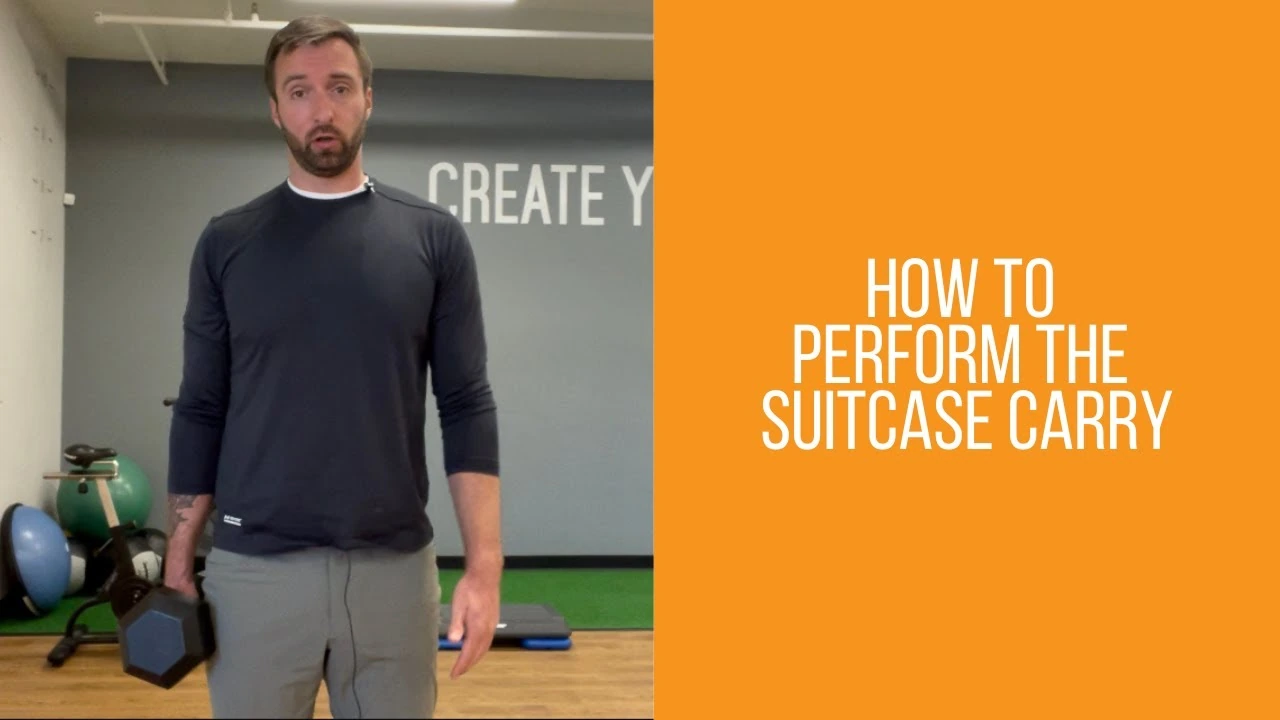
Pick the weight up properly
Hinge at the hips, take the handle, and stand up with the back flat. Getting the load off the floor badly is the likeliest way to hurt yourself on this movement.
Stand square before you move
Shoulders level, hips level, ribs pulled down, weight hanging straight beside you rather than swinging. You should look, from the front, like somebody carrying nothing.
Walk with short, even steps
Normal breathing, eyes ahead, no rush. The free arm hangs, it does not stick out for balance. Any hitch in the walk means the load has started to win.
Stop when you start to lean
A visible tilt toward the weight is the end of the set. Note the time, put it down properly, and do the same walk with the other hand.
What goes wrong
Tipping toward the weight
Leaning shortens the lever and makes the carry easier, so the body finds it on its own. Once you are tilted the skeleton is holding the load and the trunk has been let off.
Hitching the shoulder up
Shrugging the loaded side up takes the strain off the grip and off the trunk. Let the shoulder hang where it would if your hand were empty.
Only doing your strong side
It is very easy to walk further on one hand and call the set done. Match the weaker side's time on both, and let the weaker side set the number.
How Reckoner progresses this lift
Six weeks of this lift, from 22 kg, run through the real engine. Nothing below was typed in: the prescription, the decision and the sentence beside it all come from the same code that writes your week.
| Week | Prescribed | What it did |
|---|---|---|
| 1 | 4 x 30 s at 22 kg | Longer hold 30 → 40 sYou carried the full time with a hard effort and steady form (RPE 7), so the carry gains ten seconds. Once it reaches 60 seconds the load goes up instead. |
| 2 | 4 x 40 s at 22 kg | Longer hold 40 → 50 sYou carried the full time with a hard effort and steady form (RPE 7), so the carry gains ten seconds. Once it reaches 60 seconds the load goes up instead. |
| 3 | 4 x 50 s at 22 kg | Longer hold 50 → 60 sYou carried the full time with a hard effort and steady form (RPE 7), so the carry gains ten seconds. Once it reaches 60 seconds the load goes up instead. |
| 4 | 4 x 60 s at 22 kg | Load up 22 kg → 24 kgYou carried the top of the window with a hard effort and steady form (RPE 7), so the load goes up 2 kg to 24 kg and the carry drops back to 30 seconds. Given the choice between heavier and longer, a loaded lift gets heavier. |
| 5 | 4 x 30 s at 24 kg | Deload 40% of sets offFive weeks of building, then one week lighter. About 40% of the sets come off. The load holds and your reps stay where you earned them, so you keep the strength and lose the fatigue. |
| 6 | 2 x 30 s at 24 kg | Longer hold 30 → 40 sYou carried the full time with a hard effort and steady form (RPE 7), so the carry gains ten seconds. Once it reaches 60 seconds the load goes up instead. The lighter week is over, so this is back to four sets. |
Real engine output, not an illustration. Every row was produced by running the engine itself when this page was generated.
The full rule, and why the reps move before the load does, is in how Reckoner decides to add weight.
Questions people ask
Is carrying on one side bad for my back?
It costs the low back more than the same total split across two hands, and by a lot. In one measurement, thirty kilograms carried in one hand pushed low back compression above 2800 newtons while splitting the same weight between both hands brought it to 1570, and carrying thirty in each hand still produced less compression than thirty in one1. That asymmetric load is precisely what the exercise is for, which is why it earns a deliberate weight rather than the heaviest thing available.
Suitcase carry or farmer's carry?
The farmer's carry is the balanced one and it lets you load far heavier for grip and upper back work. The suitcase carry is the one that asks the side of your trunk to hold you upright. They share a swap group. Each lift keeps its own record in Reckoner. Swapping between them loses neither record and merges neither, and the lift you swap to opens at its own weight if you have trained it before.
Why is this measured in seconds rather than reps?
Because a carry is performed against a clock, so it progresses on the axis it is actually done on. The engine adds seconds to the walk the same way it adds weight to a bar.
Similar movements
Reckoner eases the load first when this lift stalls, and offers one of these only if it stalls again after that. A lift already as light as your kit goes has no load left to ease, so the offer comes straight away. Each of them has a page.
Sources
- McGill, Marshall and Andersen, Ergonomics, 2013. Low back loads while walking and carrying: comparing the load carried in one hand or in both hands six participants walking with buckets, where thirty kilograms carried in one hand pushed low back compression above 2800 newtons while the same total split between both hands brought it to 1570, a reduction of 44 per cent, and where doubling the total by carrying thirty kilograms in each hand still produced less spine compression than thirty in one