 reckoner
Weighted V-up
Flat on the floor, a weight held overhead, and then the arms and the legs come up to meet over your hips. It is the hardest of the loaded floor movements in this library to do cleanly, because you have to coordinate two halves of your body while nothing is anchored.
Reach for the toes, don't yank the neck.
- Pattern
- Core flexion
- Trains
- Abs, hip flexors
- Kit
- Dumbbell, floor
- Loading
- A weight you choose
- Reckoner prescribes
- 2 sets of 10 to 15 reps at RPE 8
- Progression step
- 1 kg once the top of the range is clean
- Skill
- Technical
- Recovery cost
- Low
- Not prescribed if you have declared
- Lower back, neck
Muscles worked
How to do it
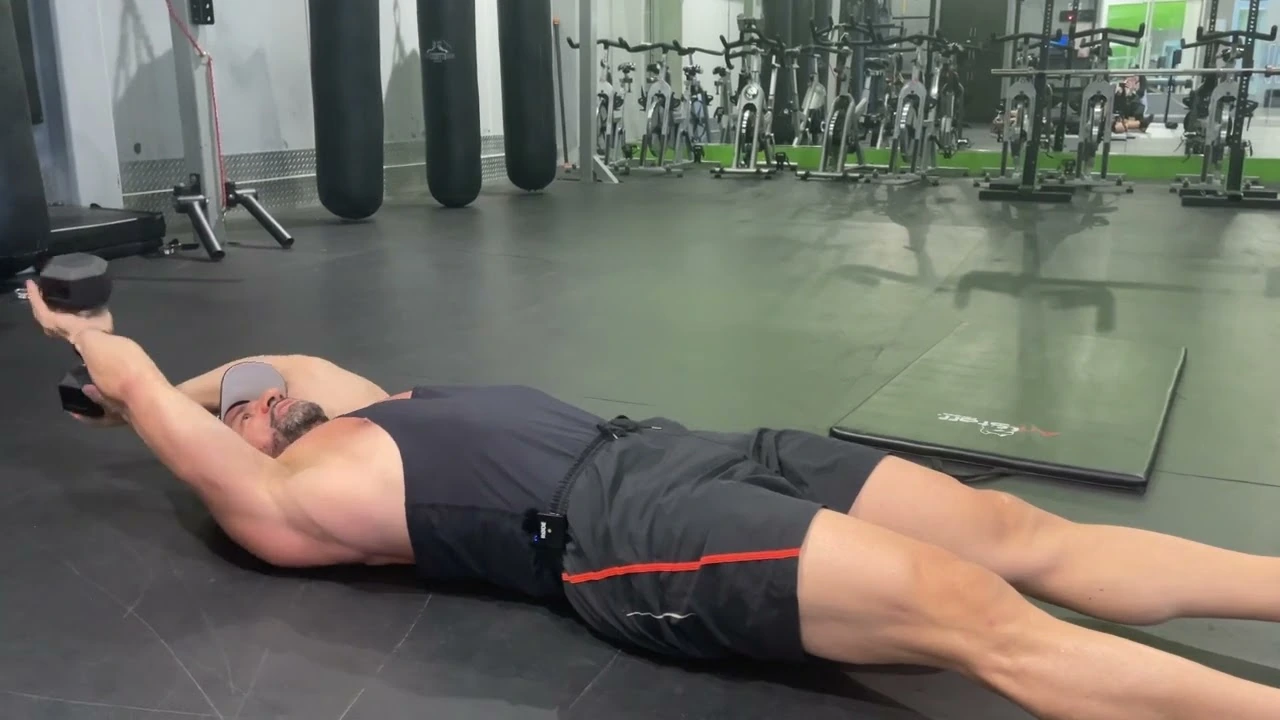
Lie long with the weight overhead
A single dumbbell held in both hands, arms straight over your head, legs straight, whole body long. Press the lower back toward the floor before anything moves.
Bring both ends up together
Reach the weight toward your feet as the legs come up, so the two halves arrive at the same time. Meeting in the middle is the movement. One end arriving first is a different exercise.
Balance on the hips at the top
For a beat you are balanced with the weight over your hips and the abs fully shortened. Hold it there rather than crashing through it.
Lower both ends under control
Come back down slowly and let the heels and the weight touch down before you go again. The lowering is where most of the work is, and it is what people skip.
What goes wrong
Using the weight as a wrecking ball
Throwing the arms up drags the torso off the floor and the rep happens without much abdominal effort. If the weight is swinging you rather than the other way round, drop the load.
Letting the back arch on the way down
The legs go low, the back bridges off the floor, and the next rep starts from a hollow you cannot brace. Stop the descent while the back is still down.
Loading it before the bodyweight version is clean
A V-up you cannot do without swinging becomes a weighted V-up you definitely cannot do without swinging. Earn the pattern first, then add the dumbbell.
How Reckoner progresses this lift
Six weeks of this lift, from 6 kg, run through the real engine. Nothing below was typed in: the prescription, the decision and the sentence beside it all come from the same code that writes your week.
| Week | Prescribed | What it did |
|---|---|---|
| 1 | 2 x 10 at 6 kg | More reps 10 → 11 repsYou finished every set with three reps left in the tank (RPE 7) and room left in the range, so the reps climb before the load does. |
| 2 | 2 x 11 at 6 kg | More reps 11 → 12 repsYou finished every set with three reps left in the tank (RPE 7) and room left in the range, so the reps climb before the load does. |
| 3 | 2 x 12 at 6 kg | More reps 12 → 13 repsYou finished every set with three reps left in the tank (RPE 7) and room left in the range, so the reps climb before the load does. |
| 4 | 2 x 13 at 6 kg | More reps 13 → 14 repsYou finished every set with three reps left in the tank (RPE 7) and room left in the range, so the reps climb before the load does. |
| 5 | 2 x 14 at 6 kg | Deload 40% of sets offFive weeks of building, then one week lighter. About 40% of the sets come off. The load holds and your reps stay where you earned them, so you keep the strength and lose the fatigue. |
| 6 | 1 x 14 at 6 kg | More reps 14 → 15 repsYou finished every set with three reps left in the tank (RPE 7) and room left in the range, so the reps climb before the load does. The lighter week is over, so this is back to two sets. |
Real engine output, not an illustration. Every row was produced by running the engine itself when this page was generated.
The full rule, and why the reps move before the load does, is in how Reckoner decides to add weight.
Questions people ask
Is this better than a crunch?
Not necessarily, and it is a lot harder to do well. The crunch already measures among the highest exercises for both halves of the rectus abdominis and both obliques1. The V-up asks for more coordination for that same work, which makes it a good exercise for somebody who can do it and a poor first choice for somebody who cannot.
How do I regress it?
Bend the knees, keep the arms lower, or drop the weight altogether and get the timing right first. A tuck version with both ends meeting cleanly is worth far more than a straight-legged version powered by a swing.
Will it burn off my stomach?
No. Six weeks of abdominal training in sedentary adults with food held level improved abdominal endurance and left body fat, abdominal girth and skinfolds unchanged2. Train the muscle here and settle what covers it somewhere else.
Similar movements
Reckoner eases the load first when this lift stalls, and offers one of these only if it stalls again after that. A lift already as light as your kit goes has no load left to ease, so the offer comes straight away. Each of them has a page.
Sources
- Escamilla and colleagues, Journal of Orthopaedic and Sports Physical Therapy, 2006. An electromyographic analysis of commercial and common abdominal exercises: implications for rehabilitation and training fourteen participants across nine abdominal exercises, with the crunch among the highest for upper and lower rectus abdominis and for both obliques, and with rectus femoris activity greatest in the bent-knee sit-up, which the authors say may be a problem for people with low back pathology
- Vispute and colleagues, Journal of Strength and Conditioning Research, 2011. The effect of abdominal exercise on abdominal fat twenty-four sedentary adults randomized to six weeks of abdominal training or nothing on an isocaloric diet, with no significant effect on body weight, body fat percentage, android fat, abdominal circumference or either skinfold, and a significant improvement in abdominal muscular endurance