 reckoner
Guide Tracking
How to choose a strength training app
Most strength training apps can record a set. Fewer can tell you what to lift next week, and that is the part that decides whether you get stronger. Here are the six questions a coach would ask first.

Search for a strength training app and you get a wall of lists, each one ranking the same dozen apps on screenshots and star ratings. None of that tells you whether an app will make you stronger, because the thing that does that is not on any screenshot.
A coach looks somewhere else: at what happens to next week once this week is logged. Here are six questions to ask of any app before you trust it with your training, in the order a coach would ask them.
Does it progress you from what you actually lifted?
Getting stronger means asking for a little more over time, and the whole question is how much and when. The American College of Sports Medicine puts it plainly in its position stand on progression: once you can do one or two reps more than the target with a load, add between 2 percent and 10 percent to it.1
That rule needs your real numbers. An app that adds weight on a calendar, every week whether you finished the reps or not, is guessing on your behalf. So ask what it does after a session where you came up short. If the answer is the same thing it does after a good session, keep looking.
A plan that ignores your log is a plan written for somebody else.
Does it ask how hard it was, and how it looked?
Two sets of eight at the same weight can be very different sets. One had three good reps left in it. The other was a grind, with the last rep breaking down. If an app stores only the weight and the reps, it cannot tell them apart, and it will read the grind as permission to go heavier.
The simplest honest measure of effort is how many good reps you had left. Researchers built a rating scale for lifting around exactly that count, and found the ratings tracked how fast the bar moved.2 Look for an app that asks that question, or one like it, and asks about form as well. Then check the answer changes something. A question that changes nothing is a form to fill in.
Can you log a set before your rest is over?
Logging that takes longer than the rest between sets stops getting done. Then the log has holes in it, and an app that plans from your log is planning from the holes.
The habit is worth protecting. A large review of experiments on goals found that monitoring your progress helps you reach them, and that it helped more when the progress was physically recorded rather than kept in your head.3 So test it where it matters, in the gym, between sets. If you have to type the weight from scratch for every set, the habit is unlikely to last. The planned weight and reps should already be there, so a set that went as written costs you a tap.
Does your week change when your week changes?
Real training weeks do not go to plan. You miss a session, you sleep badly, the squat rack is taken. A fixed program printed in January knows none of that.
Be fair to fixed programs, though. A review of studies in trained lifters compared plans that adjust the load from how the sets felt against plans set from fixed percentages, and found similar strength gains.4 Adjusting is not magic. What it buys you is a plan that stays sensible on the weeks that go wrong: a missed day is not scored as a failed one, a lift that has not moved for weeks gets a lighter bar rather than another repeat, and a swap made because the rack was taken is recorded as what you did.
Does it work on your wrist?
If you train with a watch, ask whether the app runs on it properly: the session on the wrist, set by set, with what you log coming back to your history without copying anything across. A watch that only counts reps or heart rate is doing a different job. Check that it supports the watch you already own, not only this year's model.
No watch is fine too. A good strength training app should do everything on your phone without one.
Is your training yours?
Years of logs are worth more than any app. Before you start, check that you can export all of it in a file you can open elsewhere, and that deleting your account deletes the data with it. In the European Union this is not a favor an app does you: the data protection rules give you the right to receive the data you provided in a structured, machine-readable format, and to take it to another service.5
While you are reading the privacy policy, look for one more thing: whether your training is sold or shared with anybody.
What none of this tells you
An app handles the programming: the arithmetic, the record and the decision about next week. It does not watch your squat, and it does not replace a coach who can. Pick the app that gets the six questions right, and keep a person in the loop for the things a screen cannot see.
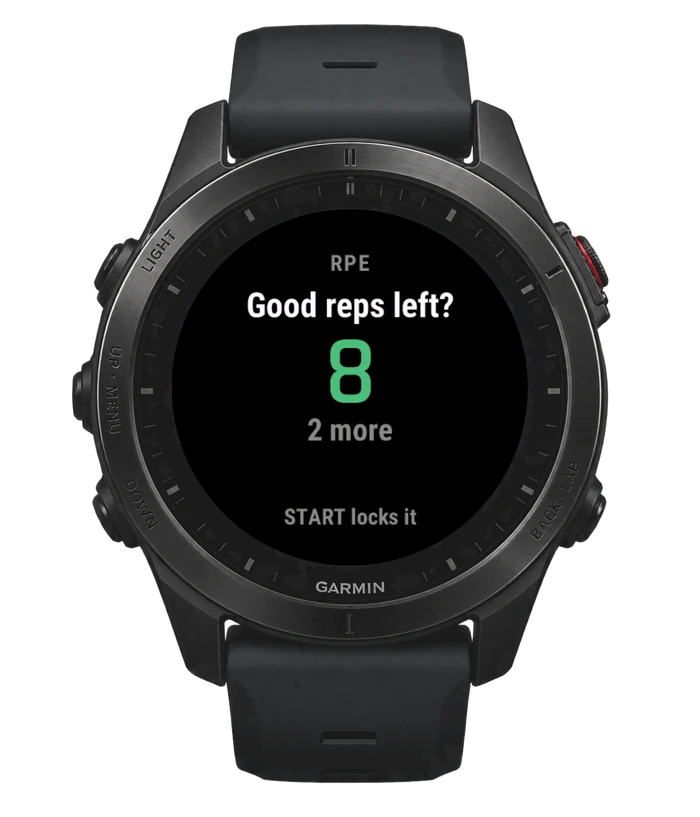
Reckoner is built around these six questions. It writes next week from what you logged, asks how many good reps you had left and how the form looked, and runs on your phone and on Garmin watches. See how it works as a strength training app.