 reckoner
Two months in and the bar is moving. The bench that felt heavy in June goes up for reps now and the log says so. Then you stand on the scale, it reads roughly what it read last month, and the obvious conclusion is that the training is working on paper and not on you. This is the point at which most people start looking up how to take body measurements, and it is the right instinct for a reason worth spelling out.
Reckoner already knows what you weigh. It asks at sign-up and reads that number for the strength standards, because a bench means one thing at sixty kilos of bodyweight and another at ninety. So none of what follows is an argument against the scale. It is an argument that one number cannot tell you where a change went.
One number, two things moving
More than three hundred people ate at a deficit for about five months, split by what else they did with the time. The ones who lifted two or three times a week were the only group whose fat-free mass went up, and they lost the most fat while it did. The ones who did cardio and the ones who did nothing both lost fat-free mass1.
Read that off a bathroom scale and you would see one line going down at slightly different speeds, with no way of knowing that underneath it one group was building and two were shrinking. A scale reports the difference between two things moving independently. It cannot report the two things. A tape can, which is the entire job body measurements do.
Two clocks, not one
So Reckoner asks for two kinds of number on two schedules, and does not pretend they answer the same question. Your weight is a weekly card. Your body measurements are monthly, on the first of the month, and the first of the month does not move.
That is not tidiness. A measurement is worth taking when the change you are hunting is bigger than the wobble in the measurement itself, and those two are not on the same clock. Weight moves fast enough to read weekly. A waist does not.
What a weekly reading looks like when it is real
A weekly clock earns its place when the thing under it genuinely moves weekly. Your weight does. Food, water, salt and the time of day push it around by a kilo or two inside a single week, and underneath that noise a real deficit or a real surplus shows up inside a month. Six weekly readings of your weight are six honest readings, and the line through them says something the individual dots do not.
Now tape your waist every Monday. You get six rows as well, laid out exactly the same way, and almost none of them mean anything. A waist that is genuinely coming down does so by a fraction of a centimetre a week, which is smaller than the difference between taping yourself before breakfast and after it. Read that series weekly and you are reading your own tape hand, not your own body. Read it monthly and the signal is finally bigger than the wobble.
The scale says something changed. The tape says where.
The four, and where the tape goes
Reckoner asks for four girths and it names the landmark inside the question, which is the part most instructions leave to you. A chest taped at a different line is a different measurement, so the number would move whether or not you did. Here is where the tape goes on each of the four.
Waist, two centimetres above your navel
Round your middle two centimetres above your navel, about two finger widths, standing up straight, at the end of a normal breath out. Keep the tape level all the way round, including at your back, and do not pull it tight. Do not hold your breath and do not pull your stomach in. You are measuring what is there, not what you can hold.
Chest, at the fullest part
Round the fullest part of the chest, arms hanging at your sides, at the end of an ordinary breath out. Lifting your arms to get the tape round and then reading it while they are still up gives you a bigger number rather than a truer one.
Hips, at the widest point
Round the widest part of your backside, feet together, tape level all the way round. Move it up and down until you find the widest reading rather than taking the first place the tape settles.
Upper arm, loose
Halfway between your shoulder and your elbow, arm hanging by your side, and cold. Not flexed, and not after a set of curls. A flexed arm measures how hard you flexed, and that changes month to month in a way your arm does not.
The waist one is worth a sentence, because nearly every instruction you will read sends the tape lower, to your belly button itself. Two centimetres above your navel is where the people who write the standards measure it4, and two finger widths is how you find that spot without a ruler and without palpating a rib.
Reckoner's own instruction was not consistent until 20 August 2026. One screen asked for the narrowest part of your middle, another asked for your belly button, and this guide said something different again. Two centimetres above your navel is the answer everywhere now. If an older reading of yours was taken somewhere else on your torso, it has been left exactly as it is: no flag, no note, no correction, because a reading taken at the narrowest part is a reading taken at the narrowest part. Take the next one at the site above and keep taking it there.
All four are stored in centimetres whatever your bar is loaded in, because a girth is not a load and it is not a bathroom scale, and a waist should not get relabelled the day you change your plates. History carries a toggle for reading them in inches. It converts where they are drawn and changes nothing underneath.
How often to take your body measurements
All four go on one clock: the first of the month, every month. One tape session, four numbers, and then you put the tape away for four weeks. Reckoner asks on the first because a fixed date is the only cadence that cannot drift, and a drifting cadence is how a monthly series quietly becomes a five-week one and then a seven-week one.
Your first set is the exception, and it does not wait for the calendar. Sign up in the middle of a month and Reckoner asks straight away, so you have a baseline to measure against, unless the first is already close enough that you would be taping twice in a week. Miss a month and nothing is broken. There is no catching up to do and no penalty to serve. Take the next one on the next first.
Take it the same way every time
Measuring yourself works better than people expect. Forty-one women, taught by a short video and taping themselves at home, produced waist and hip readings that agreed closely with their own repeats and with a trained technician's2. You do not need a second person and you do not need to be good at this yet.
The useful part of that study is the gap it found anyway. Those self-taped waists came out about half an inch larger than the technician's, and the difference was neither statistically significant nor systematic2. Your tape sits where your tape sits. It costs you nothing, so long as the only thing you ever compare it against is your own reading from last month.
This is your number to read against your own history. A measurement you take at home is not comparable to a medical threshold. Reckoner draws no band, no risk category and no comparison against anybody else, and that is a decision rather than an omission: the readings a threshold is drawn from were taken by trained technicians at a named site, and yours was taken by you in your own bathroom.
Where you put it matters more than most instructions admit. Four standard waist sites, every one of them repeatable, and in women all but one pair read significantly differently from each other3. Six spots are in common use and the people who write the standards do not agree on one4.
All of them are repeatable, which is the part worth holding on to. None of them is wrong. What is wrong is using one in March and another in April, so take the one the question names and stop thinking about it.
The rest is conditions. Same time of day, same posture, tape snug enough to lie flat and not tight enough to dent you. Which conditions you pick matters far less than next month's reading being taken under the same ones, because an error that stays the same size cancels out when you subtract and an error that moves does not.
What Reckoner does with them
The four sit on a card on Today, under the day's plan, showing your latest reading for each with a short line of its own recent history beside it. When they are due the card says so and you log them from there. When they are not, it tells you when you last did.
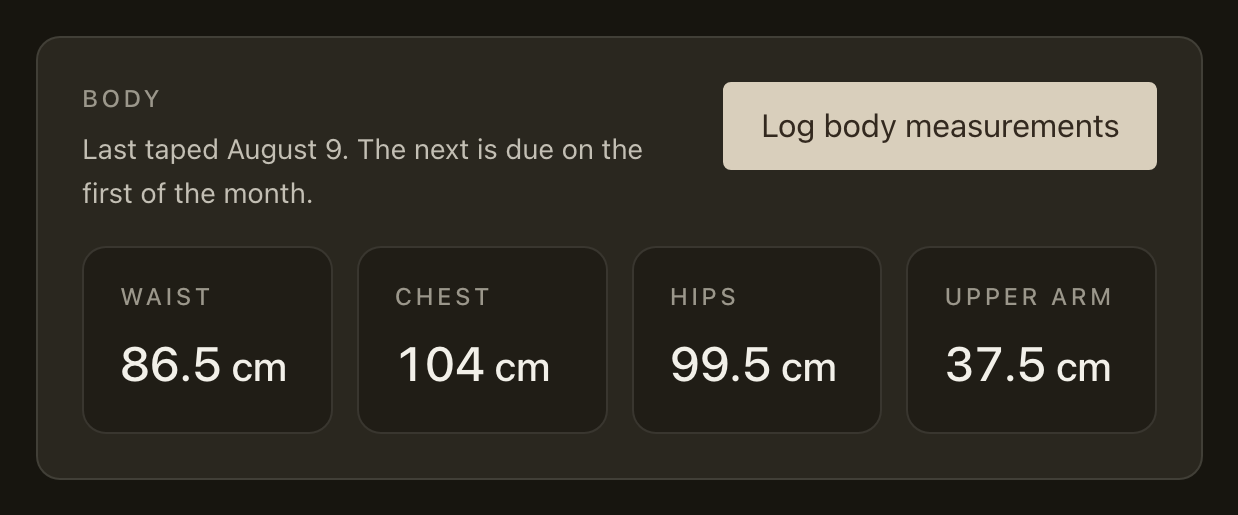
Each figure also has a page of its own, reached by pressing its tile. That page is one measurement, its line over time, and the full record of every reading you have taken of it. History draws the same lines a tab at a time if you would rather see all four together.
The lines are careful about how little they will claim. One reading is a dot rather than a line, because nothing there knows a direction yet. Two readings get a line and a note saying they are two readings and not a trend yet. A month you skipped is drawn straight through, because a gap between two tape readings is the cadence working rather than a hole, and the only thing that genuinely breaks a line is a reading you took back.
Which you can do, and the words for it are Correct and Withdraw rather than Edit and Delete. A reading you fix stays in the record beside its correction, and one you withdraw stays too, struck through. The record only ever grows. That is deliberate: a log you can quietly rewrite is a log that cannot tell you your waist has been flat for four months.
And if the asking wears thin, say so. Press Later three times running and Reckoner asks whether it should stop asking altogether. Say yes and it stops, the card stays where it is with your figures on it, and the switch to start it again sits on Setup. The weekly question and the monthly one keep separate counts, so quietening one leaves the other asking.
Nothing in your program reads any of this. Not one set, not one rep, not one plate changes because your waist did, and that is deliberate. Your body measurements are there to answer a question your training log cannot. A plan that quietly rewrote itself around a tape measure would be a plan you could no longer read.