 reckoner
Guide Range of motion
Range of motion: how deep each rep should go
Go all the way down. Full reps build more strength and more leg muscle than partial ones, and the stretched bottom of a rep looks like the part doing the most work.
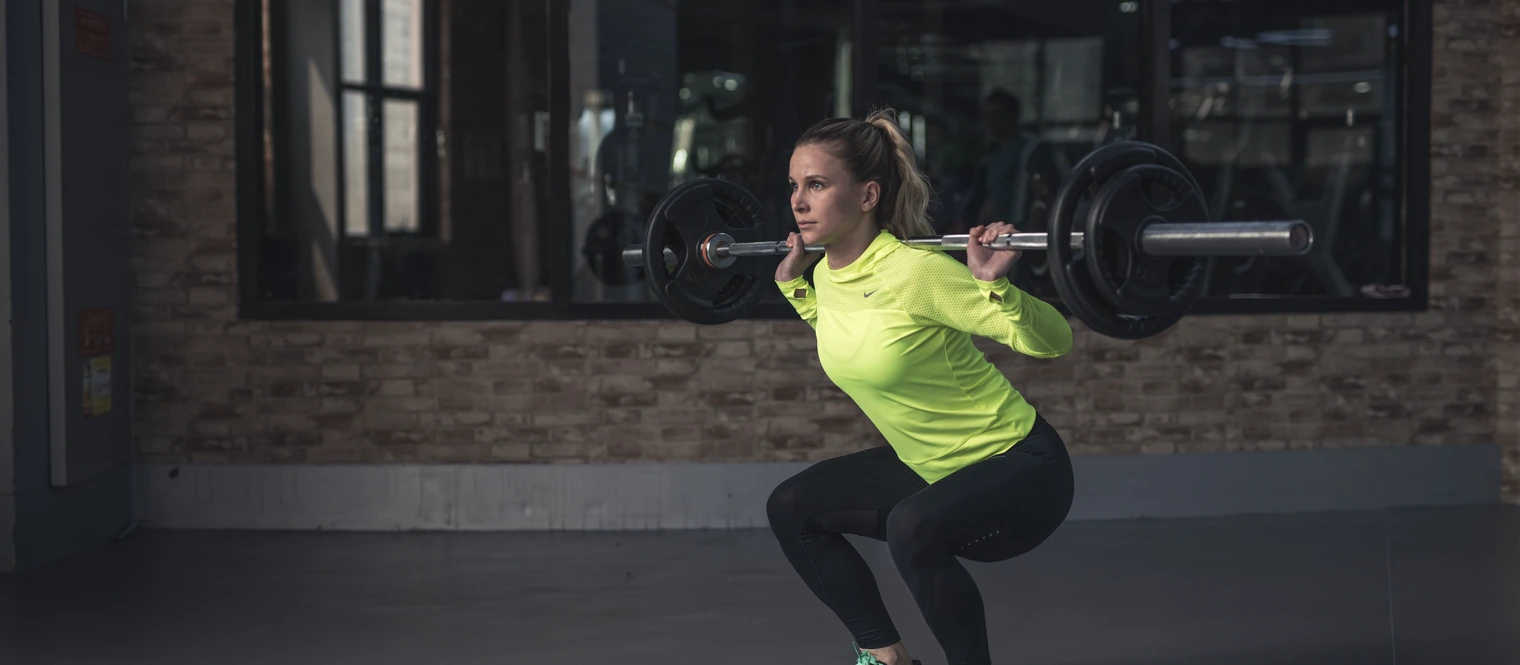
Watch a busy gym for ten minutes and you will see two kinds of rep. One goes all the way down and all the way up. The other stops a hand's width short at the bottom, moves a heavier weight, and looks strong doing it. The shorter rep usually comes with a reason attached: more weight means more muscle, or going deep is hard on the knees.
Both reasons sound sensible, and the evidence does not back either one. How far each rep travels is one of the few choices in a session that changes what you get out of it, and the deep half of the rep turns out to be the part doing most of the work.
Full range builds more, especially in the legs
A 2021 meta-analysis pulled together sixteen training studies that compared full reps with partial ones. Full range of motion produced more strength, and more muscle growth in the lower body, than partial range did1. Both differences were clear.
The picture for the upper body is less settled. A systematic review of the growth studies found the lower body case clear and the upper body research limited and conflicting, with too few studies to draw a strong conclusion2. Conflicting is not the same as a case for partials, though. Our reading is that full reps win in the legs and are the sensible default everywhere else.
The stretch is where the growth seems to live
Not every part of a rep is equal. In one study, untrained women did knee extensions through one of four ranges. The group that trained only the first half of the movement, from deeply bent knees to halfway up, grew more in parts of the thigh than the group that used the whole range3. That first half is where the muscle is at its longest.
Another study had people train one arm with the elbow overhead, which stretches the long head of the triceps, and the other arm by their side. After twelve weeks the overhead arm had grown about one and a half times as much in that long head, while lifting lighter weights the whole time4.
A 2025 systematic review put the studies of this kind together. Training at longer muscle lengths may build more muscle than training at shorter ones, and the authors are careful to call the evidence mixed5. So treat it as a strong lean rather than a law. It still points the same way as everything above: the bottom of the rep, where the muscle is stretched under load, is the part not to skip.
If a rep has to get shorter, take it off the top, never the bottom.
Strength sticks to the range you train
The knee extension study found something else worth knowing. The groups that trained part of the movement got strongest in the part they trained3. Strength is specific to the range it was built in.
That matters when you look at your own numbers. A squat that gains weight while the depth quietly creeps up is not the same lift getting stronger. It is a shorter lift with a bigger number on it, and the strength it builds is strength in the top half.
Is going deep bad for your knees?
This is the worry that keeps most squats shallow, so it deserves a straight answer. A large review of squat biomechanics looked at whether half and quarter squats are safer than deep ones. It found that stress behind the kneecap is highest around a right angle at the knee and drops as the knee bends further, and it concluded that deep squats do not raise the risk of injury to the knee's passive tissues, provided the technique is learned properly and the load goes up gradually6. That review is from 2013, older than we would like, and it has not been overturned.
Two honest limits on that answer. It is about healthy knees, and it is about squats done well. If a joint hurts at the bottom of a movement, that is not the time to push for depth. Training around pain covers what to do instead, and pain that keeps coming back is worth a visit to a doctor or physical therapist.
What to do with this
- Use the full range you can control. Down until the muscle is properly stretched, up until the rep is finished, without bouncing out of the bottom.
- Let the weight fit the range, not the other way round. If the only way to move a load is to shorten the rep, the load is too heavy. Drop it and keep the depth.
- Keep the bottom when you get tired. On the last hard reps it is tempting to stop short at the bottom. That is the part with the most to give you, so it is the last thing to cut.
- Use the same depth every week. Reckoner reads the weight and the reps you log, and a number only means something if the rep behind it is the same rep. If depth drifts, your progress is partly an illusion.
- Train the range you have. If your hips or shoulders do not reach the textbook position yet, go as deep as you can with good form and let it improve. A range you own beats one you fake.
All the way down, under control, every rep, every week.
For the rest of what good form looks like, good lifting form, and why it matters goes through it lift by lift.