 reckoner
Supersets have a reputation as the thing you do when you are in a hurry. Two lifts back to back, no rest in the middle, out of the gym sooner, and a suspicion that you must have paid for it somewhere.
Pooled across nineteen trials and 313 lifters, you did not. Supersets cut training time by about 37 per cent and came back level on maximal strength and on muscle size. What changed was how the work felt: perceived effort was higher, blood lactate was higher, and how recovered people felt afterwards did not move1.
What a superset is here
Two movements trained back to back with no rest between them, then one rest before you go round again. Three or four of them is a circuit. It is the same arrangement and the member count is the only thing that changes, including which word the screen says. Four is the ceiling, because past four the first movement has cooled off before the round comes back to it and you are doing a different kind of session.
What does not change is the training. Same sets, same reps, same loads, in the same order they were already in. A superset is a decision about your time rather than about your programme.
Making one takes two taps
It lives on the week, on the day itself. Open a day for editing and every lift name becomes a tap target, with one line above them saying so.
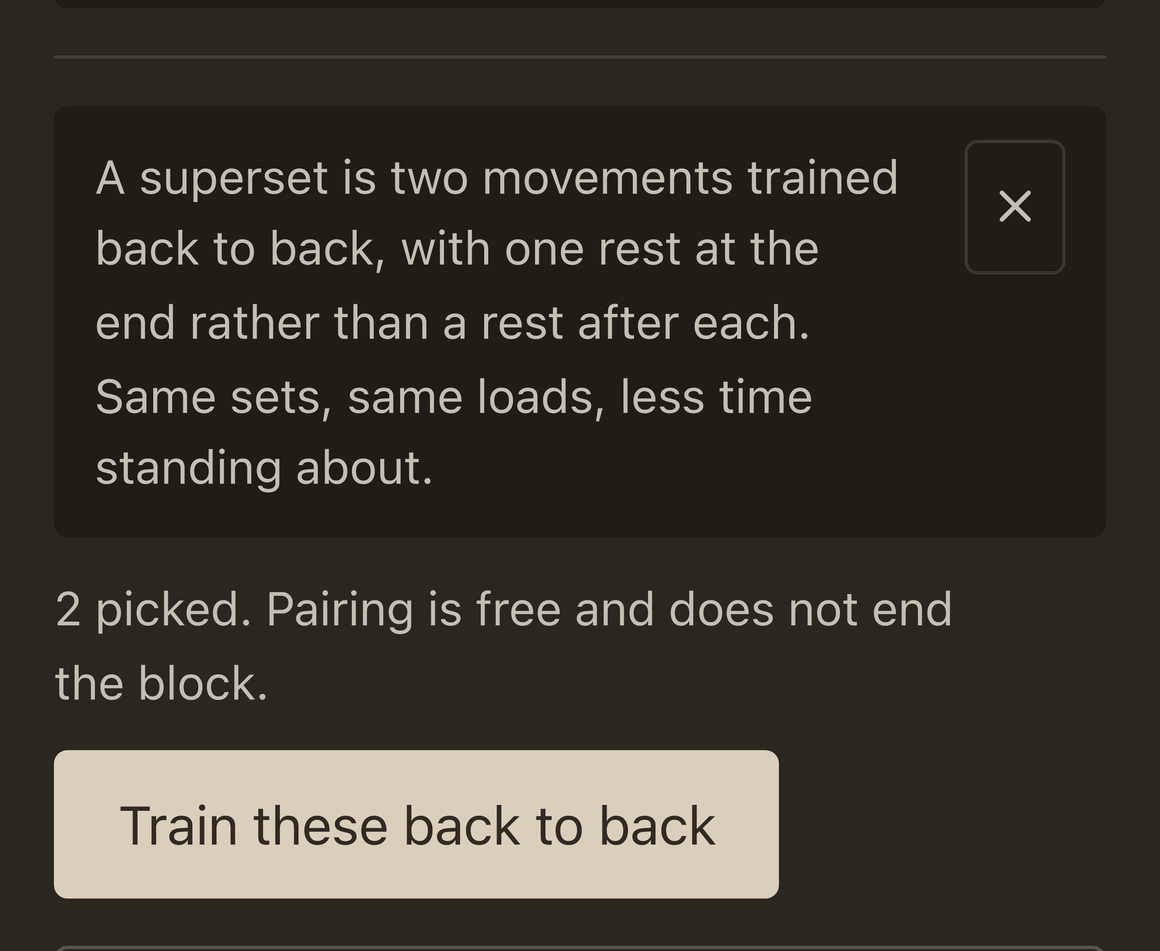
Open the day
On the week, the pencil on any day of the plan you are running opens it for editing. A day you are still drafting in the builder does not offer this, because it is not in your plan yet.
Tap two lifts that sit next to each other
Tapping a lift's name picks it. A round is a stretch of the day rather than a set of favourites, so the members have to be neighbours in the order you already train them.
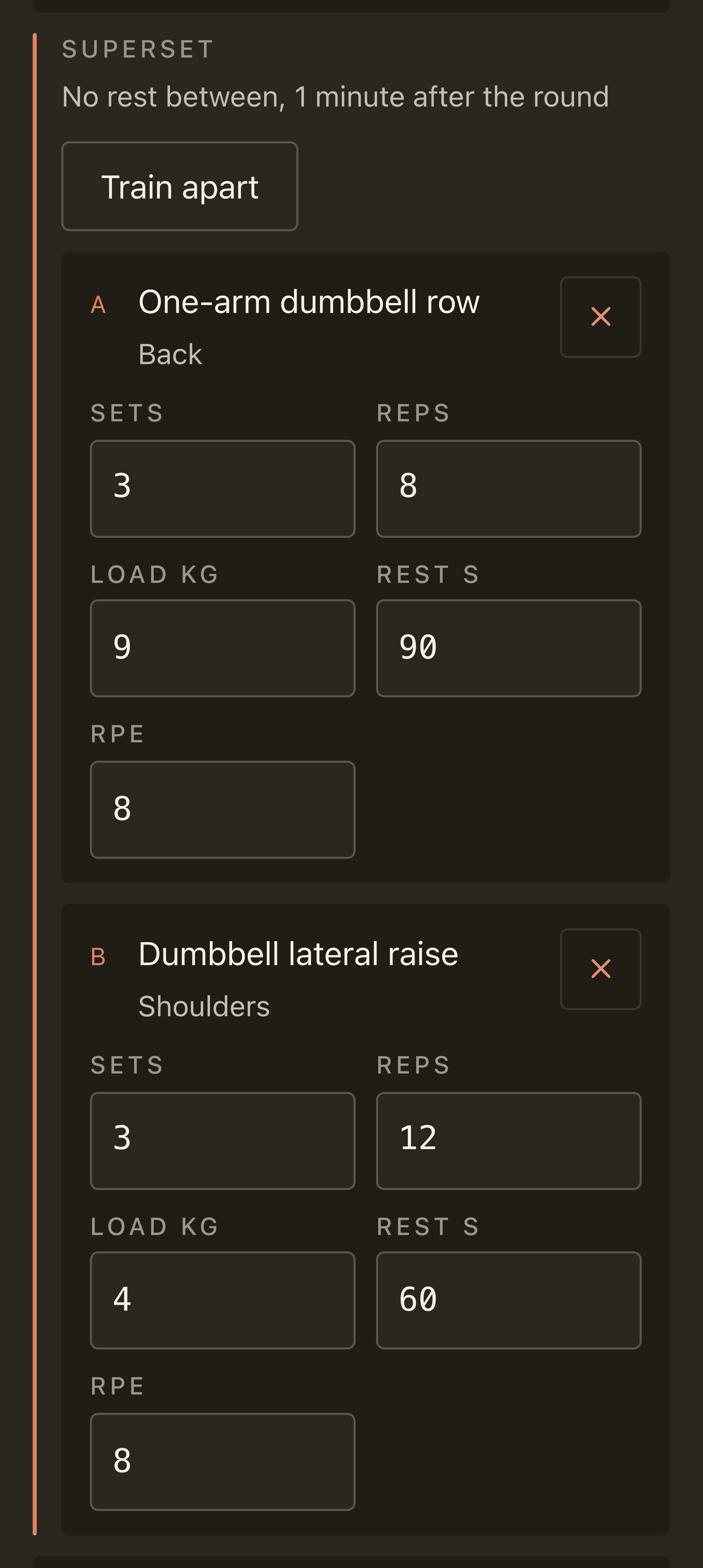
Press the button
The day saves exactly as it stands, and the arrangement is on your watch the next time it syncs. Your wrist then takes you through one set of each in turn and holds the full rest for the end of the round.
Undo it whenever you like
Train apart puts them back to two ordinary lifts. Neither direction costs you anything and neither ends the block.
The five arrangements it will not accept
The rules are checked when the day is saved, not while you are tapping, so you can pick anything and find out. A refusal names one problem rather than listing five, because the day is refused whole either way and one thing to fix is a thing you can actually go and fix.
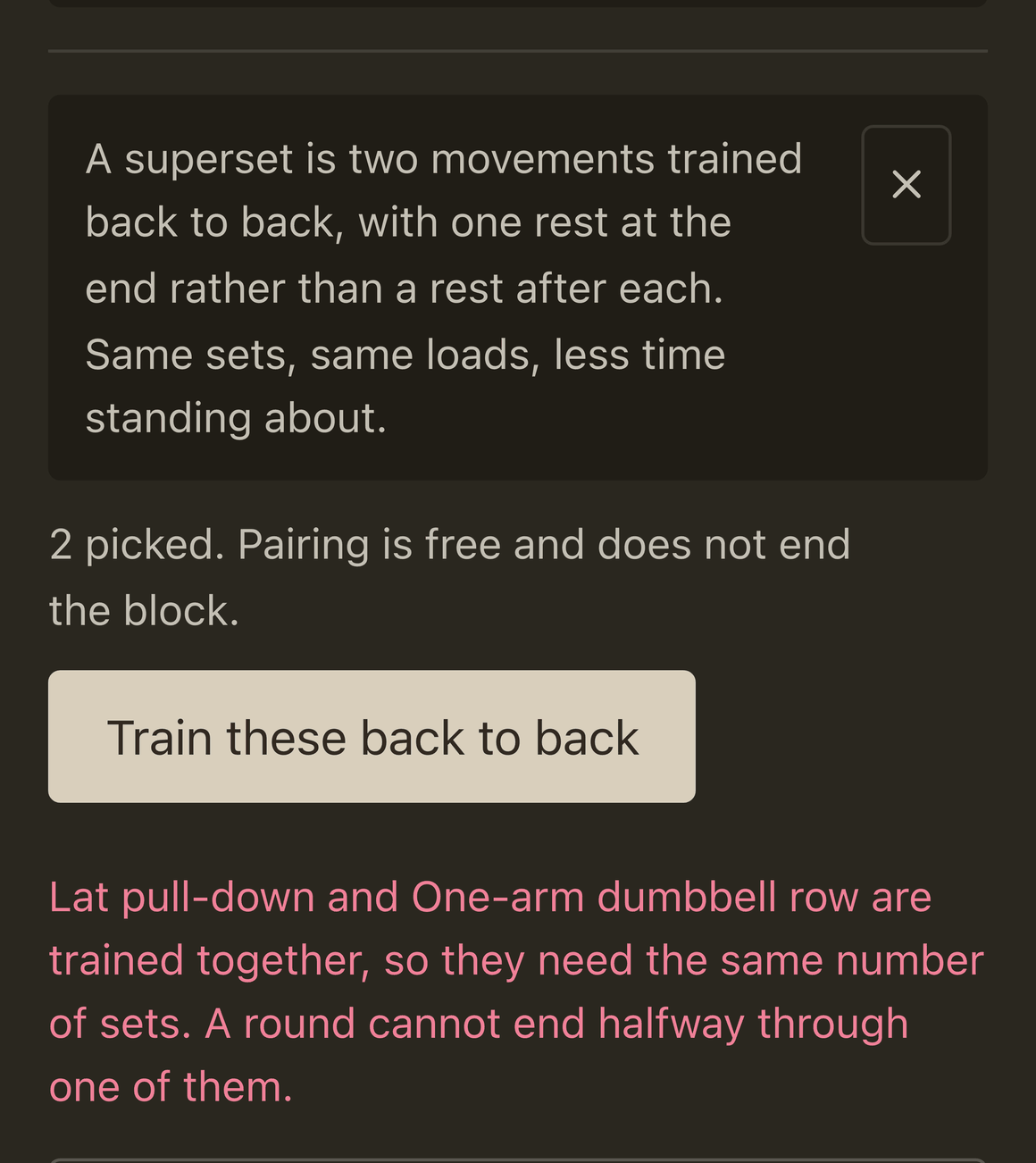
They have to sit next to each other
Two lifts with something between them are not a round, and Reckoner will not quietly reorder your day to make them one.
Four members at most
Past four, the first movement has cooled off by the time the round comes back to it, and the arrangement has stopped doing what it is for.
The same number of sets
Pairing your four-set press with your three-set row is the natural first attempt, and this is the rule that stops it. A round cannot end halfway through one of its members.
One main lift, not two
Training two heavy compounds straight after each other buries the second, which is the opposite of what a main lift is for. Pairing a main lift with something light is a different matter: in a crossover trial, adding an easy antagonist movement between bench press sets left bar speed on the bench unchanged2.
Not two lifts wanting the same station
One rack holds one bar at one weight and one cable tower has one pin, and a superset has no rest in it to reload them in. Dumbbells are exempt, because reaching for a second pair is the commonest superset there is.
A circuit is the same thing with more of it
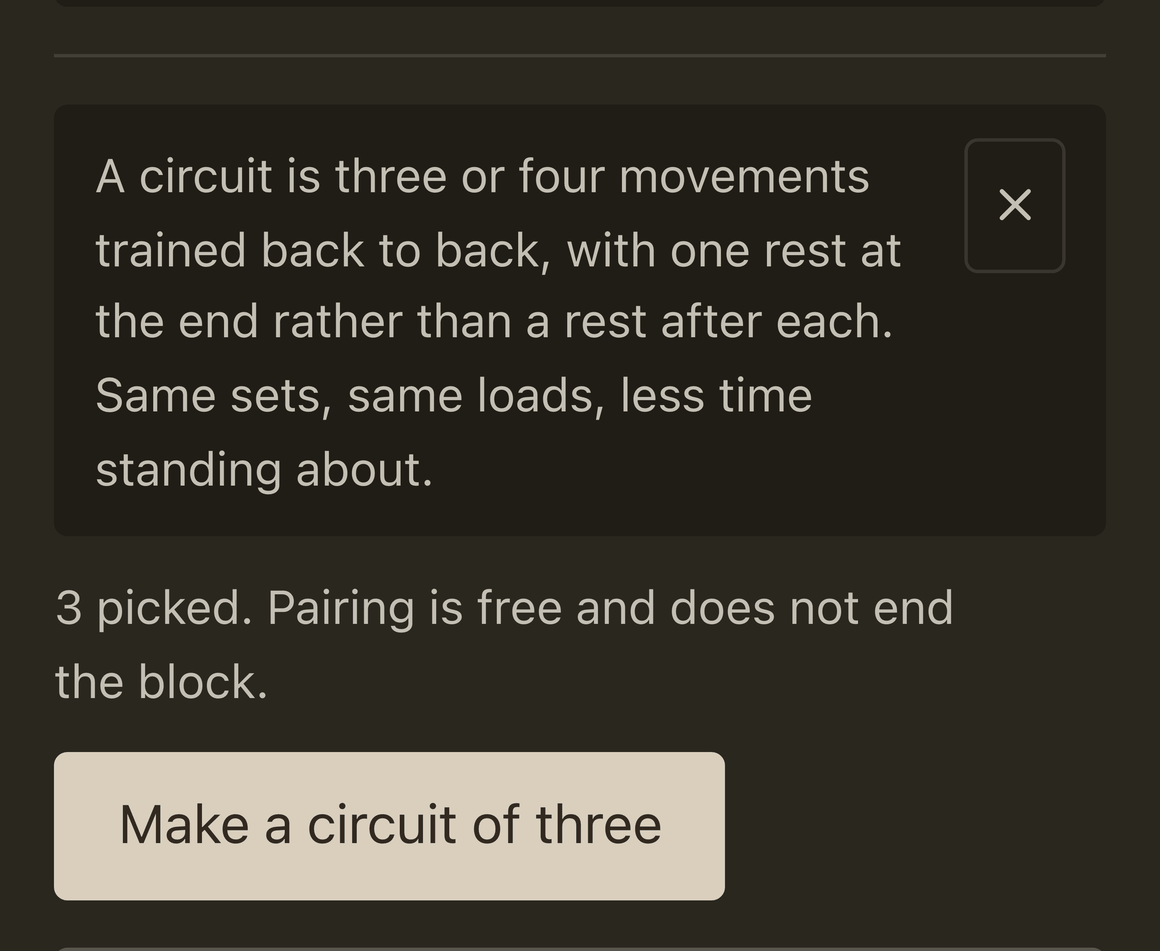
Pick a third neighbour and the button changes its mind about what you are building. Nothing else does: the rest still falls at the end of the round, every member is still scored on its own, and the ceiling is still four.
Pair the lifts you are not trying to push.
What pairing does to next week
This is where it matters, and it is worth knowing before you pair anything. Here is a lifter finishing the range comfortably every week, on a lift they have paired with something else.
| Week | Prescribed | What it did |
|---|---|---|
| 1 | 4 x 6 at 60 kg | More reps 6 → 7 repsYou finished every set at RPE 7, with room left in the range, so the reps climb before the load does. |
| 2 | 4 x 7 at 60 kg | More reps 7 → 8 repsYou finished every set at RPE 7, with room left in the range, so the reps climb before the load does. |
| 3 | 4 x 8 at 60 kg | More reps 8 → 9 repsYou finished every set at RPE 7, with room left in the range, so the reps climb before the load does. |
| 4 | 4 x 9 at 60 kg | More reps 9 → 10 repsYou finished every set at RPE 7, with room left in the range, so the reps climb before the load does. |
| 5 | 4 x 10 at 60 kg | Deload 40% of sets offFive weeks of building, then one week lighter. About 40% of the sets come off. The load holds and your reps stay where you earned them, so you keep the strength and lose the fatigue. |
| 6 | 2 x 10 at 60 kg | Load up 60 kg → 62.5 kgYou hit the top of the range at RPE 7, so the bar goes up 2.5 kg to 62.5 kg. The weight went up, so the reps come down to eight. You are now working 6 to 10. The lighter week is over, so this is back to four sets. |
Real engine output, not an illustration. Every row was produced by running the engine itself when this page was generated.
Now open how Reckoner adds weight and compare its six weeks. Not one number is different. Nothing in the engine asks whether a lift was trained on its own, so while you are finishing your range, pairing changes nothing at all.
The difference shows up when the lift stops moving. Here is the harder week: the top of the range every time, two reps short of it, at an effort over target, on a paired lift.
| Week | Prescribed | What it did |
|---|---|---|
| 1 | 4 x 10 at 60 kg | Holding steady 60 kgThe sets came up short of the reps this lift was asked for, at RPE 9. The same week is prescribed again, so you can finish it before anything is added. |
| 2 | 4 x 10 at 60 kg | Backed off 4 → 2 setsThis lift has been over what it is asked for two trained weeks running, so Reckoner takes about 40% of its sets off for one week rather than waiting for the block to do it. The load holds and your reps stay where you earned them, so you keep the strength and lose the fatigue. Nothing else in your week moves. You have also been over what this lift is asked for two trained weeks running, so the rest between sets goes up from 150 seconds to 210 seconds. Nothing else about the lift moves. |
| 3 | 2 x 10 at 60 kg | Holding steady 60 kgThe sets came up short of the reps this lift was asked for, at RPE 9. The same week is prescribed again, so you can finish it before anything is added. The lighter week is over, so this is back to four sets. |
| 4 | 4 x 10 at 60 kg | Backed off 10 → 9 repsRPE 9 again, and this lift has been over its target effort for two trained weeks in a row. The rep target comes down from ten to nine and the weight stays at 60 kg, so you can finish every set clean. |
| 5 | 4 x 9 at 60 kg | Deload 40% of sets offFive weeks of building, then one week lighter. About 40% of the sets come off. The load holds and your reps stay where you earned them, so you keep the strength and lose the fatigue. |
| 6 | 2 x 9 at 60 kg | Backed off 9 → 8 repsRPE 9 again, and this lift has been over its target effort for two trained weeks in a row. The rep target comes down from nine to eight and the weight stays at 60 kg, so you can finish every set clean. |
| 7 | 4 x 8 at 60 kg | Holding steady 60 kgThe sets came up short of the reps this lift was asked for, at RPE 9. The same week is prescribed again, so you can finish it before anything is added. |
| 8 | 4 x 8 at 60 kg | Backed off 4 → 2 setsThis lift has been over what it is asked for two trained weeks running, so Reckoner takes about 40% of its sets off for one week rather than waiting for the block to do it. The load holds and your reps stay where you earned them, so you keep the strength and lose the fatigue. Nothing else in your week moves. |
Real engine output, not an illustration. Every row was produced by running the engine itself when this page was generated.
The load holds, and it goes on holding. What does move is the recovery: the rest between sets goes up, and then the rep target comes down a rung at a time, because relief reads the effort you reported against what the lift is asked for and that reading is not a stall count. What a paired lift is never offered is the reset or a different movement, because a lane trained in a round has its stall count frozen.
That is deliberate, and it is the trade. A superset really is harder for the same work, so a higher effort is a true answer rather than a warning, and a load standing still is the right prescription rather than a plateau. Left counting, the engine would eventually offer to replace a good lift whose only problem was that you paired it. The cost of not counting is that it also stops telling you when that lift has genuinely run out of road. Relief is deliberately outside that trade: it is a safety valve, and pairing a lift is not a reason to withhold one.
What to pair, and what to leave alone
Pair the accessories
The back half of the day, the lifts you are maintaining rather than chasing. That is where the time is, where the rules will let you, and where a frozen stall count costs you nothing you wanted.
Leave the lift you are chasing on its own
If there is one movement this block is about, train it by itself. You want the engine watching that load, and you do not want it going second in a round.
Unpair when you want to know
A paired lift that has sat at the same weight for a while is telling you nothing about whether that weight is still right. Train apart for a few weeks and the count picks up where it stopped.