 reckoner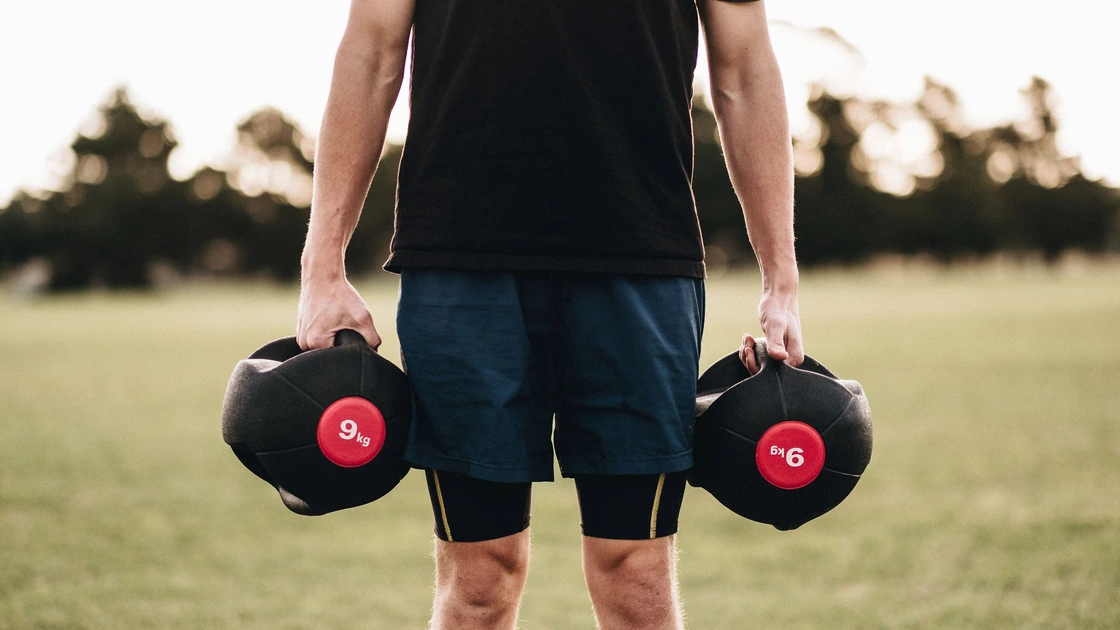
Do the farmer's carry if you want the simplest start and the heaviest weights. Do the suitcase carry if you want your trunk to fight a sideways pull. Do the front rack carry if your grip gives out before anything else does. All three are the same idea: pick something heavy up, stand tall, and walk without letting it change your shape.
Why carry anything at all
Carries ask something of you that lifting off the floor or pressing overhead does not. A study of strongman events measured the trunk and hip muscles during carries and lifts, and found that the carrying events challenged different abilities than the lifting events, which led the authors to suggest loaded carrying as an addition to an ordinary lifting program1. It is an older study and a laboratory one, and it measured what carries ask of you rather than what training with them builds.
The three, and what each one asks
The farmer's carry is a weight in each hand and a walk. There is almost nothing to learn, and it is the one you can load heaviest. For most people the grip gives out first.
The suitcase carry is one weight in one hand. The load pulls you sideways and the muscles down your other side spend the walk refusing to bend. That lopsided load is the point of the exercise, and it is also why it costs your low back more than the same weight split across two hands. In a study of people carrying buckets, one bucket in one hand loaded the low back more than the same total weight split between two hands, and more than twice that weight carried as one in each hand2. Load it lighter than you would a farmer's carry, and build it up slowly.
The front rack carry is two kettlebells held on your chest, elbows in. The weight wants to pull you into a backward lean, and refusing that lean is the work. It asks the most of your upper back and the least of your grip, which makes it the one to choose when your hands are the thing stopping your farmer's carry.
How to do any of them well
- Stand tall before you take a step. Ribs down, shoulders level, eyes ahead.
- Walk at a normal pace. Short, smooth steps, with no rushing to get it over with.
- Stop when your shape goes, not when your will does. If you are leaning, twisting or shrugging to hold on, the set is over.
- Put it down the way you picked it up. Bend your knees and set it down. Do not drop it from your hip.
What Reckoner does with a carry
A carry in Reckoner is prescribed in seconds, not reps. When you carry the full time, the next one is a little longer. When the time reaches the top of its window, the weight goes up, if your gym has a heavier one, and the time drops back to the start of the window, because given the choice between heavier and longer, a loaded lift gets heavier. If you come up short of the time, the same carry is prescribed again at the same weight.