 reckoner
Arnold press
A seated dumbbell press that starts with the palms facing you and turns them out on the way up. The rotation is the reason people do it and it is also the reason the weight is lighter, because the turn happens under load in the part of the press you are weakest in.
Rotate the palms out, ribs down.
- Pattern
- Vertical push
- Trains
- Front delts, triceps, side delts
- Kit
- Dumbbell, bench
- Loading
- A weight you choose
- Reckoner prescribes
- 4 sets of 6 to 10 reps at RPE 8
- Progression step
- 2 kg once the top of the range is clean
- Skill
- Technical
- Recovery cost
- Moderate
- Not prescribed if you have declared
- Shoulder, elbow
Muscles worked
How to do it
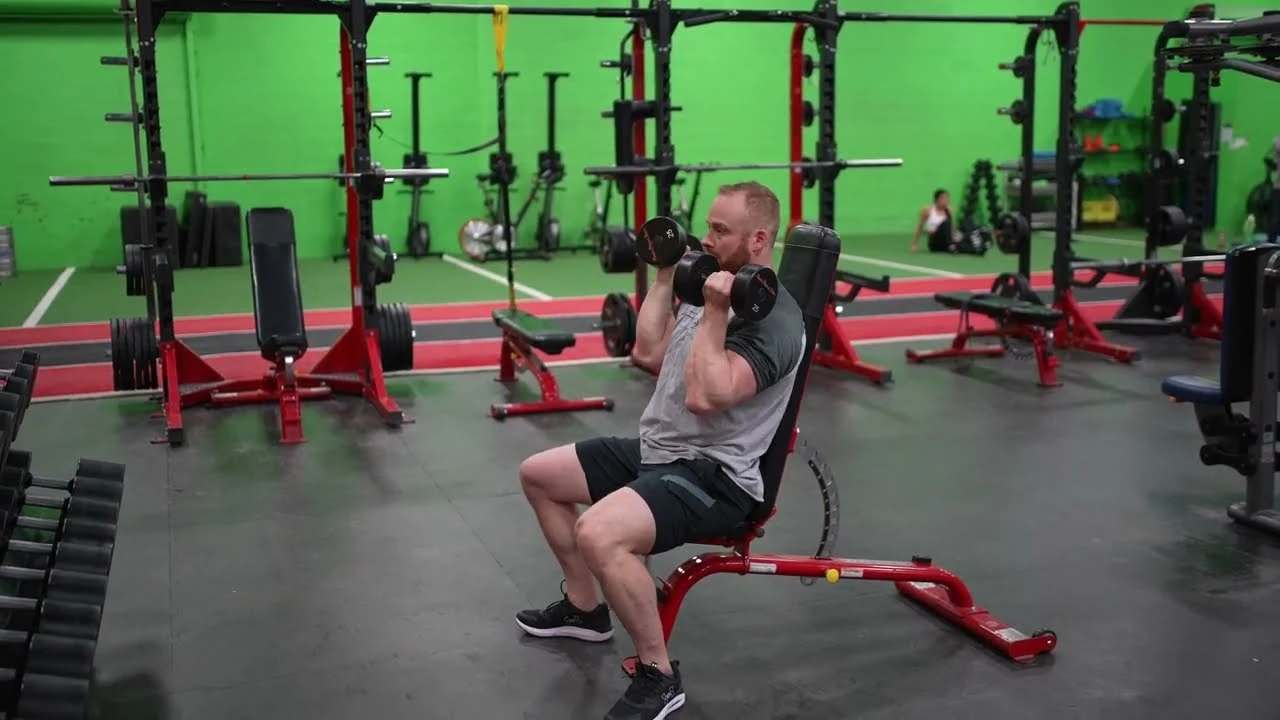
Set up as you would for any seated dumbbell press
Backrest upright or one notch off it, feet flat and pushing, shoulder blades set into the pad, bells kicked up off the thighs one at a time.
Start at chest height with the palms facing you
Elbows tucked in front of the ribs, forearms roughly vertical, bells close together in front of your collarbones. This is the position the rotation starts from, so it is worth getting right before the weight matters.
Press and rotate as one movement
As the bells rise the elbows travel out and the palms turn away from you, so that by the time your arms are half straight the palms already face forward. One motion, not a turn and then a press.
Reverse it exactly
Come down the same way: the palms turn back toward you as the bells drop, and you finish where you started with the elbows in front of the ribs. Most people do a neat Arnold press upward and an ordinary dumbbell press downward.
What goes wrong
Rotating first and pressing second
The palms flip out at the bottom, and from there it is a seated dumbbell press with a fiddly start. If you cannot blend the two, the load is too heavy to steer and the rotation is the first thing that gets dropped.
Bringing your ordinary press weight to it
You are asking the shoulder to rotate a loaded arm through the weakest part of its own range. The library gives this movement its own record for that reason, and the fact block above prints the step it climbs in.
Letting the elbows drift behind the body at the bottom
Chasing depth by pulling the bells back past the plane of your torso puts the front of the shoulder at the end of its range holding a weight. In front of the ribs is the bottom.
How Reckoner progresses this lift
Six weeks of this lift, from 14 kg, run through the real engine. Nothing below was typed in: the prescription, the decision and the sentence beside it all come from the same code that writes your week.
| Week | Prescribed | What it did |
|---|---|---|
| 1 | 4 x 6 at 14 kg | More reps 6 → 7 repsYou finished every set with three reps left in the tank (RPE 7) and room left in the range, so the reps climb before the load does. |
| 2 | 4 x 7 at 14 kg | More reps 7 → 8 repsYou finished every set with three reps left in the tank (RPE 7) and room left in the range, so the reps climb before the load does. |
| 3 | 4 x 8 at 14 kg | More reps 8 → 9 repsYou finished every set with three reps left in the tank (RPE 7) and room left in the range, so the reps climb before the load does. |
| 4 | 4 x 9 at 14 kg | More reps 9 → 10 repsYou finished every set with three reps left in the tank (RPE 7) and room left in the range, so the reps climb before the load does. |
| 5 | 4 x 10 at 14 kg | Deload 40% of sets offFive weeks of building, then one week lighter. About 40% of the sets come off. The load holds and your reps stay where you earned them, so you keep the strength and lose the fatigue. |
| 6 | 2 x 10 at 14 kg | Load up 14 kg → 16 kgYou hit the top of the range with three reps left in the tank (RPE 7), so the dumbbell weight goes up 2 kg to 16 kg. The weight went up, so the reps come down to six. You are now working 6 to 10. The lighter week is over, so this is back to four sets. |
Real engine output, not an illustration. Every row was produced by running the engine itself when this page was generated.
The full rule, and why the reps move before the load does, is in how Reckoner decides to add weight.
Questions people ask
Does the rotation actually do anything?
Nobody knows, and that is the honest answer. A search of the medical literature returns no study of the Arnold press at all: nothing comparing it to an ordinary dumbbell press for muscle activity, for strength or for size. Every claim you have read about what the turn adds, this page included, is reasoning rather than a result.
What is known about the press underneath it?
Quite a lot, because it is a seated dumbbell press. Seated, dumbbells produced about eleven per cent more front deltoid activity than a barbell, and standing, people pressed about seven per cent less with dumbbells than with a bar1. And the implement matters even when the weight is identical: at one fixed load, dumbbell, kettlebell and bottom-up kettlebell overhead presses each produced a different pattern of activity around the shoulder2. So what you hold changes the lift. Whether this particular twist is worth the weight it costs is untested.
What does Reckoner do when this lift stalls?
It eases the load first and lets you rebuild toward the weight you were stuck at. If the same wall comes back it offers you one of the other seated presses in the library instead, because by then the cheaper answer, the reset, has already been tried.
Similar movements
Reckoner eases the load first when this lift stalls, and offers one of these only if it stalls again after that. A lift already as light as your kit goes has no load left to ease, so the offer comes straight away. Each of them has a page.
Sources
- Saeterbakken and Fimland, Journal of Strength and Conditioning Research, 2013. Effects of body position and loading modality on muscle activity and strength in shoulder presses fifteen men, with anterior deltoid activity about eleven per cent lower for the seated barbell shoulder press than the seated dumbbell press, and a standing dumbbell one rep max about seven per cent below the standing barbell's
- Busch, Sarver and Comstock, Journal of Bodywork and Movement Therapies, 2024. Electromyographic analysis of shoulder-complex muscles performing overhead presses with dumbbell, kettlebell, and bottom-up kettlebell shoulder-complex muscle activity differing between dumbbell, kettlebell and bottom-up kettlebell overhead presses performed at one identical load