 reckoner
Seated dumbbell shoulder press
The overhead press with a back behind you and one weight per hand. The bench takes the balancing job away from your trunk, which is what lets you press more. Each shoulder still works on its own, which is what stops it being a barbell press.
Ribs down, don't arch the back.
- Pattern
- Vertical push
- Trains
- Front delts, triceps
- Kit
- Dumbbell, bench
- Loading
- A weight you choose
- Reckoner prescribes
- 4 sets of 6 to 10 reps at RPE 8
- Progression step
- 2 kg once the top of the range is clean
- Skill
- Some technique
- Recovery cost
- Moderate
- Not prescribed if you have declared
- Shoulder, elbow
Muscles worked
How to do it
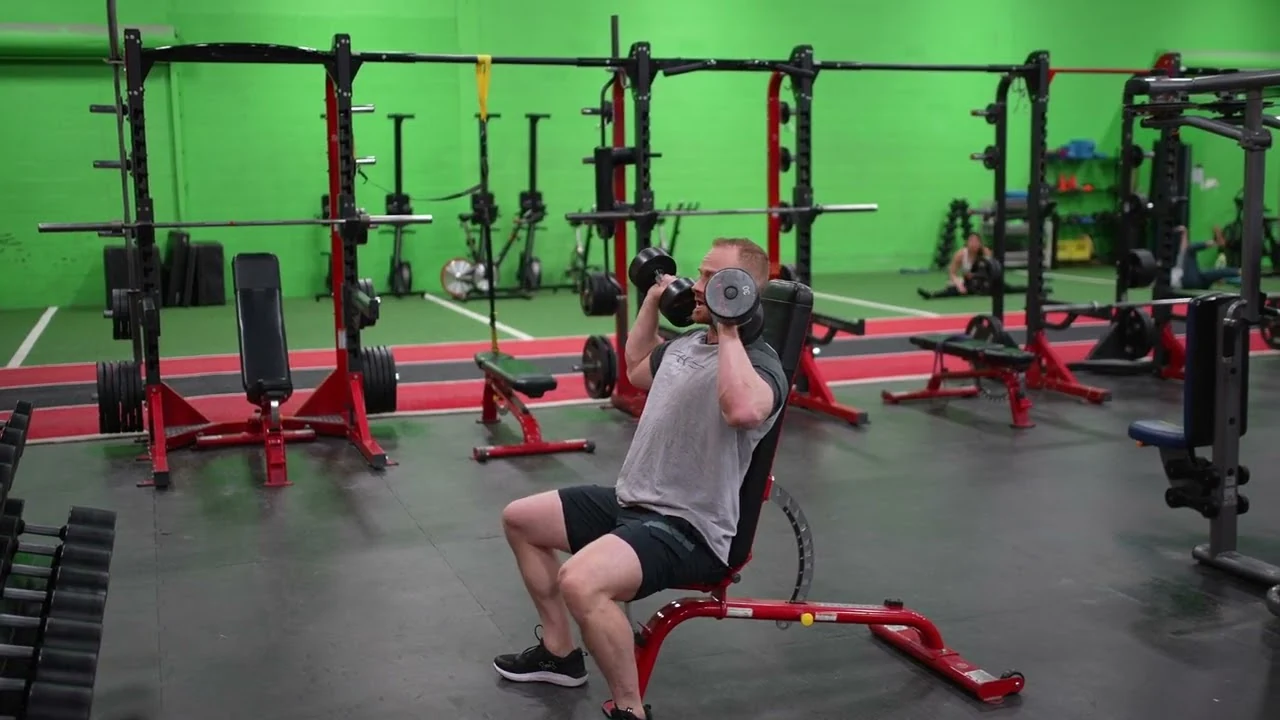
Set the backrest just off vertical
Upright, or one notch back from it. Any further and you are inclining, and the further you tilt a press the more of it the chest takes and the less it is a shoulder press.
Get the bells up without pressing them up
Sit with one on each thigh, then kick each one up to the shoulder with the knee as you lie back into the pad. Curling a heavy pair into position is a set of an exercise you did not choose.
Start at ear height with the elbows in front
Palms forward, elbows a little in front of the body rather than flat out to the sides. That is where the shoulder presses from without the joint hunting for room.
Press up and slightly in
The bells travel toward each other as they rise and finish over the shoulders, close but not touching. Then lower under control back to ear height. Clacking them together at the top is a rep you stopped controlling.
What goes wrong
Arching off the backrest to move more weight
Your chest comes up, the bench effectively tilts and you have turned it into an incline press. That is not a small change: the flatter the press, the more of it the chest takes, and a flat bench press produces roughly the same activity in the front of the shoulder as it does in the chest itself1.
Bringing your barbell numbers to it
Two bells are lighter than one bar for the same person, by around seven per cent standing2, because nothing is tying the two sides together. That is a fact about the implement, not a report on your week.
Stopping the descent at the top of your head
Half a rep repeated fifty times is still half a rep. Ear height is the bottom, and if you cannot get there without the shoulder complaining, the load is the thing to change, not the range.
How Reckoner progresses this lift
Six weeks of this lift, from 16 kg, run through the real engine. Nothing below was typed in: the prescription, the decision and the sentence beside it all come from the same code that writes your week.
| Week | Prescribed | What it did |
|---|---|---|
| 1 | 4 x 6 at 16 kg | More reps 6 → 7 repsYou finished every set with three reps left in the tank (RPE 7) and room left in the range, so the reps climb before the load does. |
| 2 | 4 x 7 at 16 kg | More reps 7 → 8 repsYou finished every set with three reps left in the tank (RPE 7) and room left in the range, so the reps climb before the load does. |
| 3 | 4 x 8 at 16 kg | More reps 8 → 9 repsYou finished every set with three reps left in the tank (RPE 7) and room left in the range, so the reps climb before the load does. |
| 4 | 4 x 9 at 16 kg | More reps 9 → 10 repsYou finished every set with three reps left in the tank (RPE 7) and room left in the range, so the reps climb before the load does. |
| 5 | 4 x 10 at 16 kg | Deload 40% of sets offFive weeks of building, then one week lighter. About 40% of the sets come off. The load holds and your reps stay where you earned them, so you keep the strength and lose the fatigue. |
| 6 | 2 x 10 at 16 kg | Load up 16 kg → 18 kgYou hit the top of the range with three reps left in the tank (RPE 7), so the dumbbell weight goes up 2 kg to 18 kg. The weight went up, so the reps come down to six. You are now working 6 to 10. The lighter week is over, so this is back to four sets. |
Real engine output, not an illustration. Every row was produced by running the engine itself when this page was generated.
The full rule, and why the reps move before the load does, is in how Reckoner decides to add weight.
Questions people ask
Seated or standing?
Seated moves more weight. Standing works more muscle. In the same lifters the seated dumbbell press came out about ten per cent heavier than the standing one, while standing produced the higher deltoid activity of the two2 and the seated version produced about eighty one per cent less rectus abdominis activity3. Both are in the library, so you do not have to choose once and forever.
Dumbbells or a barbell?
Dumbbells ask more of each shoulder. Front deltoid activity was about eleven per cent higher with dumbbells than with a barbell seated, and about fifteen per cent higher standing, at a load around seven per cent lighter2. The barbell asks more of the arms: biceps activity was about a third higher with the bar seated2. Neither is the better lift. They are two questions.
What does Reckoner do when this lift stalls?
It eases the load first and lets you rebuild toward the weight you were stuck at. Only if the same wall comes back does it offer you one of the other seated presses in the library, because the lift you swap to starts on its own record rather than carrying this one's progress, and a reset costs you two weeks.
Similar movements
Reckoner eases the load first when this lift stalls, and offers one of these only if it stalls again after that. A lift already as light as your kit goes has no load left to ease, so the offer comes straight away. Each of them has a page.
Sources
- Rodríguez-Ridao and colleagues, International Journal of Environmental Research and Public Health, 2020. Effect of Five Bench Inclinations on the Electromyographic Activity of the Pectoralis Major, Anterior Deltoid, and Triceps Brachii during the Bench Press Exercise the horizontal bench press producing similar electromyographic activity in the pectoralis major and the anterior deltoid
- Saeterbakken and Fimland, Journal of Strength and Conditioning Research, 2013. Effects of body position and loading modality on muscle activity and strength in shoulder presses anterior deltoid activity being about eleven per cent lower for the seated barbell press than the seated dumbbell press and about fifteen per cent lower standing, biceps activity being about a third greater with the seated barbell, and one repetition maximum being about seven per cent lower for standing dumbbells than the standing barbell and about ten per cent lower than seated dumbbells
- Saeterbakken and Fimland, European Journal of Applied Physiology, 2012. Muscle activity of the core during bilateral, unilateral, seated and standing resistance exercise rectus abdominis activity being about eighty one per cent lower in the seated bilateral dumbbell shoulder press than in the standing version