 reckoner
Barbell bench press
The heaviest press most lifters own. It trains the chest, the front of the shoulder and the triceps in one movement, and it is usually the first lift on a push day because everything after it is easier when it is done.
Elbows tucked, lower to the chest.
- Pattern
- Horizontal push
- Trains
- Chest, triceps, front delts
- Kit
- Barbell, bench, rack
- Loading
- A weight you choose
- Reckoner prescribes
- 4 sets of 6 to 10 reps at RPE 8
- Progression step
- 2.5 kg once the top of the range is clean
- Bar
- 20 kg
- Skill
- Technical
- Recovery cost
- High
- Not prescribed if you have declared
- Shoulder, wrist, elbow
Muscles worked
How to do it
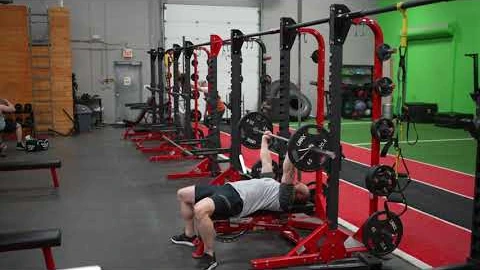
Set the bench
Lie down with your eyes under the bar. Feet flat on the floor, wide enough that your knees sit over your heels, and keep your legs pushing into the ground for the whole set.
Set the back
Pull your shoulder blades together and down into the bench, then hold them there. This is the position you press from, and it is the position you have to still be in on the last rep.
Find the groove
With your arms straight the bar starts over your shoulders. Lower it under control to the lower chest with your elbows at roughly sixty degrees, not flared out to the sides.
Press
Drive the bar back up and slightly toward your face, so it finishes over the shoulder joint. If the bar drifts toward your feet on the way up instead, the weight is winning.
What goes wrong
Bouncing the bar off the chest
The bounce does the work instead of the chest, so the number you log is not a number you own. Touch, pause for an instant, then press.
Flaring the elbows out to ninety degrees
It shortens the range and puts the shoulder in the worst position it can be in under load. Tuck to about sixty degrees and the press usually gets stronger. If your shoulder still hurts, see a doctor or physical therapist.
Letting the shoulder blades unset on the last rep
That is the rep people get hurt on. Rack it while your back is still where you put it, and log the set you actually finished.
How Reckoner progresses this lift
Six weeks of this lift, from 60 kg, run through the real engine. Nothing below was typed in: the prescription, the decision and the sentence beside it all come from the same code that writes your week.
| Week | Prescribed | What it did |
|---|---|---|
| 1 | 4 x 6 at 60 kg | First week Where the run starts. Nothing is logged yet, so nothing has changed. |
| 2 | 4 x 7 at 60 kg | More reps 6 → 7 repsYou finished every set with three reps left in the tank (RPE 7) and room left in the range, so the reps climb before the load does. |
| 3 | 4 x 8 at 60 kg | More reps 7 → 8 repsYou finished every set with three reps left in the tank (RPE 7) and room left in the range, so the reps climb before the load does. |
| 4 | 4 x 9 at 60 kg | More reps 8 → 9 repsYou finished every set with three reps left in the tank (RPE 7) and room left in the range, so the reps climb before the load does. |
| 5 | 4 x 10 at 60 kg | More reps 9 → 10 repsYou finished every set with three reps left in the tank (RPE 7) and room left in the range, so the reps climb before the load does. |
| 6 | 2 x 10 at 60 kg | Deload 4 → 2 setsFive weeks of building, then one week lighter. About 40% of the sets come off. The load holds and your reps stay where you earned them, so you keep the strength and lose the fatigue. |
| Next | 4 x 8 at 62.5 kg | Load up 60 kg → 62.5 kgYou earned this before the lighter week. The lighter week was for recovery, not a test, so the rise waited for it to end. Now the bar goes up to 62.5 kg. The lighter week is over, so this is back to four sets. |
Real engine output, not an illustration. Every row was produced by running the engine itself when this page was generated.
The full rule, and why the reps move before the load does, is in how Reckoner decides to add weight.
Questions people ask
How often should I bench press?
Twice a week suits most lifters, with a day or two of rest between the two. A 2016 review of ten training studies found more muscle growth when a muscle group was trained more often in a week, and its authors concluded that twice a week beat once1. A larger 2019 review found that gap closed once the weekly sets were equal2, so twice a week is a sound way to spread your sets rather than a rule. How often it shows up in your Reckoner week follows the days you train and the split you chose.
How much should I be lifting?
There is no number that fits everybody. Reckoner sets your best set against your bodyweight and shows you where it sits on a ladder of strength standards, which is a yardstick rather than a target.
Is the bench press safe for my shoulders?
For most people, with the shoulder blades set and the elbows tucked. Tell Reckoner your shoulder is a problem and it will not prescribe this lift at all: it picks a press your shoulder tolerates instead.
Similar movements
Reckoner eases the load first when this lift stalls, and offers one of these only if it stalls again after that. A lift already as light as your kit goes has no load left to ease, so the offer comes straight away. Each of them has a page.
Sources
- Schoenfeld, Ogborn and Krieger, Sports Medicine, 2016. Effects of Resistance Training Frequency on Measures of Muscle Hypertrophy: A Systematic Review and Meta-Analysis ten training studies, higher weekly frequency associated with a larger hypertrophy effect size (0.49 against 0.30), and the authors concluding that training a muscle group twice a week promotes superior hypertrophic outcomes to once a week. PMID 27102172, DOI 10.1007/s40279-016-0543-8
- Schoenfeld, Grgic and Krieger, Journal of Sports Sciences, 2019. How many times per week should a muscle be trained to maximize muscle hypertrophy? A systematic review and meta-analysis of studies examining the effects of resistance training frequency twenty-five studies, no significant difference between higher and lower frequency once weekly volume was equated, and a modest effect favoring higher frequency where it was not. PMID 30558493, DOI 10.1080/02640414.2018.1555906