 reckoner
Dumbbell floor press
The press with a bench made of floor. Your upper arms stop when your elbows land, so the shoulder never travels below your torso, and that is the one thing this movement is for. It is also the only press in the library that needs nothing but two bells and a room.
Let the upper arms touch the floor.
- Pattern
- Horizontal push
- Trains
- Chest, triceps, front delts
- Kit
- Dumbbell, floor
- Loading
- A weight you choose
- Reckoner prescribes
- 4 sets of 6 to 10 reps at RPE 8
- Progression step
- 2 kg once the top of the range is clean
- Skill
- Some technique
- Recovery cost
- Moderate
Muscles worked
How to do it
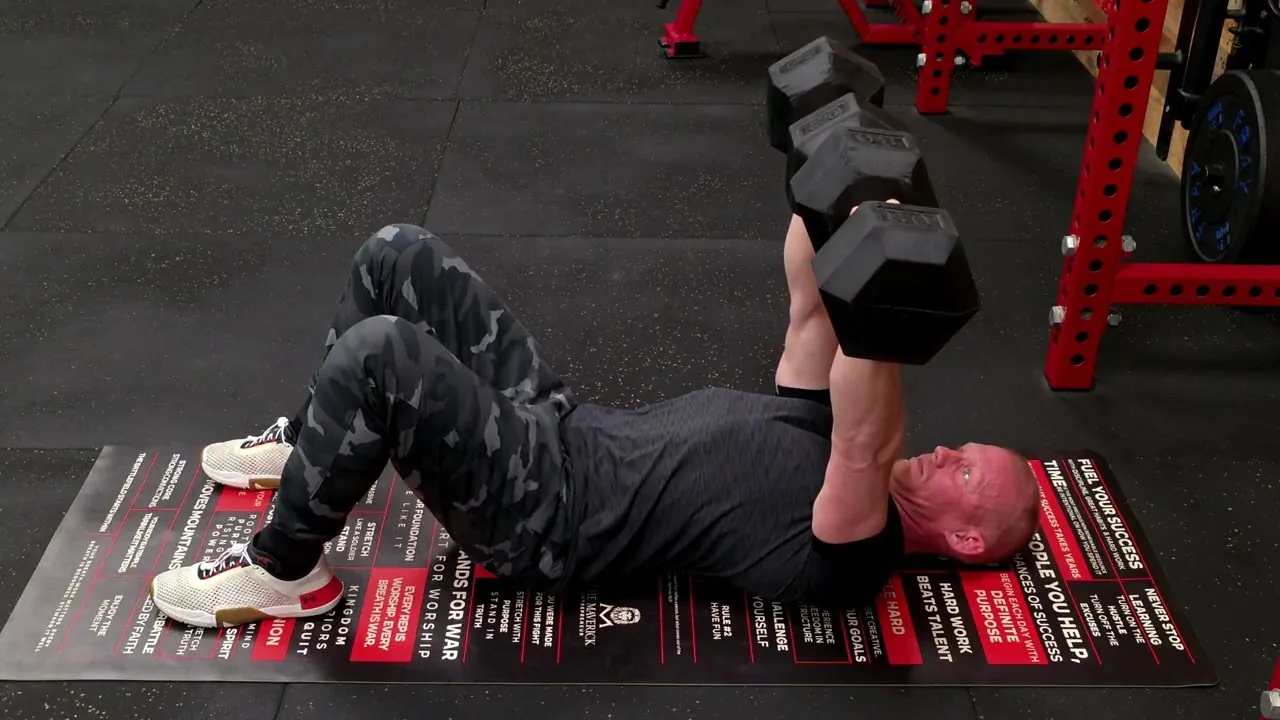
Sit down with the bells before you lie down
Sit on the floor with your knees up and a bell resting on each thigh. Roll back and let the bells come up over your chest with you. Reaching for them off the floor once you are already lying there is how the shoulder gets asked to do the wrong job.
Set the back on the floor
Shoulder blades pulled together and down, so there is a small gap under your lower back. Feet flat, knees bent, and push the floor away with your heels the whole way through. The set-up is a bench press set-up without the bench.
Lower until the elbows touch
Bring the bells down with your elbows at roughly sixty degrees to your body, until the backs of your upper arms meet the floor. That is the bottom and the floor decides it, not you.
Pause, then press
Rest the weight of your arms on the floor for a beat without letting the bells sink, then press up and slightly in. The pause is what stops the floor turning into a trampoline.
What goes wrong
Bouncing the elbows off the floor
The rebound does the hardest part and the number you log stops being a number you own. Touch, settle, then press. Same rule as a bar on a chest.
Treating it as the better version of a bench press
It is a shorter range, and full range training beat partial range for strength across sixteen studies1. Pick the floor because a shoulder needs the limit or because there is no bench in the room, not because it feels stronger.
Resting on the floor mid set
The elbows land, the arms go slack, and the set becomes a series of singles with a break in each one. Keep the bells loaded on the way down and the pause honest.
How Reckoner progresses this lift
Six weeks of this lift, from 20 kg, run through the real engine. Nothing below was typed in: the prescription, the decision and the sentence beside it all come from the same code that writes your week.
| Week | Prescribed | What it did |
|---|---|---|
| 1 | 4 x 6 at 20 kg | More reps 6 → 7 repsYou finished every set with three reps left in the tank (RPE 7) and room left in the range, so the reps climb before the load does. |
| 2 | 4 x 7 at 20 kg | More reps 7 → 8 repsYou finished every set with three reps left in the tank (RPE 7) and room left in the range, so the reps climb before the load does. |
| 3 | 4 x 8 at 20 kg | More reps 8 → 9 repsYou finished every set with three reps left in the tank (RPE 7) and room left in the range, so the reps climb before the load does. |
| 4 | 4 x 9 at 20 kg | More reps 9 → 10 repsYou finished every set with three reps left in the tank (RPE 7) and room left in the range, so the reps climb before the load does. |
| 5 | 4 x 10 at 20 kg | Deload 40% of sets offFive weeks of building, then one week lighter. About 40% of the sets come off. The load holds and your reps stay where you earned them, so you keep the strength and lose the fatigue. |
| 6 | 2 x 10 at 20 kg | Load up 20 kg → 22 kgYou hit the top of the range with three reps left in the tank (RPE 7), so the dumbbell weight goes up 2 kg to 22 kg. The weight went up, so the reps come down to six. You are now working 6 to 10. The lighter week is over, so this is back to four sets. |
Real engine output, not an illustration. Every row was produced by running the engine itself when this page was generated.
The full rule, and why the reps move before the load does, is in how Reckoner decides to add weight.
Questions people ask
Is the floor press good for a sore shoulder?
It stops the arm before it travels behind the line of your body, so the shoulder never reaches the end of that range while it is loaded. That is geometry rather than treatment, and this page will not tell you it fixes anything. If a shoulder actually hurts, see a doctor or physical therapist, and tell Reckoner your shoulder is a problem and it stops prescribing the lifts that provoke it rather than leaving you to pick a safer one.
How much does the shorter range cost me?
For strength, a real amount: full range beat partial range in a meta-analysis of sixteen studies1. For muscle size the upper body evidence is thin and it disagrees with itself2, so the honest answer is that nobody can give you a number for the chest specifically.
Does Reckoner treat it as its own lift?
Yes. It sits in the flat press group with the bench presses, so it can be offered in their place, and it carries its own weight history rather than inheriting theirs. A shorter range with a different load is a different lift to progress.
Similar movements
Reckoner eases the load first when this lift stalls, and offers one of these only if it stalls again after that. A lift already as light as your kit goes has no load left to ease, so the offer comes straight away. Each of them has a page.
Sources
- Pallarés and colleagues, Scandinavian Journal of Medicine and Science in Sports, 2021. Effects of range of motion on resistance training adaptations: A systematic review and meta-analysis sixteen studies, with full range of motion training producing significantly greater strength adaptations than partial range training
- Schoenfeld and Grgic, SAGE Open Medicine, 2020. Effects of range of motion on muscle development during resistance training interventions: A systematic review the finding that research on range of motion for the upper limbs is limited and conflicting, which prevents a strong practical inference being drawn