 reckoner
Prone Y raise
Lie face down, arms out overhead in a Y, thumbs up, and lift them off the floor. It looks like almost nothing and it reaches a muscle most training programs never load: an overhead arm raise in this position produced the greatest lower trapezius activity of ten exercises measured together1.
Thumbs up, lift into a Y off the floor.
- Pattern
- Shoulder isolation
- Trains
- Rear delts, upper back, traps
- Kit
- Bodyweight, floor
- Loading
- Your own bodyweight
- Reckoner prescribes
- 3 sets of 12 to 15 reps at RPE 8
- Progression step
- Nothing to add, so the sets climb instead
- Skill
- Simple to learn
- Recovery cost
- Very low
Muscles worked
How to do it
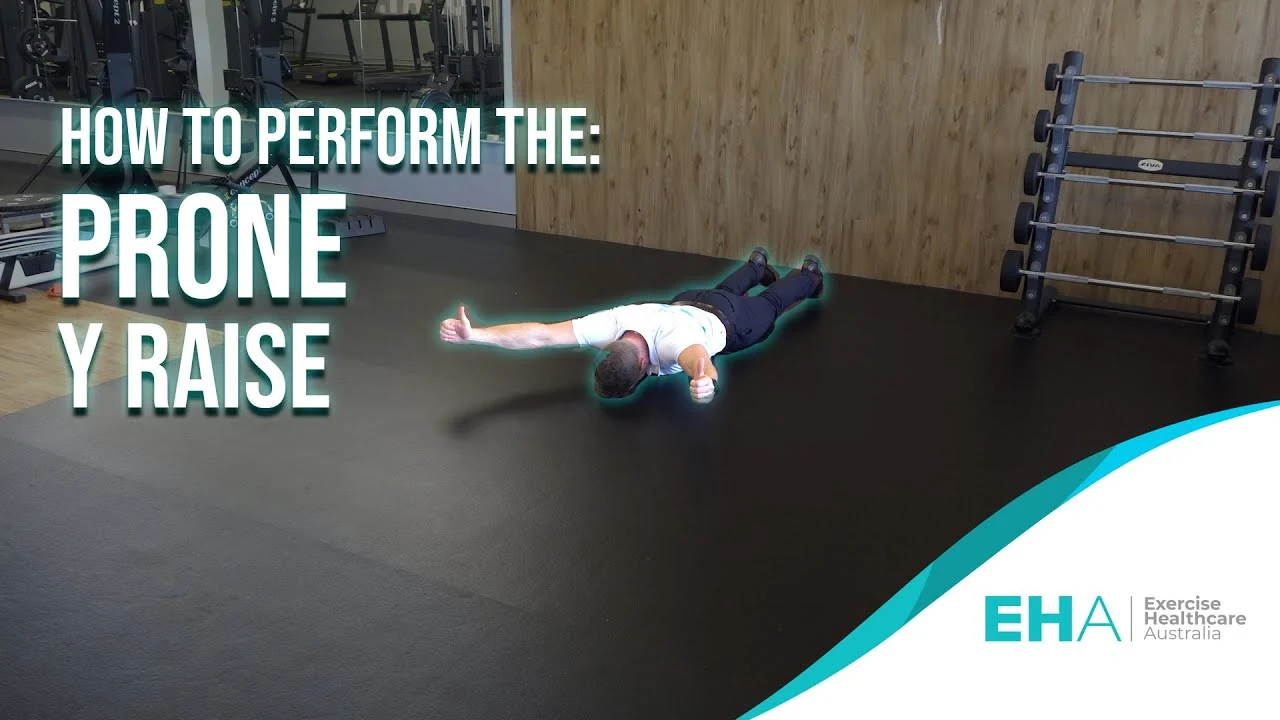
Lie face down and make the Y
Forehead down, arms out overhead at roughly forty-five degrees from your body, elbows straight. Thumbs pointing up at the ceiling. Thumbs up, lift into a Y off the floor, which is the cue on your wrist.
Set the ribs before you lift
Gently brace the belly and squeeze the glutes so the lower back stays quiet. The chest may leave the floor slightly and that is all it should do.
Lift the arms as high as they will go
Raise both arms off the floor without bending the elbows and without shrugging toward your ears. Go to the height you can reach with the shoulders staying down, which for most people is not far.
Hold, then lower and reset
Hold the top for two or three seconds, lower under control, and pause on the floor before the next one. The hold is the load, because there is no other one.
What goes wrong
Turning it into a back extension
The whole chest comes up and the lower back arches to lift arms that barely moved. Keep the ribs near the floor and let the arms be the thing that travels.
Shrugging the arms up
The shoulders ride toward the ears, the upper traps take the lift, and the muscle this position exists to reach gets nothing. Shoulders stay down and away from the ears the whole way.
Rushing through twenty of them
With no weight, the range and the hold are the only variables you have. Fast reps take away both and leave you with arm waving.
How Reckoner progresses this lift
Six weeks of this lift, run through the real engine. Nothing below was typed in: the prescription, the decision and the sentence beside it all come from the same code that writes your week.
| Week | Prescribed | What it did |
|---|---|---|
| 1 | 3 x 12 | More reps 12 → 13 repsYou finished every set with three reps left in the tank (RPE 7) and room left in the range, so the reps climb before the load does. |
| 2 | 3 x 13 | More reps 13 → 14 repsYou finished every set with three reps left in the tank (RPE 7) and room left in the range, so the reps climb before the load does. |
| 3 | 3 x 14 | More reps 14 → 15 repsYou finished every set with three reps left in the tank (RPE 7) and room left in the range, so the reps climb before the load does. |
| 4 | 3 x 15 | One more set 3 → 4 setsYou hit the top of the range with three reps left in the tank (RPE 7) and there is no weight left to add. When a lift runs out of load, the set is the increment, so it does four sets next week. |
| 5 | 4 x 15 | Deload 40% of sets offFive weeks of building, then one week lighter. About 40% of the sets come off. The load holds and your reps stay where you earned them, so you keep the strength and lose the fatigue. |
| 6 | 2 x 15 | One more set 2 → 5 setsYou hit the top of the range with three reps left in the tank (RPE 7) and there is no weight left to add. When a lift runs out of load, the set is the increment, so it does five sets next week. |
Real engine output, not an illustration. Every row was produced by running the engine itself when this page was generated.
The full rule, and why the reps move before the load does, is in how Reckoner decides to add weight.
Questions people ask
What is this actually for?
The lower and middle trapezius, which nearly every pull trains in a shortened position and this one trains overhead. The prone overhead arm raise produced the greatest lower trapezius activity and one of the two greatest middle trapezius amplitudes of ten exercises compared1.
Can I hold something?
Very light plates or nothing at all. Most people cannot reach the top position cleanly unloaded, and adding weight before that is true guarantees a shrug and an arched back.
How does Reckoner progress a movement with no weight?
It climbs the rep range first and then adds a set, because there is nothing to load. On this one the more useful progression is a longer hold at the top.
Similar movements
There is no load to ease on this lift, so Reckoner offers one of these the first time it stalls. Each of them has a page.
Sources
- Ekstrom, Donatelli and Soderberg, Journal of Orthopaedic and Sports Physical Therapy, 2003. Surface electromyographic analysis of exercises for the trapezius and serratus anterior muscles thirty healthy subjects measured across ten exercises, with the unilateral shoulder shrug producing the greatest upper trapezius activity of all ten, and the greatest middle trapezius amplitudes coming from horizontal extension with external rotation and from an overhead arm raise lying face down, which also produced the greatest lower trapezius activity