 reckoner
Reverse cable crossover
Two cables crossed in front of you, a handle in each hand, swept apart until your arms are wide. It trains the back of the shoulder, which is the opposite job to the cable crossover it is named after. The cable is the reason to bother: the resistance is still there at the wide end of the range, where the rear delt is shortest and a dumbbell has nothing left to offer.
Sweep the arms wide, thumbs pointing up.
- Pattern
- Shoulder isolation
- Trains
- Rear delts, upper back
- Kit
- Cable
- Loading
- A weight you choose
- Reckoner prescribes
- 3 sets of 12 to 15 reps at RPE 8
- Progression step
- 2.5 kg once the top of the range is clean
- Skill
- Some technique
- Recovery cost
- Low
Muscles worked
How to do it
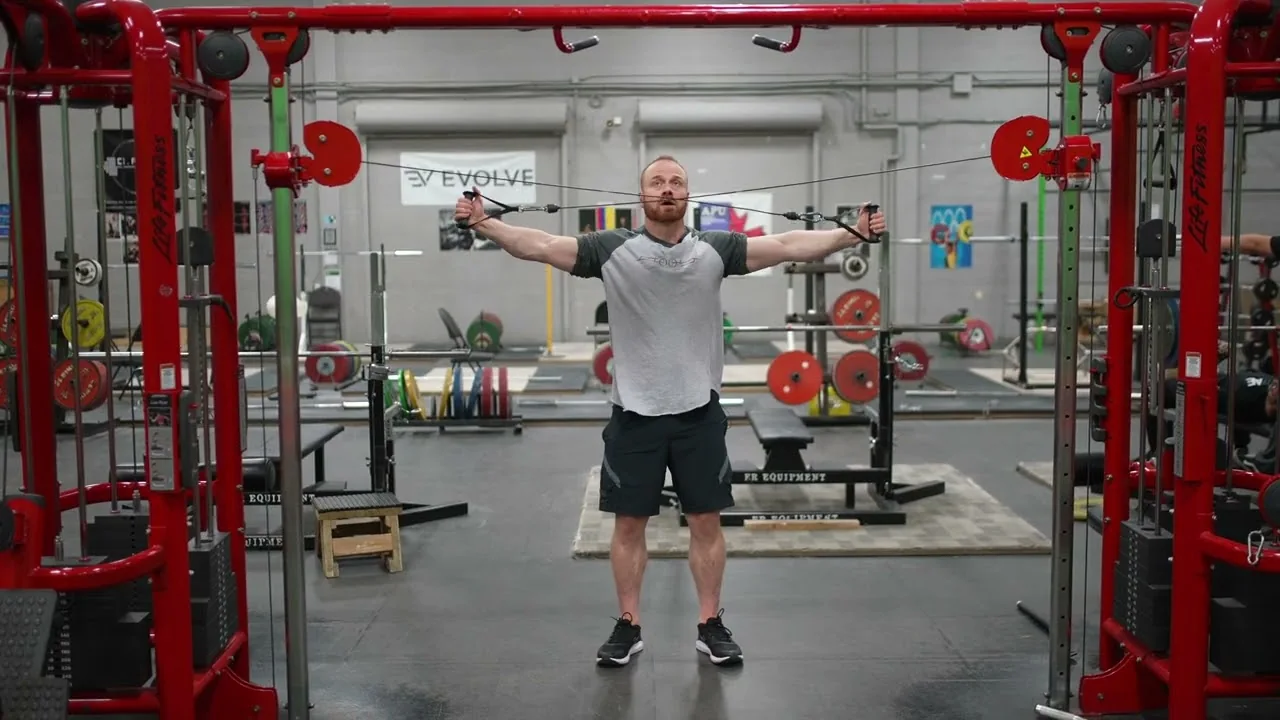
Set both pulleys at shoulder height
Shoulder height or a little above. Take the left handle in your right hand and the right handle in your left, so the cables cross in front of your chest.
Step back and set your stance
One step back until the stacks lift clear, feet split for balance, arms out in front of you with a small bend at the elbow. Chest tall, ribs down.
Sweep the arms wide
Sweep the arms wide, thumbs pointing up, which is the cue on your wrist. Thumbs up beats palms down here: on a reverse fly machine, a neutral hand position produced greater posterior deltoid and infraspinatus activity than a pronated one1.
Stop when your arms reach the line of your shoulders
A little past is fine. A long way past is your shoulder blades finishing the rep for you. The elbow angle you set at the start is the elbow angle you finish with.
Let it come back under control
Do not let the stacks drag your arms forward. The way back is the half of the rep most people give away on this one, and it costs nothing to keep.
What goes wrong
Loading it like a row
The elbows bend, the hands come in to the ribs, and it turns into a poor standing row. If your elbow angle changes during the set, the weight is too heavy. This movement is light and it stays light.
Reading it as a cable crossover in reverse
The name says so and the muscles say otherwise. A cable crossover brings the arms together across the chest and trains the chest. This takes them apart and trains the back of the shoulder. Nothing you know about one tells you anything about the other, and Reckoner records them as the different exercises they are.
Assuming your rows already cover it
They cover some of it. Deltoid activity measured across three pulling exercises put the posterior portion highest on a reverse fly, above both a seated row and a lat pull-down2. That is electrical activity during the lift rather than a measurement of growth, which is the right kind of evidence for the narrow question of whether rowing puts the back of the shoulder in the same position. It does not.
How Reckoner progresses this lift
Six weeks of this lift, from 10 kg, run through the real engine. Nothing below was typed in: the prescription, the decision and the sentence beside it all come from the same code that writes your week.
| Week | Prescribed | What it did |
|---|---|---|
| 1 | 3 x 12 at 10 kg | More reps 12 → 13 repsYou finished every set with three reps left in the tank (RPE 7) and room left in the range, so the reps climb before the load does. |
| 2 | 3 x 13 at 10 kg | More reps 13 → 14 repsYou finished every set with three reps left in the tank (RPE 7) and room left in the range, so the reps climb before the load does. |
| 3 | 3 x 14 at 10 kg | More reps 14 → 15 repsYou finished every set with three reps left in the tank (RPE 7) and room left in the range, so the reps climb before the load does. |
| 4 | 3 x 15 at 10 kg | Load up 10 kg → 12.5 kgYou hit the top of the range with three reps left in the tank (RPE 7), so the weight on the cable stack goes up 2.5 kg to 12.5 kg. The weight went up, so the reps come down to eight. You are now working 8 to 11. |
| 5 | 3 x 8 at 12.5 kg | Deload 40% of sets offFive weeks of building, then one week lighter. About 40% of the sets come off. The load holds and your reps stay where you earned them, so you keep the strength and lose the fatigue. |
| 6 | 2 x 8 at 12.5 kg | More reps 8 → 9 repsYou earned the extra rep before the lighter week. The lighter week was for recovery, not a test, so it waited for it to end, and now it lands. The lighter week is over, so this is back to three sets. |
Real engine output, not an illustration. Every row was produced by running the engine itself when this page was generated.
The full rule, and why the reps move before the load does, is in how Reckoner decides to add weight.
Questions people ask
Is this the same as a reverse pec deck?
Close, and the cables are the difference worth knowing. A machine holds the path for you. The cables make you hold it, which is harder to set up and easier to load through a full sweep. Both open the arms at the shoulder, and the machine is the better pick if setting your stance is the thing that keeps stopping you.
High cables or low cables?
Shoulder height is what this page describes, because it keeps the arms sweeping across your body rather than lifting up it. Setting the pulleys much lower or much higher is not wrong. It is a different exercise, and worth logging as one if you make a habit of it.
Will Reckoner give me this if I have a shoulder problem?
Yes. No restriction is recorded against it, and that is deliberate: opening the arms at shoulder height is not the overhead or wide pressing the shoulder tag is about. It is still your call. A movement with no tag on it is one nobody has been told to keep away from you, rather than one that has been cleared for your particular shoulder.
Similar movements
Reckoner eases the load first when this lift stalls, and offers one of these only if it stalls again after that. A lift already as light as your kit goes has no load left to ease, so the offer comes straight away. Each of them has a page.
Sources
- Schoenfeld, Sonmez, Kolber, Contreras, Harris and Ozen, Journal of Strength and Conditioning Research, 2013. Effect of hand position on EMG activity of the posterior shoulder musculature during a horizontal abduction exercise nineteen resistance-trained men performing horizontal abduction on a reverse fly machine to failure with a pronated and then a neutral grip, where the neutral hand position produced significantly greater mean electromyographic activity in the posterior deltoid and the infraspinatus
- Franke, Botton, Rodrigues, Pinto and Lima, Journal of Sports Medicine and Physical Fitness, 2015. Analysis of anterior, middle and posterior deltoid activation during single and multijoint exercises twelve trained men measured through an inclined lat pull-down, a seated row and a reverse peck deck, where activation of the posterior portion of the deltoid was greater on the reverse peck deck than on either pulling exercise