 reckoner
Cable lateral raise
One arm, one low pulley, and a raise out to the side. The cable is what makes it worth doing: a dumbbell has almost no load on it at the bottom of the range and a cable has plenty, so the muscle is under tension for the whole of the rep instead of the top half of it.
Lead with the elbow, no swinging.
- Pattern
- Shoulder isolation
- Trains
- Side delts
- Kit
- Cable
- Loading
- A weight you choose
- Reckoner prescribes
- 3 sets of 12 to 15 reps at RPE 8
- Progression step
- 2.5 kg once the top of the range is clean
- Skill
- Some technique
- Recovery cost
- Very low
- Not prescribed if you have declared
- Shoulder
Muscles worked
How to do it
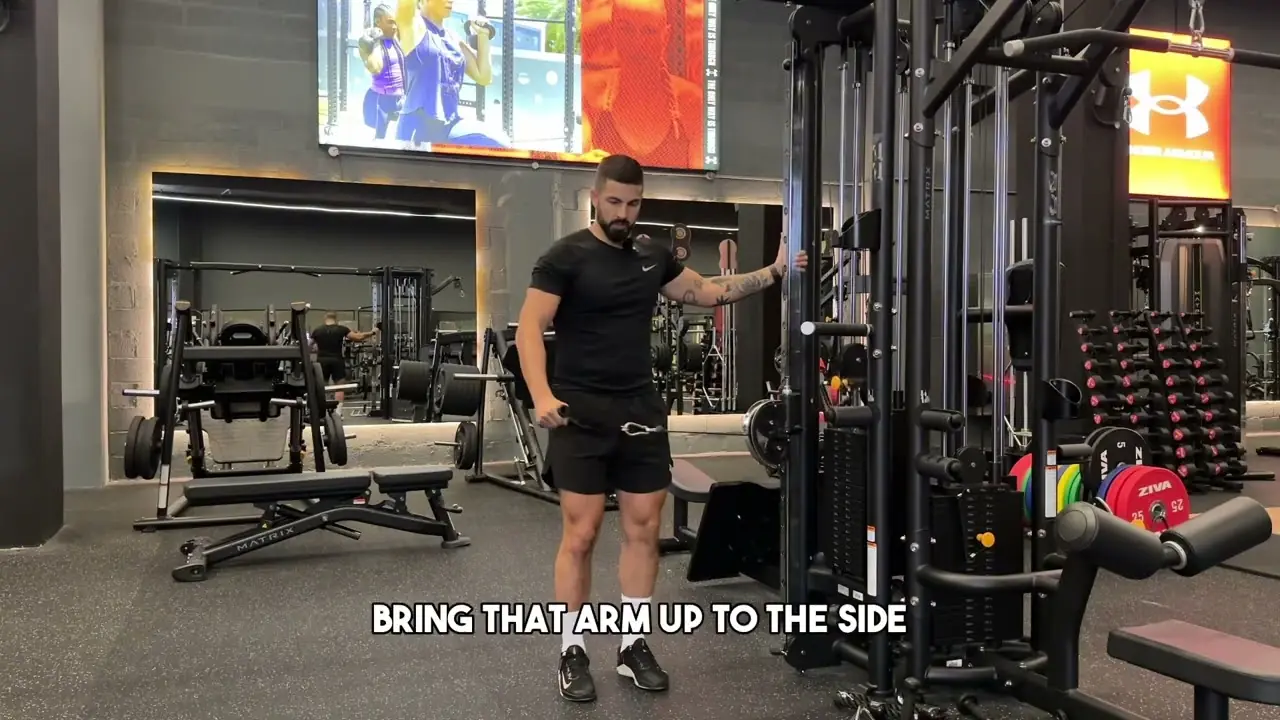
Set the pulley low and stand side on
Handle in the far hand, cable running across the front of your body, standing far enough from the stack that the arm starts a little across you. Hold something with the free hand if you need to stay still.
Keep the arm long
A very slight bend at the elbow and no more. When the medial deltoid was measured across lateral raise variations, the version with a bent elbow produced clearly less activity than the straight-armed one1.
Raise to shoulder height
Lead with the elbow, take the hand out and up to about the height of your shoulder, and stop there. Above that the trapezius takes over and the side of the shoulder has finished its job.
Lower slowly against the cable
Resist the way down all the way to the bottom, where the cable is still pulling. That bottom part is what the cable version buys you, so do not give it away by dropping the arm.
What goes wrong
Swinging the body to start the rep
A small lean and rebound gets the arm moving and lets you use a heavier setting. The shoulder then only holds the weight near the top, which is the easiest part.
Shrugging at the top
The shoulder climbs toward the ear at the end of the rep and the traps finish the movement. Keep the shoulder down and stop the raise where it is level.
Bending the elbow to shift more weight
A bent arm shortens the lever and the weight goes up. It also measurably reduces what the side of the shoulder is doing1, which is the only reason you picked this exercise.
How Reckoner progresses this lift
Six weeks of this lift, from 7.5 kg, run through the real engine. Nothing below was typed in: the prescription, the decision and the sentence beside it all come from the same code that writes your week.
| Week | Prescribed | What it did |
|---|---|---|
| 1 | 3 x 12 at 7.5 kg | More reps 12 → 13 repsYou finished every set with three reps left in the tank (RPE 7) and room left in the range, so the reps climb before the load does. |
| 2 | 3 x 13 at 7.5 kg | More reps 13 → 14 repsYou finished every set with three reps left in the tank (RPE 7) and room left in the range, so the reps climb before the load does. |
| 3 | 3 x 14 at 7.5 kg | More reps 14 → 15 repsYou finished every set with three reps left in the tank (RPE 7) and room left in the range, so the reps climb before the load does. |
| 4 | 3 x 15 at 7.5 kg | Load up 7.5 kg → 10 kgYou hit the top of the range with three reps left in the tank (RPE 7), so the weight on the cable stack goes up 2.5 kg to 10 kg. The weight went up, so the reps come down to eight. You are now working 8 to 11. |
| 5 | 3 x 8 at 10 kg | Deload 40% of sets offFive weeks of building, then one week lighter. About 40% of the sets come off. The load holds and your reps stay where you earned them, so you keep the strength and lose the fatigue. |
| 6 | 2 x 8 at 10 kg | More reps 8 → 9 repsYou finished every set with three reps left in the tank (RPE 7) and room left in the range, so the reps climb before the load does. The lighter week is over, so this is back to three sets. |
Real engine output, not an illustration. Every row was produced by running the engine itself when this page was generated.
The full rule, and why the reps move before the load does, is in how Reckoner decides to add weight.
Questions people ask
Should I pour the jug, with the thumbs turned down?
The measurement does not support it. Turning the arm inward produced the greatest upper trapezius, rear deltoid and triceps activity of any variation, and it was not shown to beat a neutral arm at the side deltoid on the way up1. So the cue reliably adds trapezius rather than side deltoid. Keep the arm neutral and the thumbs roughly level.
Cable or dumbbell?
The cable, when there is one free. They share a swap group. Each lift keeps its own record in Reckoner. Swapping between them loses neither record and merges neither, and the lift you swap to opens at its own weight if you have trained it before. The cable's advantage is tension at the bottom, where a dumbbell is nearly weightless.
How far should I raise it?
To about shoulder height. Training through a full range beats training through a partial one on most outcomes, though the difference is small2, and above the shoulder the movement stops being a lateral raise rather than becoming a longer one.
Similar movements
Reckoner eases the load first when this lift stalls, and offers one of these only if it stalls again after that. A lift already as light as your kit goes has no load left to ease, so the offer comes straight away. Each of them has a page.
Sources
- Coratella and colleagues, International Journal of Environmental Research and Public Health, 2020. An electromyographic analysis of lateral raise variations and frontal raise in competitive bodybuilders ten competitive bodybuilders across four lateral raise variations and the frontal raise, where medial deltoid activity on the way up was greater with a neutral humerus than with an externally rotated one, a bent elbow or a frontal raise, and where the internally rotated version produced the greatest upper trapezius, posterior deltoid and triceps activity of any variation without being shown to beat neutral at the medial deltoid on the concentric
- Wolf and colleagues, International Journal of Strength and Conditioning, 2023. Partial vs full range of motion resistance training: a systematic review and meta-analysis a meta-analysis reporting a trivial standardized mean difference of 0.12 in favor of full range training, with every outcome favoring full range but all effects between trivial and small, and a subgroup suggesting partials held at long muscle lengths may match or beat full range for size