 reckoner
Single-leg calf raise
A calf raise on one foot. It roughly doubles what that calf is lifting without any weight at all, which makes it the obvious next step when two legged raises stop being hard. It also stops a stronger side quietly carrying the weaker one.
Full stretch down, rise all the way up.
- Pattern
- Calf
- Trains
- Calves
- Kit
- Bodyweight, sturdy surface
- Loading
- Your own bodyweight
- Reckoner prescribes
- 3 sets of 10 to 15 reps at RPE 8
- Progression step
- Nothing to add, so the sets climb instead
- Skill
- Simple to learn
- Recovery cost
- Low
- Not prescribed if you have declared
- Ankle
Muscles worked
How to do it
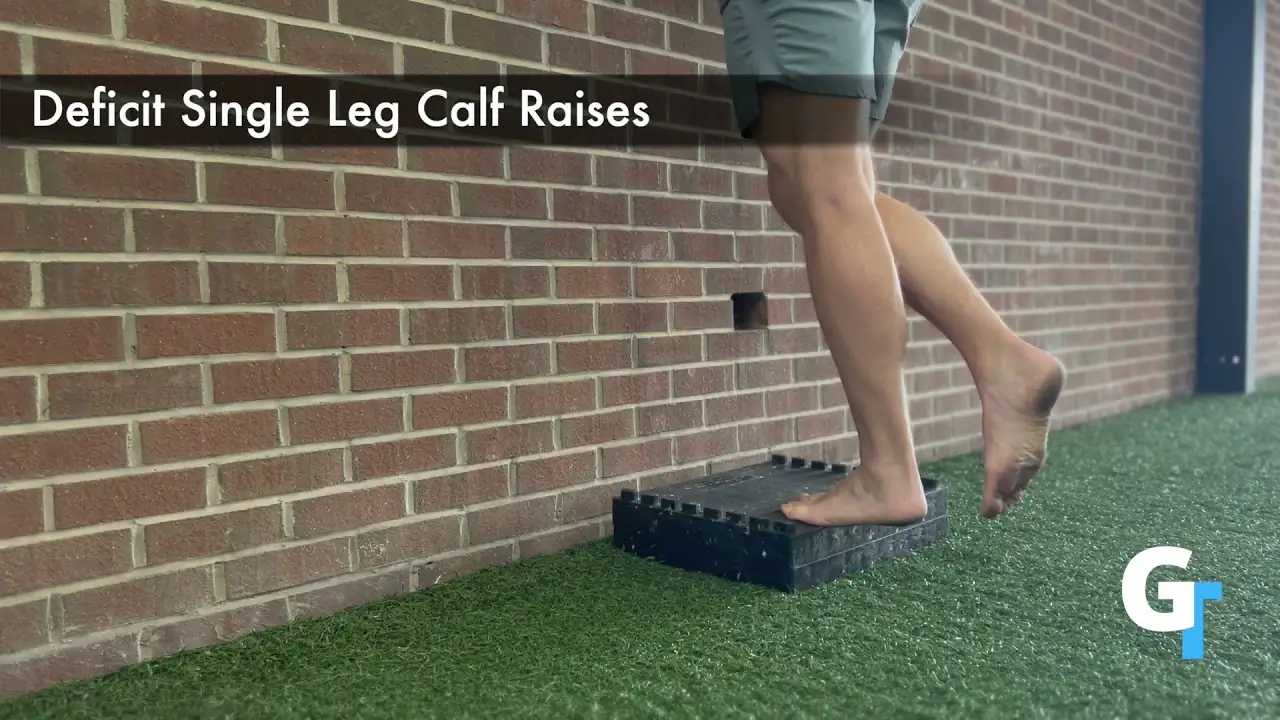
Set up on a step with a hand on something
Balls of one foot on the edge, heel hanging off. A light hand on a wall or rail for balance, taking as little weight as you can manage.
Tuck the other foot away
Hook it behind the working ankle or hold it off the step. It should not be touching anything, because a toe resting on the step takes more load off than you would guess.
Full stretch down, rise all the way up
That is the cue on your wrist, and it is both ends of the range in one sentence. Heel down below the step until the calf lengthens, then press up until the ankle is fully extended.
Finish the side before you swap
All the reps on one leg, then the other. Note if the second side gives out earlier, because that is the information this version exists to give you.
What goes wrong
Leaning on the hand
The hand is for balance, not for support, and it is very easy to start pressing down through it as the set gets hard. Use fingertips rather than a palm and you will feel the difference immediately.
Losing the bottom as the set goes on
The first reps get a full heel drop and the last few do not, which means the reps that were hardest were also the shortest. Training the calf at length is what produces the growth1, so stop the set when the range goes rather than pushing to a number.
Treating a side difference as a problem to fix today
One calf being stronger is common and it is worth knowing. Matching the weaker side's rep count on both is a reasonable response. Doing extra sets on one side is a bigger decision than it looks and it is not something this page can make for you.
How Reckoner progresses this lift
Six weeks of this lift, run through the real engine. Nothing below was typed in: the prescription, the decision and the sentence beside it all come from the same code that writes your week.
| Week | Prescribed | What it did |
|---|---|---|
| 1 | 3 x 10 | More reps 10 → 11 repsYou finished every set with three reps left in the tank (RPE 7) and room left in the range, so the reps climb before the load does. |
| 2 | 3 x 11 | More reps 11 → 12 repsYou finished every set with three reps left in the tank (RPE 7) and room left in the range, so the reps climb before the load does. |
| 3 | 3 x 12 | More reps 12 → 13 repsYou finished every set with three reps left in the tank (RPE 7) and room left in the range, so the reps climb before the load does. |
| 4 | 3 x 13 | More reps 13 → 14 repsYou finished every set with three reps left in the tank (RPE 7) and room left in the range, so the reps climb before the load does. |
| 5 | 3 x 14 | Deload 40% of sets offFive weeks of building, then one week lighter. About 40% of the sets come off. The load holds and your reps stay where you earned them, so you keep the strength and lose the fatigue. |
| 6 | 2 x 14 | More reps 14 → 15 repsYou finished every set with three reps left in the tank (RPE 7) and room left in the range, so the reps climb before the load does. The lighter week is over, so this is back to three sets. |
Real engine output, not an illustration. Every row was produced by running the engine itself when this page was generated.
The full rule, and why the reps move before the load does, is in how Reckoner decides to add weight.
Questions people ask
How much harder is one leg than two?
Roughly twice the load on that calf, since one leg is holding all of you instead of half. That is the cheapest progression available for calves and it costs nothing, which is why it sits between the bodyweight version and the loaded ones.
Should I add weight to a single-leg calf raise?
You can hold a dumbbell in the free hand, and Reckoner records this as a bodyweight movement, so log the version you actually did. If you are adding load regularly, the dumbbell calf raise is a separate movement in the library with its own record and its own ladder.
Will Reckoner take this out of my plan for an injury?
Yes, for the ankle. It is the one restriction recorded against it, so declaring an ankle restriction in setup takes it out of your plan. It does record a slightly higher recovery cost than the other calf raises, which is the doubled load showing up.
Similar movements
There is no load to ease on this lift, so Reckoner offers one of these the first time it stalls. Each of them has a page.
Sources
- Kinoshita and colleagues, Frontiers in Physiology, 2023. Triceps surae muscle hypertrophy is greater after standing versus seated calf-raise training fourteen untrained adults training one leg standing and the other seated for twelve weeks, the standing leg growing the two gastrocnemius heads by 12.4 and 9.2 per cent against 1.7 and 0.6 per cent seated, the soleus growing about the same either way at 2.1 against 2.9 per cent, and the whole calf growing 5.6 against 2.1 per cent