 reckoner
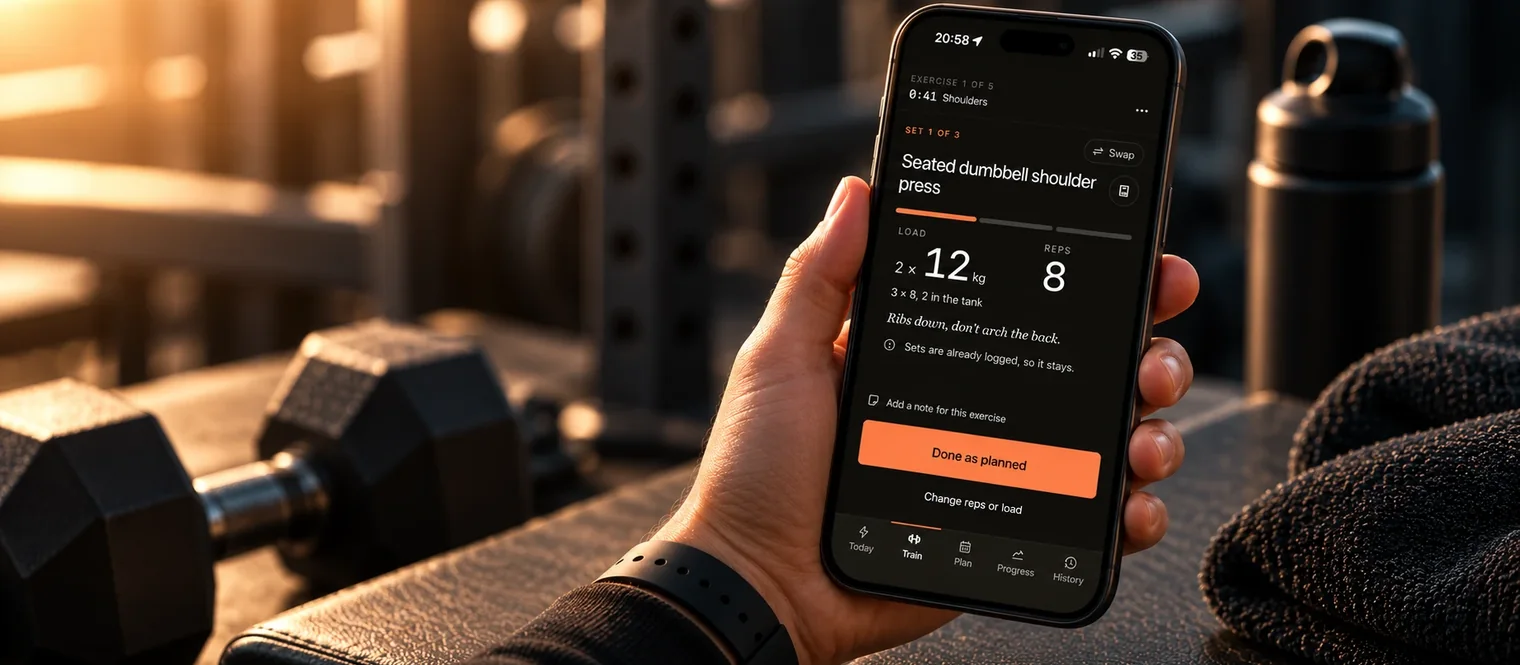
This is a gym plan for somebody who has never lifted, or has not lifted in years. Three days a week, six lifts a day, and your whole body in every session. It is Reckoner's own 3-Day Full Body for Beginners, written out here day by day so you can read every lift before you start it.
If you want the reasons to lift at all and how to learn a movement, start with how to start lifting weights. If you are still choosing between programs, a beginner strength program covers how. This page is the plan.
Why three full body days suit a beginner
Three days a week is the frequency written for somebody new to lifting. The American College of Sports Medicine recommends two to three days a week for novices, with loads you could lift for eight to twelve reps1. Full body is the simplest way to use those days, because every session trains your legs, your pushing muscles and your pulling muscles, so most muscles are worked two or three times a week without any planning on your part.
That matters for two reasons. The 2026 position stand from the same college recommends training every major muscle group hard at least twice a week3. And when the weekly sets are matched, a review of the studies comparing the two found full body training and split routines build the same strength and the same muscle2. So a beginner loses nothing by training the whole body each time, and gains a week that is easy to follow. The full body workout has the longer argument, and a push pull legs plan for beginners is the split version if you would rather train that way.
The plan leans on machines and dumbbells, and the position stand found that machines against free weights made no difference to strength gains3.
The plan, day by day
Run the days in order, A, B, C, with a rest day between each. The plan is written for Monday, Wednesday and Friday. Do the lifts in the order shown: the big lifts come first and the small ones last, which is the order the guidance recommends1, and strength improves more on a lift done at the start of a session3. That is why a different leg lift leads each day: the goblet squat, the leg press and the hip thrust each get you fresh once a week.
Rest about two minutes between sets of the first lift and about ninety seconds on the rest. The cue beside each lift is the one thing to get right. Every name links to its own page with the setup and the common mistakes.
Full body A
| Lift | Sets | Reps | The one thing to get right |
|---|---|---|---|
| Goblet squat | 3 | 8–12 | Elbows inside your knees, chest tall, sit down between your heels. |
| Machine chest press | 3 | 8–12 | Shoulder blades back and down, press to just short of locked. |
| Lat pull-down | 3 | 8–12 | Lead with your elbows and pull the bar to your upper chest. |
| Dumbbell Romanian deadlift | 2 | 8–12 | Push your hips back until you feel the hamstrings stretch, then stand up. No further. |
| Dumbbell lateral raise | 2 | 12–15 | Lead with your elbows and lift to shoulder height without swinging. |
| Plank | 2 | 20–40 seconds | Straight line from shoulders to heels, hips level. |
Full body B
| Lift | Sets | Reps | The one thing to get right |
|---|---|---|---|
| Leg press | 3 | 10–15 | Lower until just before your hips start to lift off the pad, then press through your whole foot. |
| Seated dumbbell shoulder press | 3 | 8–12 | Back against the pad and ribs down, press the dumbbells up without arching. |
| Seated cable row | 3 | 8–12 | Sit tall and pull your elbows back past your ribs. Pause there. |
| Seated leg curl | 2 | 10–15 | Curl your heels down hard and let them return slowly. |
| Dumbbell biceps curl | 2 | 10–12 | Keep your elbows still and curl the dumbbells without swinging. |
| Rope press-down | 2 | 10–15 | Pin your elbows to your sides and straighten your arms fully at the bottom. |
Full body C
| Lift | Sets | Reps | The one thing to get right |
|---|---|---|---|
| Machine hip thrust | 3 | 8–12 | Drive up through your heels and squeeze your glutes without arching. |
| Incline dumbbell press | 3 | 8–12 | Lower the dumbbells to your upper chest with elbows a little below your shoulders, then press up. |
| Chest-supported dumbbell row | 3 | 8–12 | Keep your chest on the pad and pull your elbows back past your ribs. |
| Leg extension | 2 | 12–15 | Straighten your legs smoothly and lower slowly. No kicking. |
| Standing calf raise | 3 | 10–15 | Sink into a stretch at the bottom, then rise high onto your toes. |
| Dead bug | 2 | 8–12 | Press your lower back into the floor the whole time. |
Before the first lift of the day, do a couple of lighter sets of it on the way to your working weight. The lifts after it are warmed up by the ones before.
How hard each set should be
Stop each set when you could have done about two more good reps. The position stand found that going to failure is not needed, and that stopping two or three reps short is enough effort3. You will not judge it exactly. Nobody does: people underpredict the reps they have left by about one on average, and experience does not change that4. A good rep looks like the first one. When the reps start to change shape, the set is done. Reps in reserve explains the counting.
How your first weights are set
You do not need to know your numbers. When you take the plan, Reckoner sets a starting weight for every lift from what you told it in setup, and it errs light on purpose. A light first week costs you one session. A heavy one can cost weeks of missed reps and a number you stop trusting. Each new lift starts at the bottom of its rep range, so you have the whole range to climb before any weight is added. A lift you already train with Reckoner keeps your own weight.
If your gym is missing a machine, Reckoner puts in a stand in that trains the same thing and tells you which lift it replaced. Your first week of lifting covers what those first sessions should feel like.
How the weight goes up
After each lift you say how many good reps you had left and how your form looked. The plan is rewritten from that, lift by lift:
- Reps come first. A lift that reached its target climbs, usually by a rep at the same weight.
- Then the weight. Once every set reaches the top of the range with good form, the next week adds the smallest step your gym has. The reps drop back and you climb again.
- Form can hold it. If you rate your form rough, the lift holds where it is, whatever the reps said.
- Each lift moves on its own. Some will climb every week and some will sit still for a while. Both are normal.
When to add weight walks through each step.
Week six is lighter, on purpose
The plan runs in six week blocks: five weeks of building, then one lighter week. In it every weight stays where you earned it and about two fifths of the sets come off, so a three set lift becomes two and a two set lift becomes one. Treat it as a technique week: clean reps, full range, nothing rushed. If you earned a rise in week five, it is kept and lands the week after.
This is how coaches plan training. Lighter weeks generally come every four to six weeks and last about a week, and in an international panel of strength coaches there was agreement that one can cut the sets and focus on the technique of the main lifts5. When to deload has more on why.
Three days, your whole body each time, two good reps left on every set. The record does the rest.
Start the plan
Open the 3-Day Full Body for Beginners and choose Train this plan. Train it on your phone or your watch, and what you log writes the next week.