 reckoner
Guide Calves
Calf and shin training: what the knee angle changes
Your calves are two muscles that answer to different knee angles, and your shin is a third that most programs leave out. Train each on purpose and the guesswork goes.
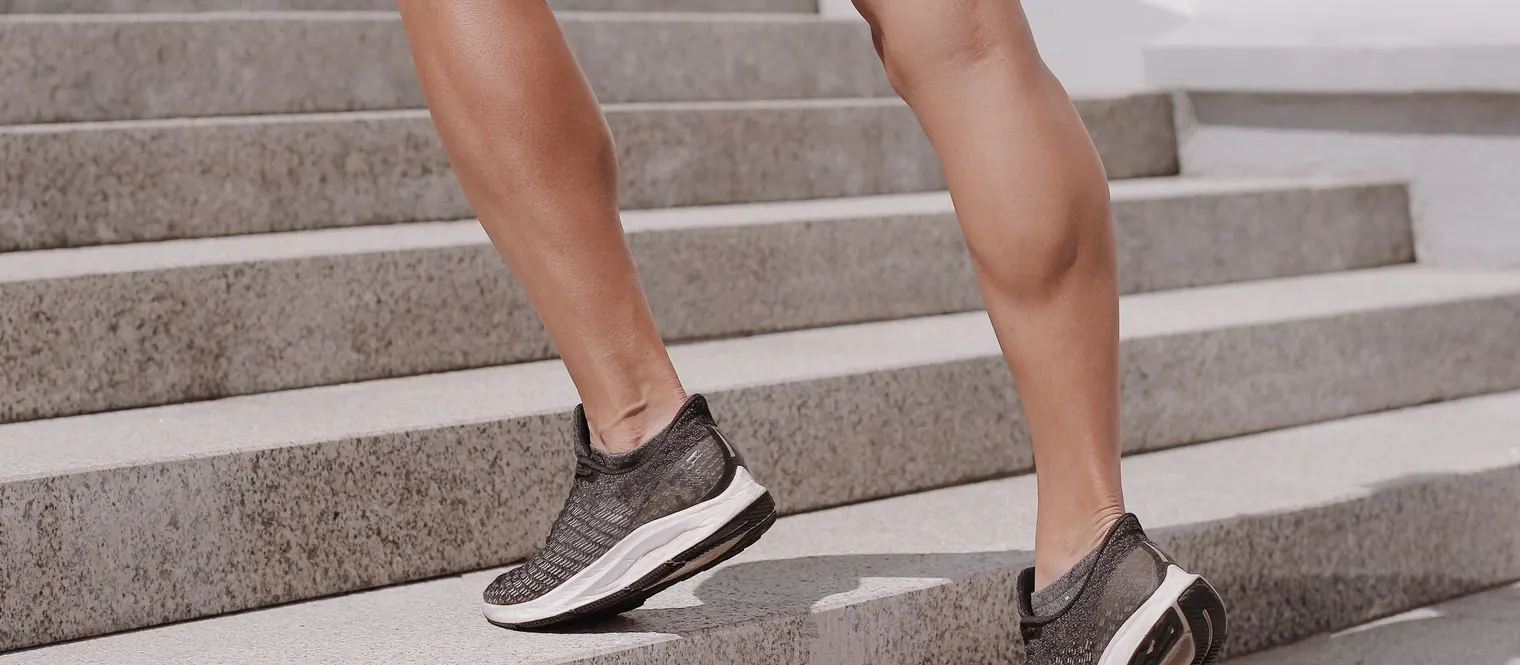
Calves have a reputation. People call them stubborn, or genetic, something you either have or you do not. Then they train them with a few quick bouncing reps at the end of leg day, stopping well short of a stretch at the bottom, and take the lack of change as proof.
There is a real reason calves can feel slow. The researchers who study them describe the calf as relatively unresponsive to training compared with other muscles, and quick to shrink when you stop1. That is exactly why the details matter. Which way your knee points and how far you sink at the bottom of each rep decide which muscle does the work, and the research on both is clearer than you might expect.
Two calf muscles, one tendon
The back of your lower leg is mostly two muscles that share the Achilles tendon. The gastrocnemius is the big two headed muscle you can see. It starts above the knee, so it crosses two joints. The soleus sits underneath it, starts below the knee and only crosses the ankle.
That one difference decides most of what follows. Straighten your knee and the gastrocnemius is stretched long. Bend your knee to a right angle, the way a seated calf machine sits you, and the gastrocnemius goes short and slack, which leaves the soleus doing most of the work1.
Standing or seated: the twelve week answer
A 2023 study put this to a clean test. Fourteen untrained adults trained one leg with a standing calf raise and the other leg with a seated one, five sets of ten, twice a week for twelve weeks, at the same relative load on both1. Then the researchers measured each muscle with MRI.
The standing leg grew its two gastrocnemius heads by 12.4 and 9.2 percent. The seated leg grew them by 1.7 and 0.6 percent. The soleus grew about the same in both legs, 2.1 percent standing and 2.9 percent seated1. The authors concluded that the standing raise was by far the more effective way to grow the gastrocnemius, and with it the calf as a whole1.
So if you only have room for one calf exercise, make it a straight knee one: a standing calf raise, a single-leg calf raise off a step, or a calf raise on the leg press. The seated calf raise still has a job. It reaches the soleus at a knee angle standing work does not, it puts no load on your spine, and it makes a fine second calf exercise. It makes a poor only one.
The bottom of the rep does the most
The second lesson is about range. A 2023 trial had 42 young women train calf raises on a leg press machine for eight weeks, three sets of 15 to 20 reps, three days a week2. One group used the full range. One used only the bottom half, where the calf is stretched. One used only the top half.
The bottom half group grew the inner gastrocnemius by 15.2 percent, against 6.7 percent for the full range and 3.4 percent for the top half2. The authors read it as a sign that calf work at longer muscle lengths may suit growth best2. It is one study in one group of people, so treat it as a strong hint rather than a law. Taken with the standing and seated result, the two point the same way: the calf seems to grow best when it works long.
What it rules out is bouncing. A rep that skips the stretch skips the part that seems to do the most. Sink until your heel is as low as it will go, pause there for a beat so you lift out of the stretch instead of springing out of it, then rise as high as you can.
The front of your shin
The muscle down the front of your shin is the tibialis anterior. It lifts the front of your foot, and when you walk it is the muscle that clears your toes off the ground as your leg swings through. In one study of that swing it was more active than either calf muscle measured beside it3.
The wall tibialis raise trains it with nothing but a wall: lean back, walk your heels out a step, and pull your toes up toward your shins. It is a perfectly good exercise. It has also become popular partly on a claim it cannot yet support, which is that it prevents shin splints.
- What the risk factor research lists. A review of shin splints in novice and recreational runners named things like how the pelvis tilts, how the hip turns and how far the arch drops. Shin strength was not among them4.
- What the muscle research found. A second review, of leg muscle features in people with shin splints, found the clearest links were less lean muscle around the lower leg and more calf activity when pushing off, and could not say which was the cause and which the effect5.
So train your shins because a balanced lower leg is a reasonable thing to want, not as a cure. Shin pain that keeps coming back is worth getting looked at by a doctor or a physio rather than trained through, and training around pain covers what to do in the meantime.
How Reckoner handles them
Reckoner counts calves as a muscle of their own when it adds up your weekly sets, and the note beside them says what this guide says: mix standing and seated raises, because they train different parts of the calf. Calf raises sit in the same rep ranges as your other accessories. There is no special high rep rule for calves, because there is no good evidence for one.
Your shins are the one muscle Reckoner tracks with no weekly set target. No study has measured how much weekly work the tibialis anterior needs, and Reckoner does not invent training numbers, so it leaves that gap visible rather than filling it with a guess.
What to do
- Make your main calf exercise a straight knee one. Standing, single-leg off a step, or on the leg press.
- Add a seated raise as a second exercise when you have the time and the machine.
- Own the bottom of every rep. Sink into a full stretch, pause, then rise. No bouncing.
- Train your shins if you want to, for their own sake, and get recurring shin pain checked rather than adding sets to it.
Calves are not stubborn. They are particular about the knee and the stretch.