 reckoner
Answer Travel
How do I stay active on holiday and work trips?
Move every day, lift a little where you can, and let the rest go. A week or two away costs far less strength than it feels like, and Reckoner keeps your place.
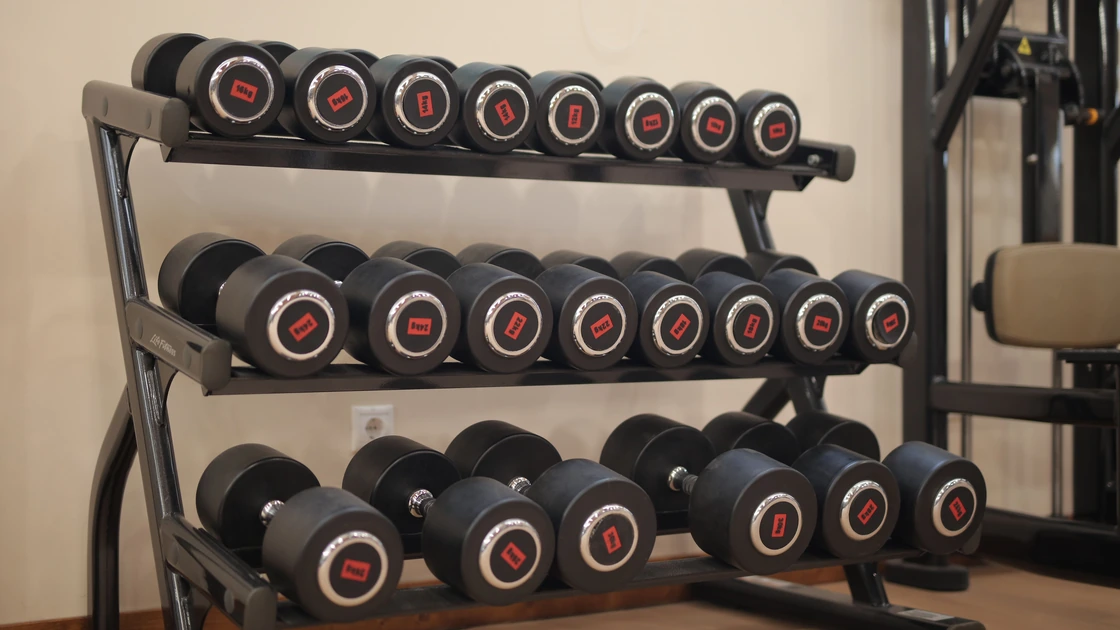
A hotel gym, a family table, back to back meetings, a flight that eats a day at each end. The routine that held your training together stays at home, and the usual reaction is to write the week off or to promise a double session when you get back. Neither is needed. Move a lot, lift a little where you can, and let the plan wait for the rest.
A trip costs less than it feels like
Strength fades slowly. A systematic review of elite rugby and American football players found that strength can be maintained for up to three weeks without training, with the loss speeding up after that1. In a small trial, recreationally trained men who stopped for six weeks showed no significant change in their best shoulder press, bench press or squat, although their power output had already slipped by nine to ten percent at three weeks2. In that trial, power slipped before maximal strength did.
A little training holds a lot. A review of the smallest dose that keeps fitness found that strength and muscle size in younger adults can be maintained for up to 32 weeks on as little as one session a week and one set per exercise, as long as the weight stays heavy relative to your strength3. In a trial of 70 adults, those who cut their training to a third of what it had been kept the muscle they had built if they were younger, and the strength they had gained was largely kept even by those who stopped altogether4. Older adults needed more to keep their muscle size34.
So a trip is a maintenance period, and maintenance is small. The catch is the weight. Those results assume the load stays heavy for you, and a hotel's light dumbbells cannot promise that. A week or two on light weights is a pause on getting stronger, not a loss, and the sections below lean on effort to make light weights count.
What Reckoner does while you are away
- A week with nothing logged moves nothing. Not the week counter, not a stall, not a lighter week. Does a week I did not train still count? has the detail.
- Pause the plan. On the Plan page, under How your plan runs, Pause the plan takes A week, A fortnight or Until I come back. No day counts as missed, nothing stalls, and the block picks up where you left it. Use it when you will not train at all.
- Hotel mode. Use it when you will train. Choose three days, five days, a week or your own dates, then tick what the room has. Hotel mode starts you from dumbbells, a bench and a mat with no barbell, and a line under the ticks tells you how many lifts swap and how many stay as they are before you commit. Each lift the room cannot do is swapped for the closest version it can, the swaps reach your watch, and a swapped lift carries no prescribed weight because Reckoner does not know the hotel's dumbbells. Your gym loads wait underneath and do not move while the stay lasts.
- A shorter day. On Today, How long? offers Full, 30 min, 20 min and Bodyweight 20. The 20 and 30 minute days keep your weights and thin out the sets. Bodyweight 20 swaps each of the day's lifts for a bodyweight one, two sets each, with no kit. It counts for the week, and it never counts as evidence for the barbell lift it stood in for, so your loads do not move. Training when you are short on time explains the shorter days.
- Coming back. The gap is counted from your last logged session, and any session you log, in a hotel gym or on a bedroom floor, restarts it. Past about three weeks, your first week back comes in about ten percent lighter, once. Past about eight weeks, Reckoner starts a fresh block with an assessment week. How do I come back to lifting after a break? covers it.
Hotel gyms and what to expect
Hotel gyms vary a lot, so read this as a list of things to check. The usual room has a rack of dumbbells that stops lighter than you use at home, a cable or multi-gym station, a treadmill and a bike. A barbell and a rack are rare. Most of your normal session can still happen, just in a different shape.
- Slow the rep down. A meta-analysis of eight studies found similar muscle growth across rep durations from half a second to eight seconds, with very slow reps of more than ten seconds doing worse5. Taking about three seconds to lower the weight is well inside that range, and it makes a light dumbbell feel heavier without costing you anything.
- Take sets closer to failure. A meta-analysis of 21 studies, where every set went to failure, found muscle growth was similar with light and heavy loads, while gains in one rep max strength favored the heavy ones6. Light dumbbells can hold your muscle if the last reps are truly hard, and strength can wait for your own gym. Reps in reserve and What training to failure is worth cover how close to go.
- Go one side at a time. A single arm or leg makes a light weight hard. Look for the One-arm dumbbell row, the Dumbbell split squat, the Rear-foot-elevated split squat if there is a proper bench, the Dumbbell step-up and the Single-arm cable row. Single-leg training has the rest.
- Pause where it is hardest. Hold for two seconds at the bottom of a split squat or with the dumbbell at your chest. A pause removes the bounce and makes the same weight count for more.
Check before you book, because the listing rarely says enough.
- Read the amenities for the words dumbbells, bench and cable. A fitness center on its own tells you almost nothing.
- Ask the hotel by message or email for the heaviest dumbbell, whether there is a bench, whether there is a cable or multi-gym station, and the opening hours.
- Look at guest photos on the hotel's map listing or in its reviews, and count the dumbbell racks.
- Find out whether a gym nearby sells a day pass. It is a better answer than a cupboard with two kettlebells.
- Tick what you learn in Hotel mode. If the room has little, plan on the hotel room session below.
No gym at all: a hotel room session
A floor, a wall and nothing else. As written it takes about half an hour, so cut each move to one or two sets when you have less time. Do the moves in order and rest about a minute between sets. Stop each set when you have about two clean reps left, not when your form has gone. In younger adults, one hard set per exercise has been enough to keep strength and muscle size3, so three sets is for the days you have the time.
| Move | Sets and reps | Make it harder | Make it easier |
|---|---|---|---|
| Bodyweight reverse lunge | 3 sets of 8 to 12 each leg | Lower for three seconds, pause one second at the bottom, or hold a loaded bag at your chest | Keep a hand on a wall and take a shorter step |
| Push-up | 3 sets of 8 to 15 | Lower for three seconds, or try the Decline push-up | Do the Incline push-up, or fewer reps |
| Prone floor row | 3 sets of 10 to 15 | Pause for two seconds with your chest lifted | Fewer reps, a smaller lift |
| Single-leg glute bridge | 3 sets of 10 to 15 each side | Pause for two seconds at the top, lower slowly | Use two legs: Glute bridge |
| Wall sit | 2 or 3 holds of 30 to 60 seconds | Add five to ten seconds each time | Slide up until your thighs are above level |
| Plank | 2 sets of 20 to 45 seconds | Squeeze your glutes and hold longer | Shorter holds, rest between |
| Side plank | 2 sets of 15 to 30 seconds each side | Lift the top leg, or hold longer | Shorter holds, or bend the bottom knee |
Push-ups are a real strength movement. In a four week trial of 23 moderately trained men, training with progressively harder push-up variations improved bench press one rep max, as bench press training itself did7. Push-up variations, from easiest to hardest lays out the steps.
Reckoner can build a version of this around your own day. Choose Bodyweight 20 under How long? and each lift in today's session gets a bodyweight stand-in, so the session trains what the day was meant to train.
The rest of the day does more than the workout
- Walk. In a pooled analysis of 15 cohorts and 47,471 adults, more steps a day went with a lower risk of dying from any cause, up to about 6,000 to 8,000 steps for adults aged 60 and over and 8,000 to 10,000 for younger adults8. That is an association, not proof, and it is about health rather than lifting. A day of walking a new city is still training you can count.
- Protect your sleep. A review of 69 publications found that six hours of sleep or less lowered exercise performance by about eight percent on average, and strength by about three percent9. After a long flight or a short night, make it a shorter day. Should I lift after a bad night's sleep? goes through it.
- Eat the protein first. In a meta-analysis of 49 trials, extra protein stopped adding muscle once total intake passed about 1.6 grams per kilogram of body weight a day, roughly 0.7 grams per pound10. You do not need to weigh anything on holiday. When you eat out, pick the protein on the menu first, such as eggs, fish, meat, beans or yogurt, and build the rest of the plate around it.
Do not try to make it up
The plan has nothing to repay. A week you did not train does not count against you, so you do not owe two sessions when you get home. Do the next session in your plan, keep the first week back clean, and let your numbers settle.
Move every day, lift where you can, and the plan will still be there.
Walk, lift a little, sleep well, and come home to a plan that waited.