 reckoner
Answer Incline
What treadmill incline should I use?
For easy cardio after lifting, start with a gentle grade at a walking pace and raise it until you are breathing harder but can still talk in full sentences. The number on the screen is a starting point. Your breathing is the setting.
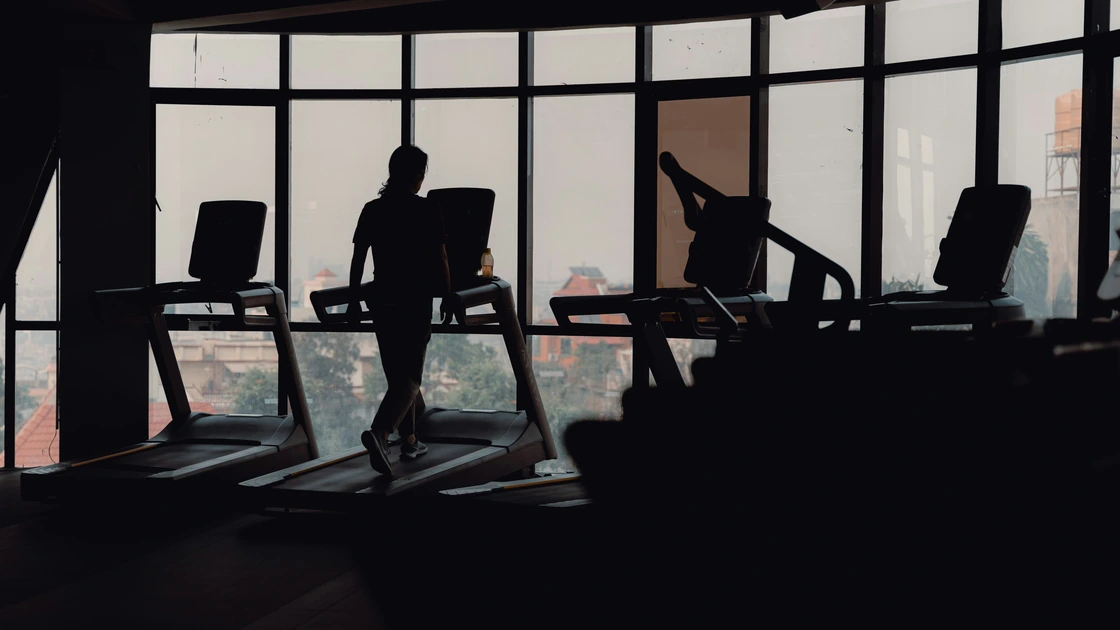
The incline on a treadmill is a grade in percent: how far the belt rises for every hundred it runs. Grade and speed work as one dial. Turning either one up makes the walk harder.
Why a slope costs so much
Walking uphill means lifting your body as well as carrying it forward, and that lifting is expensive. At a ten percent grade and an ordinary walking pace, walking cost a little more than twice what the same walk cost on the flat1.
The popular 12-3-30 routine (a twelve percent grade, three miles an hour, thirty minutes) shows where that leads. In the one lab study of it, regularly active adults in their twenties burned about 10 calories a minute, and one of the sixteen could not finish the half hour2. That is a hard workout, which is fine if a hard workout is what you came for. It is not an easy finisher after a leg day.
Steeper still, walking up a twenty percent grade at under two miles an hour cost the same as jogging on the flat and raised heart rate just as much3.
Where to start
These rows are starting points worked out from the studies on this page, not settings measured on you. Pick the row for the effort you want, then adjust.
| Effort | How it feels | Grade | Speed |
|---|---|---|---|
| Easy, for a warm up or a cool down | Breathing a little faster, you could chat | 0 to 3% | Your normal walking pace |
| Steady, for a finisher | Breathing harder, still full sentences | 4 to 8% | 2.5 to 3.2 mph (4 to 5 km/h) |
| Hard | Short phrases only | 10% and up | Any walking speed |
Then let your breathing set the dial. The point where talking first gets difficult sits almost exactly at the ventilatory threshold, the point where breathing starts to climb faster than the work4. If you can still speak in full sentences, you are at steady or below. If you cannot, take the grade down a notch.
Your normal walking pace on a belt is slower than on the street. Both younger and older adults chose a slower pace on a treadmill than walking over ground5, so go by feel rather than by the number you walk outside.
Why the same setting feels different to different people
A grade and a speed set the work. How hard that work feels depends on how much aerobic fitness you bring to it. Across more than sixteen thousand treadmill tests in an American reference set, aerobic fitness fell by about 13.5 percent each decade of age6. So a setting that feels easy to a fit 25 year old can be hard work for somebody older or newer to training. If you are new, older or coming back, start at the bottom of each range.
Holding the rails
Gripping the handrails takes work off your legs. At the same speed and grade, people gripping the rails had a lower heart rate, used less oxygen and rated the walk easier than when they swung their arms7. A light touch for balance is fine. If you find yourself gripping hard to keep up, the grade is too high for today.
What a slope does to your knees, hips and calves
Walking slowly up a slope can give the same workout as walking quickly on the flat, with less load through the knee. In adults with obesity, a slow walk up a six degree slope was as hard aerobically as a fast walk on the flat, and peak knee extension moment fell by about a fifth8. In healthy younger and older men, the load pressing on the inner side of the knee fell as the grade rose from ten percent and up910.
The work goes somewhere, and it goes to your hips and calves. At a ten percent grade and the same pace, the peak moment at the hip rose by about four fifths and the push from the ankle by about a third1. Glute and hamstring activity rises several times over on a steep walk11. That is why an incline walk is felt in the calves and the backside. Raising the grade a little at a time is the standard advice for building any kind of cardio12.
Running on an incline
Running uphill takes away the impact spike your foot makes when it lands on the flat and adds a lot of push off instead13. The extra work is done mostly at the hip14. Uphill running is hard at almost any speed: in experienced runners, slowing down by the amount a popular conversion chart suggested still left heart rate and effort higher once the grade went past four percent15. Treat an incline run as hard training rather than a cool down.
If you run on a treadmill to match running outside, set the grade to one percent. That small grade made up for the missing air resistance at typical running speeds16. That study was of running, not walking.